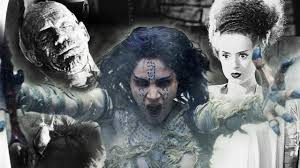
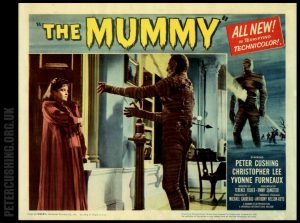
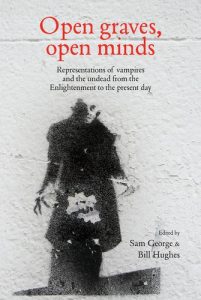
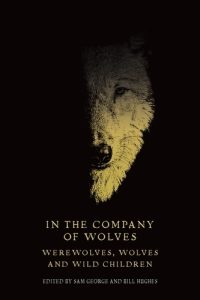
The Open Graves, Open Minds Project began by unearthing depictions of the vampire and the undead in literature, art, and other media, then embraced werewolves (and representations of wolves and wild children), fairies, and other supernatural beings and their worlds. The Project extends to all narratives of the fantastic, the folkloric, and the magical, emphasising that sense of Gothic as enchantment rather than simply horror. Through this, OGOM is articulating an ethical Gothic, cultivating moral agency and creating empathy for the marginalised, monstrous or othered, including the disenchanted natural world.
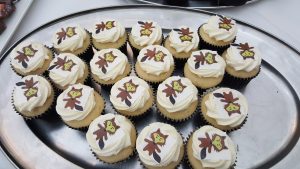
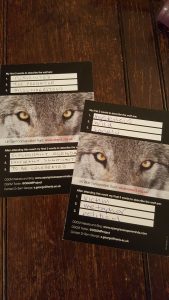
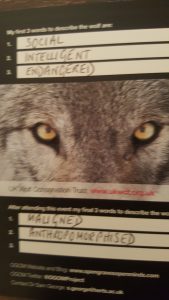
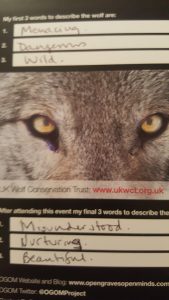
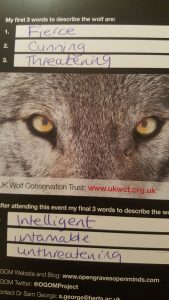
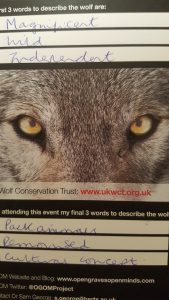
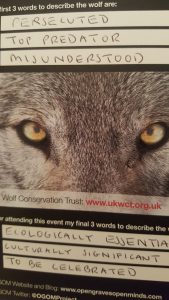
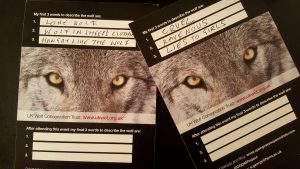
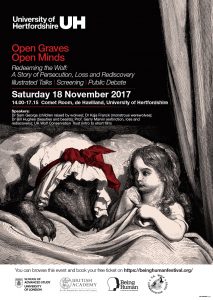
This story emphasises our collaboration with the UK Wolf Conservation Trust over the wolf’s reintroduction. If you are in London or the South of England on 18th November do come along to OGOM’s Being Human event and join in the discussion. This promises to be a fantastic day and the wolf cup cakes and Red Riding Hood goodies are back!
Redeeming the wolf: a story of persecution, loss and rediscovery
By the Open Graves, Open Minds Project
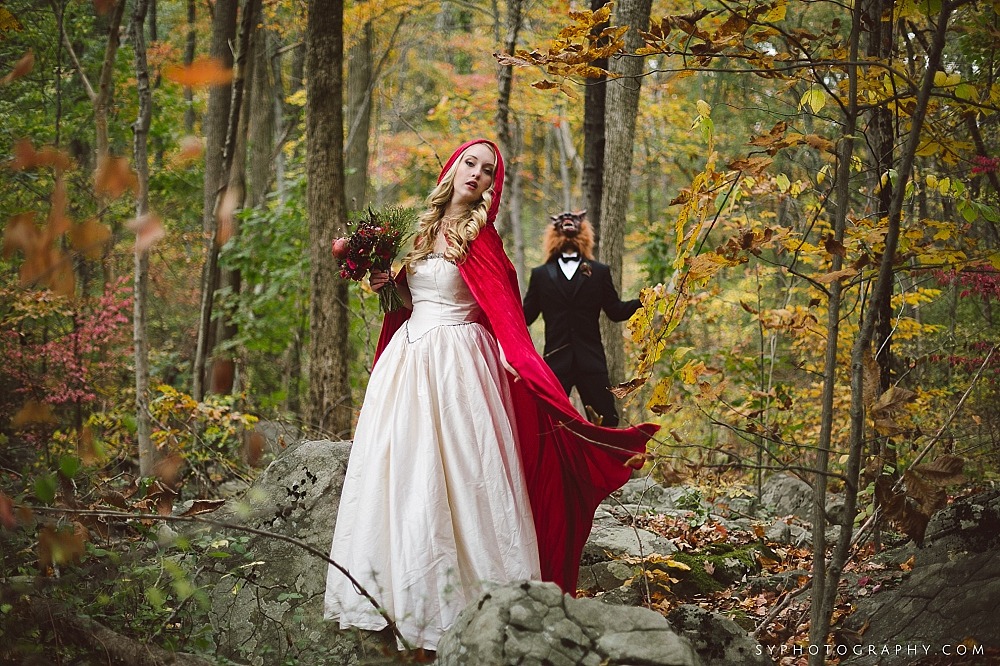
For this Halloween blog post special, the Open Graves, Open Minds Project explores whether everything you’ve heard about the big bad wolf is true. From folklore and fairy tales to conservation find out how the wolf is perceived today.
See our special Halloween post on the Being Human site here
I hope you are enjoying some spooky festivities. I have written in the past about swede or turnip Jack ‘0’ Lanterns being the most authentic and we used to carve these as children in rural Cumbria. Here’s a cat a lantern I made from a swede
This old Irish one is very scary indeed:
Then there are the vampire pumpkins and watermelons of folk legend associated with the Romany people of South Eastern Europe. These were described by Tatomir Vukanovic in the Journal of the Gypsy Lore Society which covered his trip to Serbia (1933 -1948). During the night of a full moon a pumpkin or melon could undergo a vampiric transformation, shown by the appearance of a drop of blood on its skin.
There are only two plants which are regarded as likely to turn into vampires: pumpkins of every kind and water-melons. And the change takes place when they are ‘fighting one another.’ In Podrima and Prizrenski Podgor they consider this transformation occurs if these ground fruit have been kept for more than ten days: then the gathered pumpkins stir all by themselves and make a sound like ‘brrrl, brrrl, brrrl!’ and begin to shake themselves. It is also believed that sometimes a trace of blood can be seen on the pumpkin, and the Gs. then say it has become a vampire. These pumpkins and melons go round the houses, stables, and rooms at night, all by themselves, and do harm to people. But it is thought that they cannot do great damage to folk, so people are not very afraid of this kind of vampire.
The Gs. destroy pumpkins and melons which have become vampires … by plunging them into a pot of boiling water, which is then poured away, the ground fruit being afterwards scrubbed by a broom and then thrown away, and the broom burned. (Tatomir Vukanović, Journal of the Gypsy Lore Society)
N.B. Gs stands for Gypsies as that is the word that is used at this time.
I have had fun finding the vegetables for this rather wonderful theme below…
If you are still to carve your pumpkin or swede here’s a helpful video featuring GANZA’s own Lorna Piatti Farnell
My article, ‘”A devout but nearly silent listener”: dialogue, sociability, and Promethean individualism in Mary Shelley’s Frankenstein (1818)’, has been published in The Irish Journal of Gothic and Horror Studies, 16 (Autumn 2017) alongside other excellent articles. Here’s a brief synopsis:
Dialogue, as much as the novel, may be the dominant genre of the eighteenth century. This was a period that featured and valued dialogue, sustained through the institutions described by Jürgen Habermas as the public sphere; the genre itself proliferated and permeates and modulates the novel. The novel is defined in part by its generic hybridity and many eighteenth-century novels feature embodied dialogues. The dialogue was revitalised and gained new energies amidst the political controversies and tensions of the late century and the dialogue form appears embedded in many novels, particularly ‘Jacobin’ novels of the late century.
The Romantic period has often been characterised as a shift to the inward and individual, against the communicative rationality and sociability preceding it. However, this article argues that Mary Shelley’s 1818 novel, Frankenstein, continues that dialogism and concern with the social. Born out of conversation itself—the famous talks at the Villa Diodati, where Shelley was an ambivalent listener—and out of the Jacobin novel, dialogue in this novel appears particularly as an echo of those radical dialogues that demanded universal human rights.
Frankenstein is subtitled ‘The Modern Prometheus’; Prometheus was a key figure for radical Romantics, representing (as in Percy Shelley’s drama) the rebellion against authority that inspires human progress. Yet Herbert Marcuse identifies an alternative Prometheus present in capitalism, who represents a distorted asocial individualism that, in fact, keeps humanity bound to alienated labour. I show how, in the novel, Mary Shelley explores the tensions between these two avatars of Prometheus. Uneasy tensions between emancipating sociability and bourgeois individualism pervade the novel, mapping onto a gendered dialectic between the public and domestic spheres which is revealed through the dialogue genre which it incorporates.
Vampires have a contested history. Some claim that the creatures are “as old as the world”. But more recent arguments suggest that our belief in vampires and the undead was born in the 18th century, when the first European accounts appear.
We do know that 1732 was the vampire’s annus mirabilis. There were 12 books and four dissertations on the subject published over that year, as well as the term’s first appearance in the English language, according to gothic expert Roger Luckhurst. But archaeological discoveries of deviant burials in Europe in the last few years have unearthed a belief in vampirism and revenants before 1500, much earlier than was previously understood by literary scholars.
The body of a 500-year-old “vampire”, for example, is currently on display in an ancient cemetery in the town of Kamien Pomorski, Poland. The vampire corpse, discovered two years ago, has been reported on widely in the world’s press. Archaeologists have confirmed that it has a stake through its leg (presumably to prevent it from leaving its coffin) and a rock in its mouth (to stop any unfinished blood sucking). Even older deviant burials have been discovered in villages in Bulgaria.
An 800-year-old skeleton found in Bulgaria stabbed through the chest with iron rod. Bin im Garten, CC BY-SA
Meanwhile, the medieval remains of the first English vampires in Yorkshire’s village of Wharram Percy have reputedly been found. The inhabitants who fled the village in 1500 showed widespread belief in the undead returning as revenants or reanimated corpses. They fought back against the risk of vampire attacks and showed a medieval belief in an English zombie apocalypse, an episode that would not be out of place in a scene from The Walking Dead.
So some form of vampire was evidently believed in throughout much of Europe from the medieval period. But the seductive Romantic vampire does not leave his calling card in polite society in London until 1819, when the first fictional vampire, the satanic Lord Ruthven is born in a story by John Polidori. So how did our understanding of vampires transition from dishevelled peasants into alluring Byronic aristocrats? We must return the creature to its beginnings in early folk belief to fully understand its history.
Vampire, vrykolakoi, velku
In the first written accounts of European vampires, the creatures are understood as revenants or returners, often taking the form of a diseased family member who reappears in the unfortunate guise of a vampire. In such tales, “unfinished business”, even something as trivial as the want of clothing or shoes, is enough to make the dead return to the world of the living.
The number of words for “vampire” can frustrate scholars: Krvoijac, vukodlak, wilkolak, varcolac, vurvolak, liderc nadaly, liougat, kullkutha, moroii, strigoi, murony, streghoi, vrykolakoi, upir, dschuma, velku, dlaka, nachzehrer, zaloznye, nosferatu … the list goes on.
The Oxford English Dictionary takes seven pages to define a vampire, but the earliest entry, of 1734, is of most interest here:
These Vampyres are supposed to be the Bodies of deceased Persons, animated by evil Spirits, which come out of the Graves in the Night-time, suck the Blood of many of the Living and thereby destroy them.
Le Vampire, lithograph by R. de Moraine, Les Tribunaux secrets (1864) Wikimedia Commons
There is evidently little appeal or attraction felt for these early revenant figures. Unlike the English aristocratic vampire, modelled on Lord Byron, these early folkloric vampires are peasants and tend to appear en mass like modern-day zombies.
Agnes Murgoci explored this folk belief further. She argued in 1926 that the journey from death to the afterlife is perilous – in Romanian belief it took 40 days for the soul of the deceased to enter paradise. In some cases, it was thought that it lingered for years, and during this time there are a myriad of ways that deceased family members can succumb to vampirism.
It was thought that dying unmarried, unforgiven by one’s parents, through suicide or being murdered could all lead to a person returning as a vampire. Events after death could also have the same effect – beware breezes blowing across corpses before burial, dogs or cats walking over coffins, or leaving a mirror (a soul trap) not turned to the wall at this precarious time.
Entering literary spheres
It was a treatise written in 1746 by the French monk Antoine Augustin Calmet that famously gave British writers access to a number of encounters with vampires. Calmet took inspiration from Joseph Pitton de Tournefort, a botanising man of science, who had earlier claimed to have come face to face with a plague of bloodsucking vampires in Mykonos in 1702. His account was still being read in 1741.
Three decades after Tournefort’s encounter, the London Journal of 1732 reported some enquiries into “vampyres” at Madreyga in Hungary (a story later referred to by John Polidori). Greece and Hungary feature prominently in these early accounts – and this is mirrored in Romantic literature: Lord Byron for example makes Greece the setting of his unfinished vampire story A Fragment (1819).
But it was Polidori who was responsible for the vampire’s English pedigree and its elevation of social rank. There seems never to have been an urban, nor an educated bourgeois bloodsucker prior to The Vampyre (1819). A predatory sexuality is also introduced. We see for the first time the vampire as rake or libertine, a real “lady killer” – a trend that metamorphosed into Bram Stoker’s Dracula and anticipated the arrival of vampire romance in the beautiful undead form of Twilight’s Edward Cullen.
As this all reveals, the history of vampires is a disputed and uncertain one whatever your perspective, scientific or literary. But the “vampire” burials discovered by archaeologists of late do cohere with practices that are known to suggest a belief in vampirism (such as piercing the corpse, nailing down the tongue, putting a needle in the heart and placing small stones and incense in the mouth and under the finger nails to stop blood sucking and clawing). These “vampire” corpses do therefore go some way towards finding out how old our belief in vampires actually is.
But the history of vampires is still impossible to chart with any certainty, and we should probably take heed from British vampirologist Montague Summers (1880-1948) in our search for the lair of the original fiend. He referred to vampires as “citizens of the world”: to him, they existed beyond temporal or geographical boundaries.
It’s perhaps common knowledge now that the original versions of fairy tales are not exactly sweet and innocent, but this article by Magda Origjanska, ‘The earlier versions of Little Red Riding Hood were violent and grotesque‘ may still be of interest. There are some fine illustrations of the tale.
Adaptations and reworkings of fairy tale are a central concern of OGOM, and ‘Little Red Riding Hood’ has numerous incarnations in YA paranormal romance and, most famously, the baroque revisions of Angela Carter. Here is a delightfully dark and funny version in comic form, Gabrielle Bell’s ‘Little Red and Big Bad’. It’s hilarious!
I would add to this the brilliantly disturbing The Graces by Laure Eve–one of the best YA fantastic novels I have read for a while.
Secondly, ‘15 YA Books That Live Up to the Hype‘, a mix of SF and dystopia, high fantasy, urban fantasy, and paranormal romance, and some non-fantastic novels. I don’t know whether they do live up to the hype, but the three I’ve read are excellent: Daughter of Smoke and Bone, by Laini Taylor; Three Dark Crowns, by Kendare Blake; and The Darkest Minds, by Alexandra Bracken.
Finally, featuring one of the dominant motifs of YA paranormal romance (the genre’s very form facilitates writing about Otherness), Eric Smith on ‘10 of the Best Young Adult Novels About Outcasts‘. These all look very engaging, though are apparently mostly realist, with a couple of SF/dystopian novels. The themes of ethnic otherness, intersexuality, rejection, delinquency, and mutation interact with many YA fictions of the fantastic.
I should have posted this earlier; my apologies! The Call for Papers is now out for the 14th conference of the International Gothic Association, themed ‘Gothic Hybridities: Interdisciplinary, Multimodal and Transhistorical Approaches’. Manchester Metropolitan University are hosting the event on 31 July–3 August 2018. The deadline for submissions is 31 January 2018.
The Manchester Centre for Gothic Studies invites the submission of abstracts that creatively interpret and respond to the theme of Gothic Hybridities: Interdisciplinary, Multimodal and Transhistorical Approaches. Papers might explore the ways in which the Gothic mode has entered into conceptual and thematic dialogue with other forms of representation in time, or address the role that the Gothic has played in fostering exchange across different media and disciplinary boundaries.
Marina Warner
Marina Warner is a writer of fiction, criticism and history; her works include novels and short stories as well as studies of art, myths, symbols and fairytales.
Centre for Myth Studies, University of Essex
The Centre It promotes the study of myth, from ancient to modern, and raises awareness of the importance of myth within the contemporary world.
Mythopoeic Society
The Mythopoeic Society is a non-profit organization devoted to the study of mythopoeic literature, particularly the works of members of the informal Oxford literary circle known as the “Inklings.”
Sheffield Gothic
Sheffield Gothic is a collective group of Postgraduate Students in the School of English at The University of Sheffield with a shared interest in all things Gothic.
American Gothic Studies
American Gothic Studies is the official journal of the Society for the Study of the American Gothic (SSAG), which promotes and advances the study of the American Gothic
Echinox Journal
Caietele Echinox is a biannual academic journal in world and comparative literature, dedicated to the study of the social, historical, cultural, religious, literary and arts imaginaries
Folklore
Journal of The Folklore Society. A fully peer-reviewed international journal of folklore and folkloristics, in printed and digital format
Gothic Nature
Gothic Nature: New Directions in Ecohorror and the Ecogothic
Gothic Studies
The official journal of the International Gothic Association considers the field of Gothic studies from the eighteenth century to the present day.
International Journal of Young Adult Literature
an academic peer-reviewed journal dedicated to publishing original and serious scholarship on young adult literature from all parts of the world.
Irish Journal of Gothic and Horror Studies
The Irish Journal of Gothic and Horror Studies (ISSN 2009-0374) is a peer-reviewed, interdisciplinary, electronic publication dedicated to the study of Gothic and horror literature, film, new media and television.
Journal of Popular Romance Studies
The Journal of Popular Romance Studies is a double-blind peer reviewed interdisciplinary journal exploring popular romance fiction and the logics, institutions, and social practices of romantic love in global popular culture.
Journal of the Fantastic in the Arts
An interdisciplinary journal devoted to the study of the fantastic in Literature, Art, Drama, Film, and Popular Media
Monsters and the Monstrous
Monsters and the Monstrous is a biannual peer reviewed global journal that serves to explore the broad concept of “The Monster” and “The Monstrous” from a multifaceted inter-disciplinary perspective.
Studies in the Fantastic
Studies in the Fantastic is a journal devoted to the Speculative, Fantastic, and Weird in literature and other arts
Supernatural Studies
Supernatural Studies is a peer-reviewed journal that promotes rigorous yet accessible scholarship in the growing field of representations of the supernatural, the speculative, the uncanny, and the weird.
The Lion and the Unicorn
The Lion and the Unicorn, an international theme- and genre-centered journal, is committed to a serious, ongoing discussion of literature for children.
Victorian Popular Fictions Journal
Victorian Popular Fictions is the journal of the Victorian Popular Fiction Association. The VPFA is a forum for the dissemination and discussion of new research into nineteenth- and early-twentieth-century popular narrativeo
Related Links
Aarne-Thompson-Uther Index
The Aarne-Thompson-Uther Index is a classification numeric system created to group similar folktales from different cultures
ACADEmy
LSAD centre for research into Art, Curatorial Studies, Applied Design and Art and Design Education
African Religions
With the Yoruba Religion Reader and similar resources
Angela Carter Society
Promoting the study and appreciation of the life and work of Angela Carter
Art Passions
Art Passions: Fairy Tales are the Myths We Live By
Asian Gothic
Asian Gothic appears as an attempt to make sense of the vast and diverse body of Asian literature, film, television, games, comics and other forms of cultural production by reading these texts from a Gothic perspective
British Association for Romantic Studies (BARS)
The UK’s leading national organisation for promoting the study of Romanticism and the history and culture of the period from which it emerged.
British Association for Victorian Studies (BAVS)
The British Association for Victorian Studies (BAVS) is a multidisciplinary organisation dedicated to the advancement and dissemination of knowledge about the Victorian period.
Byron Society
The Byron Society celebrates the life and works of Lord George Gordon Byron (1788-1824), a poet, traveller and revolutionary
Cambridge Research Network for Fairy-Tale Studies
The Cambridge Research Network for Fairy-Tale Studies is an open space at the University of Cambridge aimed at connecting researchers with an interest in fairy tales across different disciplines and scholarly perspectives.
Carterhaugh School
We give lectures and teach courses on fairy tales, folklore, witches, writing, and more. Basically, your ultimate fantasy college courses
Centre for Myth Studies, University of Essex
The Centre It promotes the study of myth, from ancient to modern, and raises awareness of the importance of myth within the contemporary world.
Deborah Hyde
Deborah Hyde wants to know why people believe in weird stuff. She attributes her fascination with the supernatural to having spent her childhood with mad aunties. She approaches the subject using the perspectives of psychology and history.
Fairyist: The Fairy Investigation Society
A website that will gather together sources, links, bibliographical references and discussions on fairies and related supernatural creatures
Folklore Society
The Folklore Society (FLS) is a learned society, based in London, devoted to the study of all aspects of folklore and tradition, including: ballads, folktales, fairy tales, myths, legends, traditional song and dance, folk plays, games, seasonal events, ca
Ghoul Guides
Home to the Ghoul Guides – a digital multimedia project devoted to exploring, understanding, and enjoying the wonders and weirdness of the Gothic
Gothic Feminism
Gothic Feminism is a research project based at the University of Kent which seeks to re-engage with theories of the Gothic and reflect specifically upon the depiction of the Gothic heroine in film
Gothic Herts Reading Group
This site is our one-stop platform for discussing our latest Gothic texts, from journal articles and press pieces, to full length books both old and new
Gothic Women Project
2023: The Year of Gothic Women. An interdisciplinary project devoted to spotlighting undervalued and understudied women writers
Haunted Shores
Haunted Shores Research Network, dedicated to investigating coasts and littoral space in Gothic, horror, and fantastic multimedia
Hellebore magazine
HELLEBORE is a UK-based small press devoted to British folk horror and the occult. Maria J. Pérez Cuervo publishes the magazine twice a year, on Beltane and Samhain
MEARCSTAPA
monsters: the experimental association for the research of cryptozoology through scholarly theory and practical application
Mermaids of the British Isles
a history of mermaids in the arts and cultural imagination of our early islands, which will map the place of these beguiling, and often deadly, figures in the national maritime imaginary, and explore our ancestors’ persistent reimagining of the mermaid
Open Folklore
Open Folklore is devoted to increasing the number of useful resources, published and unpublished, available in open access form for folklore studies and the communities with which folklorists partner
PCA Vampire Studies
A site dedicated to the Vampire Studies Area of the Pop Culture Association
Pook Press
Publisher of Vintage Illustrated Fairy Tales, Folk Tales and Children’s Classics
Romance Scholarship DB
This Romance Scholarship Database is therefore intended as a tool to assist popular romance scholars in their research into modern popular romance novels
RomanceWiki
A wiki resource for romance fiction authors, texts, and publishers
Science Fiction and Fantasy Research Database
The Science Fiction and Fantasy Research Database is a freely available online resource designed to help students and researchers locate secondary sources for the study of the science fiction and fantasy and associated genres.
Sophie Lancaster Foundation
The charity, known as The Sophie Lancaster Foundation, will focus on creating respect for and understanding of subcultures in our communities.
Supernatural Cities
Supernatural Cities is an interdisciplinary network of humanities and social science scholars of urban environments and the supernatural.
Supernatural Studies Association
The Supernatural Studies Association is an organization dedicated to the academic study of representations of the supernatural, the speculative, the uncanny, and the weird across periods and disciplines.
The Association for the Study of Buffy+
The mission of the Association is to promote the scholarship of Buffy+ Studies, focusing on inclusivity, intersectionality, and excellence. We define Buffy+ Studies as the scholarly exploration of Buffy the Vampire Slayer and its related texts.
The Society for the Study of the American Gothic (SSAG)
The Society for the Study of the American Gothic (SSAG) was established in 2023 to promote and advance the study of the American Gothic through research, teaching, and publication
The Thinker's Garden
we also love Plotinus and the Renaissance Platonists, as well as the Transcendentalists and Romantics. We are also drawn to the peculiarities of the Theosophists and hermeticists of the nineteenth century
Vamped
Vamped is a general interest non-fiction vampire site. We publish interviews, investigations, lists, opinions, reviews and articles on various topics.
Vampire Studies Association
TThe Vampire Studies Association (VSA) was founded by Anthony Hogg . . .“to establish vampire studies as a multidisciplinary field by promoting, disseminating and publishing contributions to vampire scholarship
Victorian Popular Fiction Association
The Association is committed to the revival of interest in understudied popular writers, literary genres and other cultural forms.
Wells at the World's End
I am reading through the complete works of H G Wells, in chronological order. This blog is for my jottings, as I go along.
YA Literature, Media, and Culture
YALMC is a resource for those of us researching, writing, writing about, interested in Young Adult Literature, Media, and Culture.
YA Studies Association (YASA)
The YA Studies Association (YASA) is an international organisation existing to increase the knowledge of, and research on, YA literature, media, and related fields