Animals and Us

John Berger’s groundbreaking essay ‘Why Look at Animals’ (1980; Penguin, Great Ideas, 2009) has inspired a new exhibition ‘Animals and Us’ at the Turner Contemporary Gallery in Margate. Berger argued that the ancient relationship between man and nature had been severed in the modern consumer age. The animals that used to be at the centre of our existence were marginalised and reduced to spectacle.

Animals were depicted on cave walls by prehistoric people. The first paint was probably animal blood. Margate’s unusually varied and compelling show interrogates this primal impulse and explores our creative encounters with the animal ‘other’. Artists range from Marc Chagall to Marcus Coates, Beatrix Potter to E. H. Shepherd (illustrator of Winnie-the-Pooh), Tracy Emin, Lucian Freud, Landseer, Paula Rego, Picasso, William Wegman, and Andy Warhol.

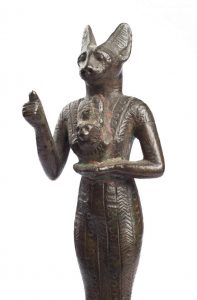
The exhibition boasts an ancient Egyptian figurine of the cat-headed goddess Bastet, from the collection of Sigmund Freud. This is juxtaposed with Michal Rovner’s 2017 video portraits of jackals and a film of Joseph Beuys’s 1974 performance I Like America and America Likes Me, documenting the three days he spent locked in a cage with a wild coyote. Laura Ford’s sculpture, A King’s Appetite is a large, crudely made giraffe, lying flat with its head on a cushion. It represents the first giraffe to come to Britain in 1827, a gift from Egypt to the King. It was transported on the back of a camel across the desert, and then shipped to George IV’s menagerie at Windsor castle; unsurprisingly, it only lived for two years.

The most radical works in the exhibition go beyond ‘looking’ and try and break down the barriers between humans and other animals. For Tracey Emin, a fox represents the elusiveness of human love in her video essay Love never wanted me. Andy and Peter Holden’s A Natural History of Nest-Building is an homage in video and sculpture to the inventive architectural structures created by birds. It raises questions about the supposed uniqueness of the human imagination. Are we really the only species that can appreciate beauty? Is creativity as uniquely human as we think?

Meanwhile, Candida Hofer’s sorrowful photographs of animals in zoos reflects the tragedy of those wild at heart, now caged for our entertainment.  In March, the last male northern white rhinoceros died  highlighting a huge extinction crisis. Reports confirm that around 60 percent of chimps and primates and one in eight bird species are threatened with global extinction. It’s thought that up to 100,000 species of animals become extinct every year. The great auk disappeared in the mid-19th century. It was flightless and easy to catch. Its soft down was used to stuff cushions.  Marcus Coates’s film shows him in the bird’s native habitat: Fogo Island in Canada. He meets with the mayor, to make a speech, ‘Apology to the Great Auk’. The mayor delivers  the words to the sea, in front of a small audience, as he promises to protect future species.

In another artwork, Coates becomes animal, hanging half way up a Scots pine, inhabiting the position usually occupied by the Goshawk as it looks for prey. In Stoat, he wears wooden stilts designed to make him move as a stoat does. He stumbles always on the verge of falling.

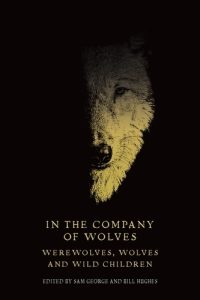
The themes in this new show will appeal to those who attended OGOM’s Company of Wolves Conference and our Being Human event ‘Redeeming the Wolf’. Our book, In the Company of Wolves: Werewolves, Wolves and Wild Children – Narratives of Sociality and Animality (MUP, 2019), has developed out of these endeavours and it features an essay by Dr Sarah Wade on the artist Marcus Coates: ‘A running wolf and other grey animals: The various shapes of Marcus Coates’. At the time of the conference, Sarah was researching her thesis on contemporary artistic and curatorial engagements with wildlife in the department of History of Art at University College London; she has recently been awarded her PhD (congratulations!). Her timely essay on Coates will appear in ‘Animal Selves: Becoming wolf’ in our forthcoming book. You can see a synopsis of  the research paper it started out as here

Sir Chris Frayling, friend of OGOM and plenary speaker at the ‘Company of Wolves’ conference, was at the preview of ‘Animals and Us’. You can listen to his insightful commentary on Saturday Review, BBC Radio 4, 2nd June via the iplayer. 


Posted in Events, exhibitions, News, OGOM: The Company of Wolves | Tagged , , , , , , , , , , , | Leave a comment

OGOM: Fearful Fens

Thanks to Kaja for initiating the fabulous #FearfulFens during May.  Some really interesting and fun research came out of this and you can catch up via our Twitter ‘moment’ below. Our new hashtag for June is the deliciously wicked #TheFallen. Join in on Twitter @OGOMProject and accompany us on this journey to the gates of hell and back… and fasten your seat belts it is going to be a bumpy ride!!

Posted in OGOM News, OGOM Research | Tagged , , , | Leave a comment

YA Gothic Fiction: CFP (edited collection) and NYALitFest (event)

Research into Young Adult Gothic fiction forms a core part of the OGOM Project, and feeds into the associated teaching that Dr Sam George has been conducting for some years now at the University of Hertfordshire (see here). So these two additions to that area are very welcome:

1. Call for Papers: Edited Collection on Young Adult Gothic Fiction (deadline 16 July 2018).

In the proposed collection we seek to explain what the current Gothic revival in YA fiction signifies and call for papers engaging with any aspect of Gothic fiction published for young adults since 2000.

2. NYALitFest – The Supernatural & Fantastical in YA, University of Central Lancashire, Preston, 21 July 2018. Among the authors attending is the much acclaimed Marcus Sedgwick, who has been a supportive and stimulating participant in the OGOM Project since its inception.

An afternoon full of all things Supernatural & Fantastical. We have bestselling authors Melvin Burgess, Sally Green, A.J Hartley, Taran Matharu, Melinda Salisbury, David Owen, Alexandra Christo & Marcus Sedgwick are confirmed.


Posted in Call for Articles, Events | Tagged , , , , , | Leave a comment

Mythology and folklore, contemporary legend

Two great new resources here–I’ve added them to the Related Links sections on the right-hand side of the Blog and Resources pages.

First, a rich compendium of folklore and myth from a wide range of cultures; it’s the course content for the Myth & Folklore module taught at the University of Oklahoma.

Then, the new Centre for Contemporary Legend at Sheffield Hallam University, who are also planning ‘an academic conference devoted to folklore on screen‘. We wish them luck:

The National Centre for English Cultural Tradition (NATCECT), founded in the 1960s at the University of Sheffield, established Sheffield as the only city in England with a dedicated folklore centre that combined teaching, research and archives. In the early 1980s, the university hosted a series of Contemporary Legend conferences that helped confirm Sheffield as a centre for the study of what are now popularly referred to as “urban” or “modern” legends. Sadly, NATCECT closed in 2008, and we feel that the time is right for Sheffield Hallam (SHU) to launch a new ‘Centre’ for legend studies, building upon the established reputation of Sheffield as a centre for scholarship in this area.


Posted in Resources | Tagged , , , , | Leave a comment

Anthem Gothic, Dracula, popular culture — books, articles, and reviews wanted

Opportunities to publish here:

1. Contributions on the Gothic sought for a new series from Anthem Press, Anthem Studies in Gothic Literature:

Anthem Studies in Gothic Literature incorporates a broad range of titles that undertake rigorous, multi-disciplinary and original scholarship in the domain of Gothic Studies and respond, where possible, to existing classroom/module needs. The series aims to foster innovative international scholarship that interrogates established ideas in this rapidly growing field, to broaden critical and theoretical discussion among scholars and students, and to enhance the nature and availability of existing scholarly resources.

2. Articles sought for Journal of Dracula Studies, deadline 1 June 2018:

We invite manuscripts of scholarly articles (4000-6000 words) on any of the following: Bram Stoker, the novel Dracula, the historical Dracula, the vampire in folklore, fiction, film, popular culture, and related topics.

3. Reviewers sought for The Popular Culture Studies Journal:

The Popular Culture Studies Journal is now seeking reviewers for its upcoming issues. The reviews section include books on any aspect of U.S. or international popular culture, as well as reviews of movies, shows, podcast series, and games (reviews of video and board games will be welcomed). These new options are an exciting new addition and I am personally thrilled to see how this will deepen our thoughts on the impact popular culture has on our everyday lives.

Posted in Call for Articles | Tagged , , , , , , | Leave a comment

CFP: Northern Osmosis: Literary Viscosity as Material Solidarity, 11-13 April 2019, Simon Fraser University

This is a CFP for a lab on viscosity at IONA: Early Medieval Studies on the Islands of the North Atlantic transformative networks, skills, theories, and methods for the future of the field. The IONA conference is held 11-13 April 2019, at Simon Fraser University, Vancouver, BC, Canada; deadline 1 July 2018.

In this IONA lab, we invite scholars and artists to test the theoretical capacity of viscosity. We will begin charting viscosity’s theoretical realm by experimenting with Exeter Book riddles. Old English riddles congeal unsettled identities in a material network of viscous substances: blood, ice, ink, mead. A viscous reading of the Exeter riddles, we propose, resists conventional Western epistemology’s insistence on the duality of active subjects and passive non-subjects. Together, we will discuss the ways in which these riddles may assert a material sociability that ventures beyond a human-hegemonic hierarchy of relation. (Or, indeed, not.)

Posted in CFP (Conferences) | Tagged , , , , , | Leave a comment

CFPs: Popular Novels, Dracula

Two CFPs for conferences have come to our attention:

1. Panel papers invited for ‘Novels, Then and Now‘ at the MAPACA conference, Georgia, USA; deadline 30 June 2018:

The Popular Novels area includes all novel genres, authors, time periods, cultures, and settings. Consider it a safety net for novels that don’t fit neatly into a specific genre or that cross genres. Consider the many sub-genres of Romance with a capital “R”—western, thriller, paranormal, religious, romance (with a small “r”), detective, urban fantasy, etc. From Pearl S. Buck to Lee Child, from Laurie King to Tony Hillerman, from Julia Spencer-Fleming to Emilie Richards—all are welcome.

2. A Cross-Platform Dracula Conference, 17-19 October 2018, Brasov, Romania; deadline 30 May 2018:

The Children of the Night Conference series is a non-profit academic initiative, supported by worldwide renowned Dracula experts.
Our aim is to present groundbreaking research on Bram Stoker, his novel Dracula and related topics on a bi-annual basis.
Participation is open to everyone who has a truly interesting paper to present. Moreover, the conferences will feature artistic contests and will be accompanied by a cultural program.

Posted in CFP (Conferences) | Tagged , , , | Leave a comment

‘Do fictional monsters reflect our reality?’, The Royal Institution, 5 June 2018

This event at The Royal Institute, London may be of interest:

Do fictional monsters reflect our reality?
Tuesday 5 June, 7.00pm – 8.30pm
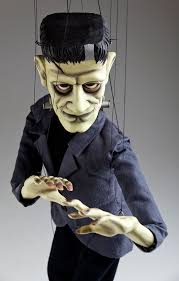
Frankenstein’s creature is a classic example of a monster in popular culture. But what can fictional beings tell us about the hopes and fears of the society in which they were created?

Discover why creatures continue to survive in our culture, how monsters reflect gender and power dynamics and how researchers are studying brain scans of people watching films to try and decipher how our brain’s work.

http://www.rigb.org/whats-on/events-2018/june/public-do-fictional-monsters-reflect-reality

Posted in Events | Tagged , , , , , | Leave a comment

Polidori and the Romantic/Byronic Vampire

Just a reminder that I will be in the Polidori room at the Living Frankenstein event tomorrow with a very special prop! I’m so excited. There are still tickets available….

Dare to join us on Wednesday 23 May for the third in our Living Literature series, an epic thriller brought to life through immersive performances, talks, workshops and activities. Welcome to the world of Mary Shelley’s Frankenstein!

Listen to chilling ghost stories by candlelight read by the feminist performance troupe Scary Little Girls, as Gothic Professor, Nick Groom (University of Exeter), sets the scene of that night in the ‘year without a summer’ at the Villa Diodati, where the first version of Mary Shelley’s Frankenstein was created. Tread carefully through Victor Frankenstein’s rooms in Ingolstadt, hear about Polidori’s The Vampyre (the other creature created at the Villa Diodati) with Dr Sam George (University of Hertfordshire) and play with a historical vampire slaying kit. 

Book here 

23 May 2018 | After hours | Senate House, London

Price: £20 Standard | £10 Concessions


Posted in Events, OGOM News, OGOM Research | Tagged , , , , | Leave a comment

RIP Gérard Genette (1930-2018)

I am very saddened by the death of Gérard Genette (1930-2018). Genette, for me, was one of most rewarding of French literary theorists. He employed a structuralist methodology but in a way that avoided metaphysical excesses and that never lost sight of the particularity of the text. His pioneering work in narratology (in Narrative Discourse (1970) and then Narrative Discourse Revisited (1983)) read Proust closely to elucidate such ideas as voice, focalisation, and the temporality of narrative.

In The Architext (1979), he sets out, all too briefly, foundations for a theory of genre.  In Palimpsests: Literature in the Second Degree (1982), he explores the process that he calls ‘hypertextuality’ whereby literary works are constructed out of earlier ones through such devices as parody, expansion, and imitation. Here, he is lucid and erudite (the breadth of his reading is astonishing), and great fun too. Paratexts: Thresholds of Interpretation (1987) looks at how such peripheral apparatuses as prefaces, footnotes, and titles function as part of the literary effect of a work—this he calls ‘paratextuality’.

Sarah Bartlett and I drew on Genette’s ideas of transtextuality in a proposal here to represent the relationships between literary texts on the Semantic Web–a machine-readable format that creates meaning-laden links between resources. (‘Transtextuality’ is Genette’s more precise formulation of what is often called ‘intertextuality’ and it includes the notions of hypertextuality and paratextuality.)

I have also found Genette’s work in Palimpsests extremely useful in my current exploration of the reworking of fairy tales into YA paranormal romance and also of the evolution of that genre itself from the Gothic novel through the Gothic Romance of the likes of Daphne du Maurier and its interaction with and formation through other peripheral genres. Genette’s work is invaluable for anyone working on genre and narrative form.

(I’ve given English titles but original publication dates.)

Posted in Critical thoughts | Tagged , , , , | Leave a comment