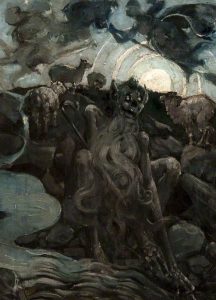
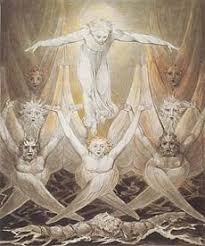
(William Blake (1757-1827), ‘David delivered out of many waters [by angels] with God presiding over’ c.1805)
Who and What are Angels?
Angels are referred to in Hebrew as mal’ach, in Greek as aggelos, both meaning ‘messenger’. Seraphim, Cherubim and ‘watchers’ also denote angels. Almost every culture has a sense of a densely populated spiritual world which acts as an intermediary between the creator and humankind, but it is in the traditions of Judaism, Christianity and Islam that these divinities are called ‘angels’.
How do they act as Messengers?
The angelic world is the meeting of the heavenly and mundane; the angels act as intermediaries, delivering messages between the two. The messages which they deliver to humankind are from God, not from the angels themselves. Likewise angels are thought to carry the prayers of humankind to Heaven, and according to medieval romance this was the particular function of the Archangel Gabriel[1]. All the major events in the life of Christ are attended by angels. Messages of a more lowly kind, warnings, prompts, prophecies, etc. are brought by the Angels on the Ninth Choir of Dionysius, who are closest to humankind and whose specific function is to communicate with us.
What do Angels look like?
Early artistic representations of Angels are modelled on pagan Gods, such as Hermes, Eros, Iris the Rainbow (following Roman conversion to Christianity). By the middle ages Christian churches were filled with Angels, or those androgynous winged creatures we now associate with Angels. During the Reformation most of the angels in Northern European churches were removed. A few remain high up in our cathedrals, the remnants of an ancient memory of what we believed angels looked like.
Since everything we know about angels is based on visionary experience, we have to rely on inspired writers (Dante, Marlowe, Donne, Blake, Milton, Hardy, Rilke, Salmon Rushdie, Phillip Pullman, David Almond, Penelope Fitzgerald) to name a few, and artists (Blake figures largely again) for our information. Such narratives seldom agree even as to when angels were created (some say before time and space, others on the Sixth Day of Creation) but most acknowledge that they are commonly associated with light. According to Thomas Traherne, Angels are spirits of light, who were brought into being when God created light. Dionysus considered Seraphim, Cherubim, and Thrones [2] of his first order of angels to be associated with fire. The Cherubim who have a single pair of blue wings reflect knowledge or wisdom. They are thought to be derived from the ka-ri-bu, the monstrous guardians of Babylonian temples, first mentioned in Genesis as the Guardians of the Tree of life, East of Eden[3].
Descriptions of Angels suggest that religious doctrine and belief in the supernatural are not necessarily in opposition. The following is the most striking description of Angels I know and it comes from the prophet Ezekiel’s visit to the heavenly court. The beings he encounters are unsettled, hybrid, fiery and luminous:
They were of human form. Each had four faces, and each of them had four wings. Their legs were straight, and the soles of their feet were like the sole of a calf’s foot; and they sparkled like burnished bronze. Under their wings on their four sides they had human hands. And the four had their faces and their wings thus: their wings touched one another; each of them moved straight ahead, without turning as they moved. As for the appearance of their faces: the four had the face of a human being, the face of a lion on the right side, the face of an ox on the left side, the face of an eagle, such were their faces. Their wings were spread out above; each creature had two wings, each of which touched the wing of another, while two covered their bodies. Each moved straight ahead; wherever the spirits would go, they went without turning as they went. In the middle of the living creatures there was something that looked like burning coals of fire, like torches moving to and fro among the living creatures; the fire was bright, and lightening issued from the fire. The living creatures darted to and fro, like a flash of lightening (Ezekiel 1. 5-14)[4].
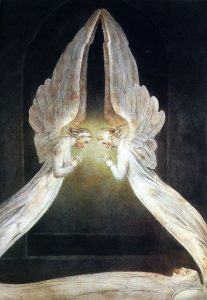
(William Blake, ‘Christ in the sepulchre guided by Angels’ c.1805) [5].
How does Angel taxonomy work?
The Nine Choirs of Angels
First order: Seraphim, Cherubim, Thrones
Second order: Dominions, Powers, Virtues
Third order: Principalities, Archangels, Angels
Archangels
The Third Order, which includes Archangels, has contact with our world and with humankind. Only two Archangels (Michael and Gabriel) are named in the Old Testament and two (Raphael and Uriel) in the Apocrypha (O.T.) but there are actually seven Archangels according to Christian tradition and many more in Jewish tradition (Islam cites only four). Michael is the leader of the heavenly armies, and his role is to drive rebel angels from Heaven. He is often depicted as a winged lad clad in white with a lance or shield, or slaying a dragon.
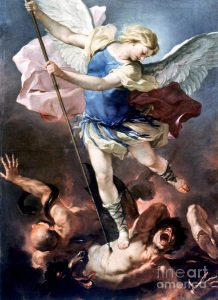
(‘The Archangel Michael’, Byzantine fresco, Cyprus. 1474)
In the book of Revelation he is described as combating a great dragon (referred to as the devil and Satan). His association with dragons is often recorded at Christian sites with Celtic origins (Mont St Michael in Brittany and St Michael’s Mount in Cornwall). Michael is also a guide for souls of the dead on the journey to the hereafter, in which role he is depicted with a set of scales:
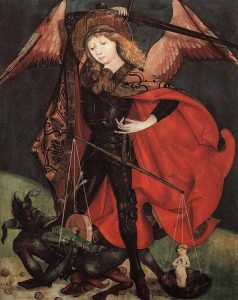
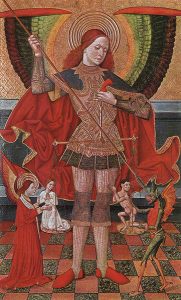
(Abadia, Juan de la, ‘The Archangel Michael’ (c. 1490). Micheal is depicted weighing souls and battling a demon).
Archangel Raphael is associated both with healing and with death. He is often portrayed with a pilgrim’s staff or with a fish (following the story of Tobias and the Angel in the book of Tobit, O.T. Apocrypha).
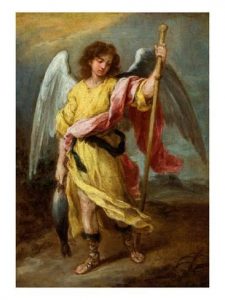
(‘The Archangel Raphael’ (c. C17th), Spanish Baroque painter Bartolomé Esteban Murillo, 1617-1682).
What is Jacob’s Ladder?
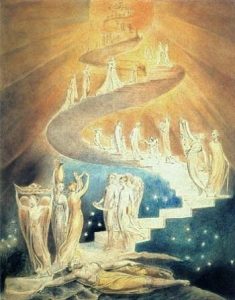
William Blake, ‘Jacob’s Ladder, or Jacob’s Dream’ (Start Date: 1799 Completion Date 1806)
Jacob’s Ladder is the name given to the stairway that appears in the dream of Jacob (described in Genesis 28: 10-19). Jacob saw a ladder that connected heaven to earth, additionally, Jacob is said to have seen God at the top of the ladder, and also angels, ascending and descending the structure.
How do Angels become fallen?
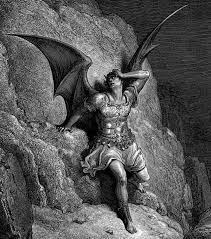
(From Paul Gustave Doré’s (1832-1883) illustrations to John Milton’s Paradise Lost (1866))
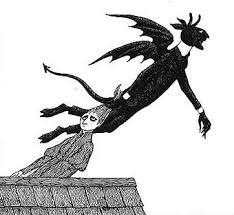
Angels fall through pride, envy or lust (Aquinas argued they only fall through pride and envy, omitting lust).[6] This idea developed through narrative elaborations on scripture.[7] For example, St Jerome equated Lucifer the fallen angel with Satan (whose name is the Hebrew common noun for ‘adversary’). Once Satan had become the embodiment of evil, the story of an angel rebelling against his maker through pride, falling, and being punished was perpetuated. As fallen angel, Satan assists in humankind’s fatal fall in the Garden of Eden. The devil’s sin is not submitting to the will of God, and desiring instead to exceed the limits of his own nature. This desire is equated with free will in Milton but it is also ambiguously pride/envy (‘better to reign in hell that serve in heaven’). This is echoed at the beginning of Paradise Lost
His pride
Had cast him out from heaven with all his host
Of rebel angels, by whose aid aspiring
To set himself in glory above his peers,
He trusted to have equalled the most high (PL 1.36-40).
In most accounts the sin of pride is equated with envy of God, but in another tradition envy of humankind is the primal angelic sin. Milton’s Satan is eaten up with envy, spite (and lust) on seeing God’s new favourites on earth, Adam and Eve but conversely his first instinct is to love them because they look so much like God. Hatred is an effort of his will (this could be seen as making him either more, or less, sympathetic).
Can Angels Weep or Show Emotion?
In Book I of Paradise Lost Milton’s fallen angel Satan weeps at the sight of his fallen followers and cannot speak for tears:
Thrice he essayed, and thrice in spite of scorn,
Tears such as angels weep, burst forth (PL I.619-20)
Pro-Satanists interpret the tears as compassion, but anti-Satanists point out that angels were not supposed in Orthodox theology to weep, since tears were a sign of passion, which angels were not subject to. The tearlessness of angels is emphasised by Milton in Book II where Michael shows Adam the effects that death and disease will have upon mankind in the future. Adam weeps, but Michael remains dry-eyed, and Milton remarks on the contrast between them (see PL Book II. 494-7).
Guardian Angels
The idea that every living being has its own attendant spirit is shared by many cultures. For the Romans it was the genius, and for Persians, the jinn, and according to Plato the souls of the dead were carried away by their attendant genii. The literature of encounters with angels is vast and a surprising number of people speak of experiencing angelic assistance or visions [8]. One of the most striking things about these stories is how abundant they are in the secular world. The idea of a supernatural being whose role is to see that we come to no harm is just what we would wish for ourselves and our loved ones, but if every person does have an angel guide then numbers in the invisible world must be beyond reckoning. According to the prophet Muhammad, every created thing has an angel, even raindrops. I recently made a trip to see a rare statue of a Guardian Angel at the Victorian Gothic Holy Name Church, on Oxford Road, Manchester. Interestingly, the bible does not seem to have a concept of a guardian angel, despite angels sometimes being protectors of human beings. They do this only for a particular short lived purpose, and not for life. Guardian angels are the acceptable face of belief and there are many who believe in them whilst simultaneously dismissing the notion of the ‘angel of death’[9], a being that shows that angels can be fierce as well as benevolent.
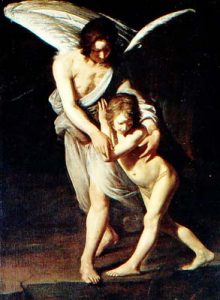
(Guardian Angel, Giovanni Antonio Spadarino (c.1615-1650))
Warring Angels versus Guardian Angels
Angels in times of war are prevalent, following stories of warring Angels in heaven and contemporary manifestations of guardian angels. These two types of angels are conflated in the myth of The Angels of Mons who supposedly protected soldiers at the outset of the First World War. Jennie Gray has argued along with historians such as Paul Fussell, that the legend was inspired by Arthur Machen’s ‘The Bowman’ (1914), the narrative of which influenced the perception and image of the angels in the developing myth. Machen’s angels are actually the ghosts of the English bowman dead at Agrincourt who protect their warring countrymen by shooting arrows at German soldiers, creating invisible wounds. The bowman are described as having a shining about them and it is this luminous imagery which gives rise to the idea that warrior angels had appeared on the battlefields to aid the British. It was deemed unpatriotic not to believe in them. Jennie Gray explains that
The angels were supposed to have appeared in the sky during the British retreat from Mons and to have safeguarded the weary and exhausted men from their enemies. Some weeks later, on September 29th, 1914 Arthur Machen published ‘The Bowman’ in the Evening News, a slight and openly fictional story in which the ghosts of English bowmen dead at Agrincort come to the aid of their hard pressed living comrades [10].
To elaborate on this further, the book of Revelation (12. 7-12) tells that there is spiritual warfare in heaven between two forces, the forces of light and the forces of darkness. The forces of light are obviously the angels but the forces of darkness, led by the devil or Satan, are angels too, but they have rebelled and turned against God. The Archangel Michael, as military commander, drives these bad angels from heaven. David Albert Jones argues that ‘this is good news for heaven but bad news for the earth, as the bad angels now prowl the earth trying to cause trouble for human beings'[11].
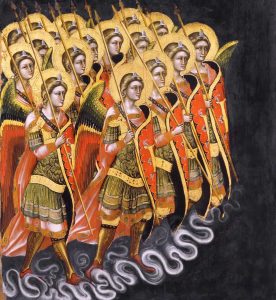
(Paduan artist Guariento (c. 1338-70) painted each of the nine choirs of angels. Here the Principalities are shown as an army)
The twentieth century has had its fair share of guardian angels in film and at times they have a connection to war, especially in narratives around pilots, who acquire wings. Noteworthy guardian angels include Clarence in It’s A Wonderful Life (1946), an apprentice angel trying to get his wings, and Billy Bigelow in Carousel, a 1956 film adaptation of the 1945 Rodgers and Hammerstein stage musical of the same name[12]. Billy gets permission from the star keeper in heaven to visit his unhappy family on earth. We also get the beginnings of angel/human romance and intrigue in the 1940s with I Married an Angel (1942) and A Guy Named Joe (1943). In the latter, Spencer Tracy a pilot, dies and becomes the guardian angel to other pilots during WWII. In 1989, Spielberg made Always, a remake of Joe starring Audrey Hepburn as a guardian angel who assists a dead pilot to find a companion for his widowed earthly girlfriend. Stories of Angels appearing in times of war are reinforced in these narratives.
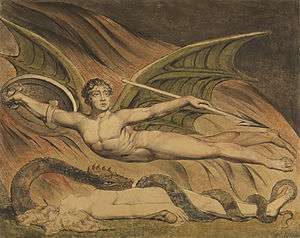
(William Blake, Satan with Shield and Spear from illustrations to Paradise Lost c.1807).
Contemporary Manifestations of Angels in Fiction
@Geryonsback has observed that ‘Angels in recent years are warriors’ (i.e. in the Supernatural TV series and the films Dogma, Legion and Constantine, all of which set a trend for celluloid angels which are far from angelic). They can be seen to follow the Archangel Michael in this and the Angels of Mons. Although popularly thought of as harp-playing divine beings of sweetness and light, Angels often present a more active, militant picture in scripture and in myth. In the present we are most likely to find Angels in paranormal romance and young adult fiction. Bill Hughes’s list of contemporary angel fiction charts the rise of this new sub genre. Back in 2010, The Guardian predicted that a host of new books (pardon the pun) would appear as angels were due to become the theme of a new teenage reading cult. They’re heavenly, or hellish, but tales about angels are joining vampire sagas on the bestseller shelves. Vanessa Thorpe argues that in these books ‘the only good angel is a dead angel’, which raises some interesting questions about the immortality and benevolence of contemporary representations of angels:
The publication of Angel, written by L.A. Weatherly, an established children’s writer was followed by two sequels, Angel Heat and Angel Burn. They imagine a world where the ‘potent magnetism” of these “stunning beings” is not what it seems. Far from benevolent forces, Weatherly’s angels are “despicable creatures” who must be destroyed by the book’s hero, Alex, to stop them “feasting lustily on the energy of innocent victims”. For Alex, “the only good angel is a dead angel”.
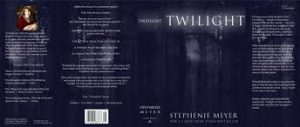
When romancing an angel it is worth noting that ‘The treachery of demons is nothing compared to the betrayal of an angel’ (Brenna Yovanoff, The Space Between). A scorned angel is also to be avoided (Emily Bronte’s Catherine Earnshaw learns this). There is a link to paranormal romance here as this novel is in an intertextual relationship to Twilight and is loved of Bella Swan (in fact it was shamelessly re-marketed to not only look like Twilight but to carry a slogan which linked it to the trilogy). Cathy in Bronte’s novel is not much enamoured of angels (she belongs too much to the dark side along with Heathcliff). In the ghostly Victorian world of Wuthering Heights heaven can wait:
Heaven did not seem to be my home; and I broke my heart with weeping to come back to earth; and the angels were so angry that they flung me out into the middle of the heath on the top of Wuthering Heights; where I woke sobbing for joy (Emily Bronte, 1847).
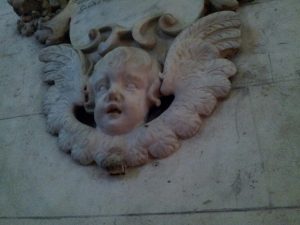
(own photo St Albans Abbey interior)
Angels also have a fascinating link to folklore through the work of Lady Francesca Wilde (1821-96):
In Ireland in 1887 the fallen appear as fairies: The Islanders, like all the Irish, believe that the faeries are the fallen angels that were cast down by the Lord God out of heaven for their sinful pride. And some fell into the sea, and some on the dry land, and some fell deep down into hell, and the devil gives to these knowledge and power and sends them on earth where they work much evil. But the faeries of the earth and the sea are the most beautiful creatures, who will do harm if they are let alone, and allowed to dance on the fairy raths in the moonlight to their own sweet music undisturbed by the presence of mortals [13].
If you already know your angels you might enjoy The Guardian’s Angels in Fiction Quiz , or the Ten Best Angels in Literature.
I hope to post more on angelology!
Dr Sam George (aka Lucy Northenra).
[1] Gabriel dictated the Koran to Muhammad, brought news of the birth of John the Baptist, and appeared to Mary, mother of Jesus.
[2] Ezekiel described the Thrones, seats of god, as fiery wheels with eyes, elsewhere they are made of crystal with wheels shining like the sun.
[3] Linda Proud, Angels (Andover: Pitkin, 2001), p. 4
[4] For physical descriptions of Angels see Jane Williams, Angels (Oxford: Hudson, 2006), pp. 22-39
[5] Tamsin Rosewall (member of the Blake Society, responsible for a three part radio series on Blake) has informed me that ‘This image of Blake’s is really interesting […] it combines two different moments – the scene is Christ in the Sepulchre, but the angels are taken from the description of the Tabernacle in the Book of Exodus, not from the scene at the tomb, where they are described as seated’ (‘the cherubim shall stretch forth their wings on high/and their faces shall look one to another‘ Exodus 25:20). Tamsin adds that ‘it is God’s instruction to the prophet Moses about constructing the tabernacle, of course Blake saw himself as a prophet too’. Many thanks @autumnrosewell
[6] For fallen angels see Joad Raymond, ‘Why did the angels fall?’ in Milton’s Angels (Oxford: OUP, 2010), pp. 73-78; Jane Williams, ‘fallen angels’, Angels, pp. 81-91; David Albert Jones, Angels: A Very Short Introduction (Oxford: OUP, 2011), pp.97-116.
[7] See Williams, Expositor, 117-8 cited in Joad Raymond, Milton’s Angels, p. 73
[8] For Guardian Angels see Linda Proud, Angels, p. 10; Jane Williams, Angels, pp. 68-81
[9] For the ‘angel of death’ see Jane Williams, Angels, pp. 58-9.
[10] David Albert Jones, Angels: A Very Short Introduction, p. 98
[11] Jennie Gray, ‘The Angels of Mons: A Legend of the Great War’, The Goth, vol. 10 (December 1992), pp. 15-30. Many thanks to @Lovecraftianuk for access to this journal from The Gothic Society.
[12] Angels in film are detailed by Rosemary Guiley, The Encyclopaedia of Angels (N.Y.: Checkmark Books, 2003), pp. 131-2 and James Parish, Ghosts and Angels in Hollywood Films (Jefferson N.C.: McFarland, 1994).
[13] Lady Francesac Wilde, Ancient Legends, Mystic Charms, and Superstitions of Ireland (1887) http://www.libraryireland.com/AncientLegendsSuperstitions/Fairies-Fallen-Angels.php [accessed Dec, 30th, 2017]