Shapeshifters and Werecats

I’m still compiling my own top-ten shapeshifters in response to Sam’s and Kaja’s lists, but I came across this paranormal romance about a werecat, and I am very tempted:
https://www.amazon.com/Cats-Tale-Melissa-Snark-ebook/dp/B00IVPYACA?ie=UTF8&redirect=true&tag=indautlan-20

Posted in Books and Articles, Fun stuff | Tagged , , , | Leave a comment

Top Ten Shapeshifters – The Retro Version

In response to The Guardian’s Top Ten Shapeshifters in Fiction (which is very noughties) and Kaja’s lively alternative list, I am posting my own top ten which is a little bit more retro! A shapeshifter is usually understood to be a person or being that can morph into another form, or undergo a bodily transformation. In Ovid, the theme of Metamorphoses is change, and the narratives are meant to reflect the never ending flux and reflux of the universe. I am collapsing the boundaries, however liminal, between transformation, shapeshifting and metamorphosis in the list below (which may be controversial). The shapeshifter’s position in the top ten reflects the power of their influence on my own formative imagination.

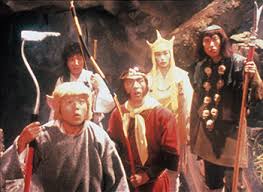
  1. Monkey (From the Japanese TV series ‘Monkey’, or ‘Monkey Magic’, circa 1970).

monkey

Monkey, was made by NTV in the late 1970s. It is a quest narrative drawn from a sixteenth-century Chinese epic called Hsi Yu Chi (or ‘Journey to the West’). The title of ‘Monkey’ comes from Arthur Waley’s English translation of the folk tales (1942). The tales, set in 630 AD, describe the demons and monsters who try to stop the Tang Priest (Tripitaka) from reaching a Buddhist monastery in India to retrieve sacred scriptures. Monkey, comic and brave, escorts Tripitaka, the pig monster Pigsy, and the water sprite Sandy, on their perilous mission. According to the theme song Monkey was ‘born from an egg on a mountain top’ and becomes ‘the funkiest monkey that ever popped!!”

Does he qualify as a shapeshifter? Well, Monkey can change form (into a hornet in Episode 3) and when the journey begins he transforms into a girl to trick Pigsy. Monkey’s other magic powers include summoning a cloud which he flies on; the use of a magic wishing staff, which he can shrink and grow at will (and store in his ear); and the ability to conjure monkey warriors by blowing on hairs plucked from his chest. I have never forgotten this funky monkey. He is my number one shapeshifter. You can find the book that the series is based on here  and the boxed set (which is very expensive.. sigh). And this is a rather funky tribute site that will make you curious I think.

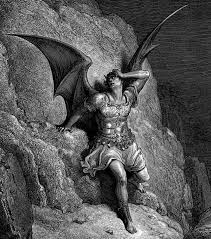
  1. Satan (Milton, Paradise Lost, 1667).

angel2index

Satan is an archangel who rebels against God and is cast out of the Kingdom of Heaven. We first see him chained to a burning lake in perpetual darkness. These are punishments the Almighty has designed for him in return for his disobedience. In the poem Satan is shown to be more of an imaginative and creative being than God (even though God has created the universe) and he is something of a trickster, as well as a shapeshifter and freedom fighter (‘better to reign in hell than serve in heaven’). Milton inspires sympathy for the devil who wages war against ‘the tyranny of heaven’ (a battle which he cannot possibly win, since God is omniscient and omnipotent).  The description of Satan’s perilous final journey to the new world, to seek out ‘some new race called man’ is one of the most beautiful passages in English poetry. These lines also inspired Phillip Pullman’s Dark Materials Trilogy:

Into this wild abyss,
The womb of nature and perhaps her grave,
Of neither sea, nor shore, nor air, nor fire,
But all of these in her pregnant causes mixed
Confus’dly, and which thus must ever fight,
Unless the almighty maker them ordain
His dark materials to create more worlds,
Into this wild abyss the wary fiend
Stood, on the brink of hell and looked awhile,
Pondering his voyage (II.910-919)

I now teach this work to undergraduates but I came to it via Mary Shelley’s Frankenstein as it is one of the books read by the monster in the 1819 novel. The monster, though innocent, identifies with Satan, not Adam, because Satan too is rejected by his creator (whereas Adam is loved unconditionally by God and has a companion in Eve). Does Satan qualify as a shapeshifter? Well, Milton is drawing on Ovid’s Metamorphoses as well as the book of Genesis in this epic and Satan’s final incarnation is of course in the form of a talking snake. Eaten up with malice, and ‘bent on man’s destruction’, he appears in the garden as a creeping black mist and enters the sleeping serpent through its mouth. On waking and finding Eve, he changes the course of human history forever. This is Epic in the true sense of the word!

I recommend Stephen Orgel and Jonathan Goldberg’s edited edition in Oxford Worlds Classics. And you can read Phillip Pullman’s controversial introduction to the poem in a Blackwell edition here.

  1. Count Dracula (Bram Stoker, 1897).

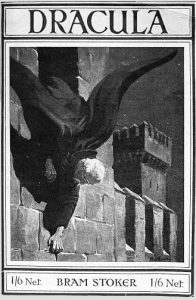
Dracula is not the first shapeshifting vampire (Le Fanu’s Carmilla (1871) turns into a cat) but his are the most  uncanny transformations. He arrives in Whitby in the form of a wolf (or large dog) and is famously seen by Jonathan Harker scaling the castle walls in the shape of a lizard or bat. This scene appears on the cover of the 1903 edition of the novel and it is thought to be the only illustration of Dracula that Stoker ever saw.

Dracula_Book_Cover_1916

Dracula has the power of necromancy, he can control the dead, direct the elements and ‘command all the meaner things, the rat, and the owl and the bat-the moth, and the fox, and the wolf; he can grow and become small; and he can at times vanish and become unknown’. There are many representations of these attributes in film but my favourite has to be Tod Browning’s 1931 masterpiece (written about so well by Stacy Abbott in the Open Graves, Open Minds book). The scene below shows a wonderfully mannered and paranoid Renfield being driven in a stagecoach by Dracula in the form of a bat (if you look carefully) and it is followed by the iconic entrance of Bela Lugosi as the Count, together with some rather curious armadillos (which nobody can explain). ‘Listen to them, the creatures of the night. What music they make!’.

  1. The tragic bear from The Singing Ringing Tree, circa 1960).

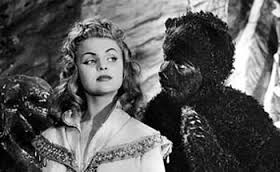
The Singing Ringing Tree is a cult TVs series which the BBC bought from East Germany in the 1960s. It seems to have terrified a whole generation of children. There is a complete programme on BBC Radio 4 dedicated to it. Those who have seen it will remember the evil dwarf, the selfish princess and giant spooky fish, trapped in a frozen lake, but my favourite character is the rather shy and wistful bear. He is really a prince who has been changed into a bear by the evil dwarf for trying to steal the magical singing ringing tree. He hides in the forest, because of his ugliness (much like Frankenstein’s monster) and is often seen clutching a red rose (or a branch of the magical tree), a reference to Beauty and the Beast, which leads me on nicely to number 5.

singing ringing tree

  1. Beast (Cocteau, La Belle et la Bête, 1946).

bete2

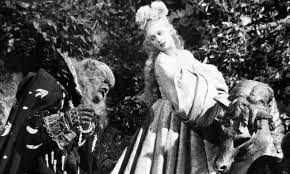
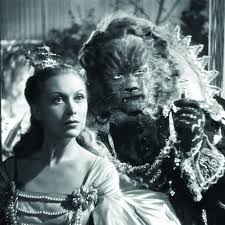
Like Kaja, I love the noble characterisation of Beast in Robin Mckinly’s Beauty (1978) but my favourite representation of him comes from Jean Cocteau’s 1946 film. It was this film that made the story so attractively gothic and inspired a whole genre of paranormal romances that draw unashamedly, and in a very postmodern way on this reincarnation of the original fairy tale. The set designs and cinematography are intended to evoke the illustrations and paintings of Gustave Doré and Vermeer. The reissued BFI DVD has an insightful and informative commentary by friend of OGOM Sir Christopher Frayling.

bete

‘Beauty and the Beast’ belongs to the ‘Animal Bridegroom’ cycle of fairy tales (written about by Bruno Bettelheim and others). The original fairy tale by Jeanne-Marie Le Prince de Beaumont (c.1740) is nicely translated and introduced in The Norton edition of The Classic Fairy Tales, ed. by Maria Tatar. It is one of only a few well known fairy tales attributed to a woman and is widely believed to be a metaphor for arranged marriage (with the protagonist Beauty being sacrificed to a beastly husband by her father in exchange for wealth and prosperity). I am fascinated by how the animal representation of the beast changes from a warthog to a lion or a bear in different retellings, and by our changing relationship to it. Marina Warner argues that ‘the attraction of the wild, and the wild brother in twentieth-century culture, cannot be over estimated; as the century advanced, in the cascade of deliberate revisions of the tale, Beauty stands in need of the Beast, rather than vice versa and the beast’s beastliness is good, even adorable’ (Warner, ‘Go Be a Beast’, Beast, 307). Victorian readers sympathised with Beauty and the power of female virtue triumphing over crude animal desire, whereas twenty-first century audiences are more likely to embrace Beast, in all his wildness and alterity. This idea of the sympathetic animal ‘other’ takes me to no. 6.

  1. The Tiger’s Bride (Angela Carter, The Bloody Chamber, 1993)

Carter indulges in a subversive and unexpected reversal of the traditional ending of the beauty and the beast plot. Instead of Beauty transforming the beast into a human, Beauty herself transforms into a beast. She literally becomes furred in this feline version in her manifestation as the tiger’s bride. Genius. If you haven’t read Carter yet, you really must. Here’s a handy link to this collection.

  1. Mrs. Mothersole (M.R. James, ‘The Ash Tree’, 1904).

Mrs Mothersole is the shapeshifting Witch in M.R. James’s ‘The Ash Tree’ (Ghost Stories of Antiquary, 1904).  The story takes place in Castringham Hall in Suffolk, the setting of the 1690 witch trials. It is here that Mrs Mothersole was hanged as a witch on the evidence of Sir Matthew Fell. The squire claimed he saw the woman gathering sprigs from his ash tree then running from the scene in the shape of a hare. At the execution she muttered the ominous lines ‘there will be guests at the hall’ and the tree is later found to be infested with these ‘guests’ in the form of devilish spiders with greyish hair and human faces, the spawn of the dead witch. The tale is peculiarly haunting and memorable and many generations of the Fell family fall prey to the witch curse. The name Mothersole appears on gravestones in the churchyard at Livermere, the Suffolk village where MRJ spent much of his childhood. You can listen to the full story being read by Michael Hordern below:

And here is a clip showing the ending of the 1975 TV adaptation

8. Hobgoblin Puck (Shakespeare, A MidSummer Night’s Dream (circa. 1594-6), Julia Kagawa, The Iron King, 2011 )

I have always been intrigued by the figure of Puck in folklore and more recently I have been doing some intertextual readings of Julia Kagawa’s The Iron King In the novel the teenage protagonist Meghan is unaware that she is Oberon’s daughter and that her best friend Robbie is actually Robin Goodfellow, or Puck, a very old faery, who has ballads, poems and stories written about him. In fact, Puck is a half domestic fairy of the hobgoblin type, the best known of all hobgoblins. Mentions of him in Elizabethan literature are common (hence Shakespeare uses him as a character in A Midsummer Night’s Dream). Interestingly, Kagawa’s Puck is something of a shapeshifter and Pooka, the Irish Puck, often takes animal form, especially that of a horse. According to sources in the Norton Shakespeare, Puck inherited his tricksy nature from the fairies but had to be given fairy powers by his superhuman father (for background see Robin Goodfellow: his mad pranks and merry jests, 1628). Shakespeare’s Puck is mischievous and meddling; he takes delight in the discord he has helped to sow among the mortal couples but he is not the originator of the discord; in fact, he is the indispensable agent for setting things right (Norton Shakespeare, p. 808). In this role he is both the mischief maker and match maker . Hence he is the perfect vehicle for keeping Meghan away from Queen Mab’s son Ash, the Prince of the Winter Court, and causing havoc with the would-be lovers in the Never Never world of Julia Kagawa’s enchanting paranormal romance.

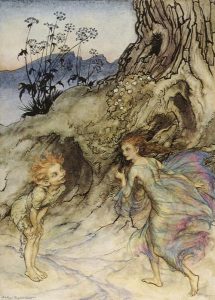
msd21_puck_and_fairy_rackham

  1. The Little Mermaid (Hans Andersen, 1837).

‘The Little Mermaid’ was amongst the first of Hans Andersen’s tales to be translated into English in 1846. It is a story of deep desire, profound pain and unbearable loss, an allegory for the search for human redemption. When the Little Mermaid falls in love with a Prince she does not want to return to the sea. She is granted feet and legs but is told that every step will be like treading on a sharp knife ‘enough to make your feet bleed’. As her love for the Prince and life outside the sea grows she is forced to give up her voice to the sea witch and can no longer sing or speak. When it becomes clear that she has not secured the love of the prince she is given a knife to stab into his heart and told that when the warm blood splashes over her feet they will grow together into a fishes tail and she will be able to return to the sea. You will have to read the story to find out what happens next! There is an excellent translation in Classic Fairy Tales ed. by Maria Tatar (linked to above).

The Little Mermaid’ was celebrated by the Victorians but has been criticized in recent years for promoting silence as an ideal of female behaviour. This is a misreading, I think, as the mermaid’s voiceless plight is a symbol of her continued oppression. There is authenticity here too as this trope is rooted in the ancient myths of mermaids, selkies and seabrides who often marry mortals on certain conditions, and whose silence is traditionally part of the bargain. It is a tale of a love that dare not and cannot speak its name. Oscar Wilde’s ‘The Fisherman and his Soul’ (1891) and H. G. Well’s ‘The Sea Lady (1903) are both indebted to it. I am so taken with this tale that I have written my own diabetic homage to it, entitled ‘The Little Sugar Maiden’, for OGOM’s Books of Blood project  (in which I investigate blood imagery in fairy tales).

10. Black Phillip (Egger, 2016)

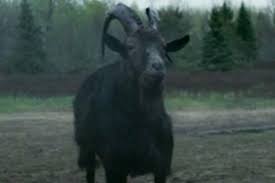
Black Phillip is the seventeenth-century goat star of Robert Egger’s debut film The Witch; he is the devil incarnate.

black peter index

My perception of goats is largely influenced by my obsession with the Norwegian folk tale ‘The Three Billy Goats Gruff’  (with ugly troll), and wanting to be Heidi as a child (oh, and the Lonely Goatherd puppet show from The Sound of Music), but my daydream of living on a mountain top with a kindly grandfather and a herd of skipping goats has been forever shattered by the appearance of Black Phillip. Thanks to ‘The Witch’, I will be walking with apprehension past any fields or barns which may contain talking goats. Remarkably, Black Phillip has his own twitter feed (@BlackPhillip) and there is even a biography. I tried to watch him with the demonic children in the barn again but it is just too plain scary! You can see him misbehaving in the clip below:

Despite his wonderful voice, he has to be one of the most chilling and unsettling animals in film ever.

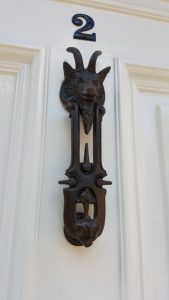
Overall I have two trees (reflecting my botanical interests), five animals who shift shape (inspired by research for OGOM’s Company of Wolves) and three devils, illustrating my gothic sensibilities (Dracula is the anti-Christ, Satan is, well, Lucifer, and Black Phillip is the devil incarnate).  To make matters worse my neighbours at no. 2 have this demonic doorknob which looks remarkably like Black Phillip!! I have planted St John’s Wort and will be ready with the holy water should they want to call on me unexpectedly.

CjZCIPlWsAA32kr

Please do comment on my list, or Kaja’s or the original Guardian article, or suggest your own top ten and we will respond!! If you have a useful definition of the ‘shapeshifter’ we would be interested too. In the meantime I eagerly await Bill’s list coming soon.

Posted in Critical thoughts, Fun stuff, Reviews | Tagged , , , , , , , , , , , , , | Leave a comment

The People Seeking the Company of Wolves

Anyone involved in academia will know of the importance of impact and on 8th June I will be speaking about the Open Graves, Open Minds project at the Public Engagement with Research Conference 2016 (Prince Edward Lecture Hall, University of Hertfordshire, College Lane Campus).  I will be live tweeting on the day from @OGOMProject and @DrSamGeorge1 using #uhengage16. I hope some OGOMERS will be following and responding. A synopsis of my paper is below:


OGOM Events

OGOM Events

Open Graves, Open Minds – adventures in the media and ‘The people seeking the company of wolves’.


This paper will focus on ‘impacts’ relating to the ‘Open Graves, Open Minds’ project. OGOM relates the undead in literature, art, and other media to questions concerning gender, technology, consumption, and social change. It extends to all narratives of the dark arts, the fantastic, the fabulous, and the magical. I will seek to explore the measuring of impact in relation to the project and the difficulties faced in providing evidence for cultural change (or pedagogical shifts) in response to the underpinning research. From this, I will address the problem of archiving material (going back to 2010), to demonstrate the reach of the project. In particular I will interrogate the problems encountered in disseminating and evaluating responses to the project’s activities in the media, taking the 2016 ‘Company of Wolves’ conference as a case study. The 3 day event ‘The Company of Wolves’: Sociality, Animality, and Subjectivity in Literary and Cultural Narratives—Werewolves, Shapeshifters, and Feral Humans’ received unprecedented attention in both the national and international press (from the BBC to The Guardian and The Independent, from Russia Today to the Smithsonian Magazine in the US and the South China Post), but the question remains as to who exactly was reading these stories, and how this can be measured or disseminated? Responding to the coverage in the BBC I will seek to answer the questions who were ‘The people seeking ‘the company of wolves”? And why does this matter?


Posted in OGOM News, Press Coverage | Tagged , , | 1 Comment

Top 10 Shapeshifters in Fiction (an alternative)

Over the weekend The Guardian published an article about the top ten shapeshifters in fiction. It was an enjoyable read and proof that shapeshifters continue to be relevant. However the choice of texts was limited (three examples from Harry Potter?). And, whilst I love Sirius Black in way that only someone who has grown up with novels and gone from fancying Harry to the Weasley twins to the complex Sirius can, I would argue that Sirius’ animagi status is not essential to his characterisation. So I offer you my alternative list.

Sandra Francey from Melvin Burgess’ Lady: My Life as a Bitch (2001)

My mum bought this novel for me when I was in my teens. It’s a very graphic depiction of what it’s like being a teenage girl. (My mother also bought me Anne Rice’s The Claiming of Sleeping Beauty (1983)  for my 16th birthday without realising it was a erotic BDSM novel which might explain why she thought it was suitable). Sandra wakes up one day as a dog and the novel follows her acceptance of this state. Its intense depiction of the embodied experience of sexuality is paralleled with animality by Burgess. It’s not a perfect novel but reading it as a pubescent girl felt ground-breaking and taboo. Sandra’s devil-may-care attitude and disregard of social mores makes her present as a less neurotic Holden Caulfield.

Tallula from Glen Duncan’s The Last Werewolf Trilogy (2011-2014)

Duncan’s female protagonist is as unapologetic as Burgess’. She’s intelligent, independent, sexual, a successful business woman and very, very scary. Her ability to absorb the tenets of lycanthropy, which include killing someone every full moon, show her tenacity and will to survive. But as well as being a consummate carnivore, Tallula also becomes a mother throughout the novels and it is this aspect that makes her presentation particularly powerful. She is presented as maternal but without it annihilating the other aspects of her character. Nor does her motherhood make her more monstrous; it becomes another facet of her personality. The character of Tallula is a complex exploration of lycanthropy.

Kaye from Holly Black’s Tithe (2002)

Kaye was the first changeling that I met in a novel and she introduced me to the darkly enticing world of Black’s urban fey. I had always been intrigued by changelings (and I’m currently convinced my partner might be one) and was taken with Kaye’s ignorance of her true nature. The parallel between Kaye’s experience and the teenage sensations of feeling as though you don’t belong whilst fearing you don’t was elegantly expressed through the motif of the changeling. The balance throughout the novel between otherwordly beauty and gritty reality envisaged through dirty clothes, the smell of cigarettes and bitter coffee gives Black’s work an intense tactility.

The Beast from Robin McKinley’s Beauty (1978)

As Bill has rightly pointed out ‘Beauty and the Beast’, like ‘Little Red Riding Hood’, is an important narrative in relation to the figure of the shapeshifter/ werewolf. Though I am very fond of Angela Carter’s adaptations of these fairy tales, McKinley’s full length novel is a wonderful reinterpretation for the Young Adult audience. In particular the Beast’s character is more fully fleshed out making him more charming in both beastly and human form. Indeed perhaps the greatest risk of McKinley’s writing is that, along with the gorgeous library and self-cleaning house, the Beast’s charm makes him quite a catch regardless of his form. However the novel never fully describes the Beast so that even as I write this piece I can only picture a fluid, nebulous area of darkness where the Beast should be – which seems incredibly appropriate for the monster of such a Gothic text.

The werewolves in Sally Gardner’s Tinder (2013)

Based on Hans Christian Andersen’s ‘The Tinderbox’ (1835), Gardner’s novel returns to the dark and tragic mood of early fairy tales. The story follows a soldier who makes a deal with a strange wolf-like man carrying a belt. Slowly the soldier makes his fortune but Gardner ensures through the dream-like narrative that the reader is never easy with a simple happy ending. Curling throughout the prose is the presence of the werewolves who replace the original fairy tale’s dogs with enormous eyes. The power of the story comes it part from its grounding in real life events – it is set during the Thirty Years War – and Gardner acknowledges that she researched the accounts of the Werewolf Trials as well as the malignant potential of the stranger’s girdle.

Narcissus from Ovid’s Metamorphoses (8 C.E.)

Any instance of shapeshifting that goes on to inspire the name of personality disorder is clearly worthy of consideration. The influence of myth and legends on our understanding of the real world is perfectly encapsulated in the legacy of the story of Narcissus. (As well as its influence on horticulture). The relationship between physical versus psychological transformation continues to dog the representation of the werewolf through the idea of the ‘beast within’ which pertains more to the human psyche that the real life wolf. Thus Narcissus is representative of the importance of the figure of the shapeshifter in popular culture and the human imagination. We can also see the influence of Ovid’s tale in Oscar Wilde’s The Picture of Dorian Gray (1891) and for that I owe it a huge debt of gratitude.

The Little Mermaid from Hans Christian Andersen’s ‘The Little Mermaid’ (1837)

With a half-Danish father, Hans Christian Andersen formed an important part of my childhood. (I remember my dad reading me ‘The Little Match Girl’ (1845) when I was seven years old as a rite of passage and crying and crying over the image of her little body in the snow). I re-read ‘The Little Mermaid’ recently and I was struck anew by the beauty of the prose especially the description of the garden under the sea and colours of the storm that sinks the Prince’s boat. The Little Mermaid’s transition into a human and then sea foam is heartbreaking: first through the pain of her new feet which are like walking on knives and secondly through the sacrifice of her life for the man she loves. It is undeniably problematic but the many heartbreaking images which are tossed to the surface are remain singularly affective when compared to more anodyne accounts of shapeshifters.

Dracula’s Bloodline in Kim Newman’s Anno Dracula (1992)

If you haven’t read Newman’s Anno Dracula then I urge you to go and read it immediately. (And not simply because he spoke at OGOM’s ‘Bram Stoker Centenary Symposium’). It is an absolutely delightful read for any vampire nerd and the level of intertexuality is delicious. The basic premise is that Count Dracula wins the battle against Van Helsing et. al and has married Queen Victoria. He and his kin are transforming large numbers of Victoria’s subjects but in doing so his bloodline is becoming increasingly degenerate. The streets are lined with sanguinary prostitutes who sell their bodies for a lick of blood. Dracula’s shapeshifting abilities are diluted and disturbed creating harrowing images of blood-starved foundlings with stunted bat wings: a dystopian vision of a vampiric future.

Luke Garroway from Cassandra Clare’s The Mortal Instruments Series (2007-2014)

Luke, or Lucian, from Clare’s series has many overlaps with Remus Lupin from J. K. Rolwing’s Harry Potter series. They are both rejected from society for their lycanthropy and find themselves making decisions to sacrifice their own happiness for the greater good. However, where Lupin truly does transform into a traditional monstrous werewolf, Luke is able to control his transformations. In many ways this makes his betrayal by his best friend, who encourages Luke to kill himself having been infected, even more heartbreaking. Luke does not have to be a monster and is instead a victim of prejudice.

Quinn from Charlaine Harris’ The Southern Vampire Mysteries (2001-2013)

He’s a weretiger. Quite possibly the coolest option that therianthropy has to offer. Quinn also has purple irises which makes him the Elizabeth Taylor of shapeshifters. Harris managed to express Quinn’s tiger aspect even in his human form describing his elegance and physicality in hypnotic language. However whilst I was convinced by Harris’ world building I couldn’t help wondering, as I do will all accounts of shapeshifting, why there are never any were-slugs.

I hope you enjoyed this list. Are there any I have missed? Which are your favourites? Feel free to comment below.

Posted in Fun stuff | Tagged , , , , | 2 Comments

Vampire Politics meets the EU

This article ‘Transylvania joining EU could see one million vampires in UK by 2020’ was published on the satirical news site NewsThump. Adding a Gothic twist to Brexit, it exaggerates fears regarding national identity by suggesting that by remaining in the EU, Britain remains open to invasion from foreign blood suckers. Though not directly referred to, the article is based on Bram Stoker’s Dracula (1897) and its presentation of Transylvania and the vampire mythology. This is particularly interesting given the representation of the foreign Other in this novel. As Stephen Arata argues in ‘The Occidental Tourist: Dracula and the Anxiety of Reverse Colonization’ the novel enacts a fear of the ‘civilised’ world, in this case Britain, being invaded by ‘primitive’ forces, Count Dracula, in much the same way as the British Empire attacked countries and cultures that were perceived to be ‘primitive’. It is this relationship between vampires, ‘foreignness’ and British political xenophobia that the article from NewsThump plays on via the medium of Stoker’s Gothic novel.

However, the mythology of Dracula as the archetypal vampire hailing from Transylvania is made more complex by the knowledge that Stoker’s novel views the Romanian country through the prism of cultural imperialism. His vampire is an Anglo-Irish invention based on the misinterpretation of foreign folklore. In light of Arata’s analysis of Dracula and reverse colonization, the fear of the vampire and its relation to the Romanian population seems even more flawed. It is a circular relationship: the creation of the monstrous foreign Other, such as Count Dracula, and its dissemination in popular culture confirms xenophobic fears and allays imperial guilt. The monster’s traits can then be read back onto the people themselves which is what has happened in regards to fears about immigration within the EU.

What the article doesn’t acknowledge is that Romania is already part of the EU. More problematically the image of vampires was evoked when Romania became part of the EU as British tabloid newspapers framed the arrival of Romanian migrant workers as an invasion threatening to suck the life blood from British labourers. This article from The Sun gives a taste of the xenophobic tone of this ‘journalism’. (Which is acknowledged and interrogated in this article from The Guardian by Stewart Lee). The framing of this piece is a reimagining of Dracula for the twenty-first century but one which has seeped from a fictional text into newspapers. The tone of The Sun’s article has all the markers of, to use Patrick Brantlinger’s term, imperial Gothic yet unlike its counterpart from NewsThump, it is not satire nor fiction. Much of what I have discussed reminded me of the paper given by Dr Duncan Light at the ‘Beliefs and Behaviours in Education and Culture’ conference which Sam and I attended last year. Dr Light has written about the impact of Stoker’s novel in The Dracula Dilemma: Tourism, Identity and the State in Romania but the paper he gave considered more how British culture viewed Romanians due to the lasting influence of Count Dracula.

What my brief discussion has shown, I hope, is the final line between reactionary and revolutionary forces in the Gothic. Whilst I rarely recommend going below the article to the Comments Section, it is interesting to do so here. Some commentators have acknowledged the satirical quality of the article but one person states that they ‘thought they [vampires] were already here cos someone somewhere is sucking the life out of this nation’. The language used here remains within the Gothic and the vampiric but from the point of view that Britain is already a Gothic nightmare colonized by the foreign Other. An article that attempts to attack xenophobic fears and show them to be childish and superstitious is re-interpreted (rather than ‘misinterpreted’) to lend further weight to those fears.


Posted in Critical thoughts | Tagged , , , | 4 Comments

Photographs of Children Raised by Wolves

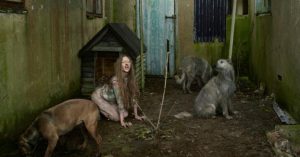
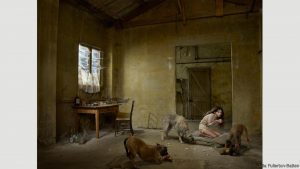
The photographer Julia Fullerton Batten has created a series of images of wolf children, or children supposedly raised by animals. In Feral: The Children Raised by Wolves, Fiona Macdonald reports that these pictures have a ‘dreamlike, fairy-tale quality’, and yet the lives they portray are real. There are two different scenarios – one where the children involuntarily end up in the forest, and another where they are so neglected and abused that they voluntarily seek comfort from animals. I find that the images privilege the human rather than the animal side and yet in doing so the children seem strangely at odds with their environment. They are often pictured crouching and scavenging for food and yet they appear pristine and often clothed. The project claims to raise awareness of child cruelty because in many cases the human parents have allowed the children to become feral or have abandoned them in forests much like a modern day story of Hansel and Gretel.

I am currently writing about animal-parented children in literature for the OGOM Company of Wolves book, following my plenary talk at the conference: ‘This is what it sounds like when wolves cry’; Wolf Children, Storytelling and the State of Nature’ . You can see the full conference programme here.Wolf children appear in many cultures throughout history and the myth can be traced back to the story of Romulus and Remus who were suckled by a She wolf, according to the descriptions of the creation of Rome (in Livy, History of Rome circa. 29 BC). Modern day readers are more familiar with them through the character of Mowgli in Kipling’s Jungle Book (1894), though there are many ‘real life’ accounts preceding this in the Enlightenment period and in British Romanticism, where writers responded to Rousseau’s ideas regarding ‘the state of nature’ and ‘the noble savage’.

Below are two of Batten’s contemporary images representing the stories of twentieth and twenty-first century wolf children. They show that the myth of wolf children continues to fascinate down the centuries.

(Oxana, Ukraine, 1991)

proxy

(Madina, Russia, 2013)

p0351mg9

Posted in OGOM: The Company of Wolves, Resources | Tagged , , | Leave a comment

On Twilight, dangerous love, romantic poetry and voyeurism

The following blog post, ‘Love is Dangerous’, appeared on my Facebook news feed. I read it and the post which it is reacting to (which you can read here) with interest. Whilst the original post on ‘What Happens Next: A Gallimaufry’ dealt with romantic depictions of Kylo Ren, a dark and tortured individual from the latest Star Wars film, in fanfiction, I think many of the questions raised pertain to themes surrounding YA Gothic and in particular Stephenie Meyer’s Twilight series. In particular we return, almost inevitably, to whether or not the portrayal of problematic romantic relationships can have negative effect on a young female readership. Do novels such as Meyer’s inculcate in young women an unhealthy attitude towards their personal relationships? Are they a conservative back lash to the strides that feminism has made over the past decades? In the wide context of the Gothic, this debate engages with the issue of whether literature has, or should have, a didactic, moral purpose.

I have blogged about other ways of framing this debate as well as expressing concern with the unproblematic assumption that literature has a degenerative effect on the reader – specifically young female authors. However, it was when reviewing ‘Reimagining the Gothic’ that I was reminded again of the use of the blazon and the female gaze in Meyer’s texts. I think by engaging with how Edward Cullen is presented in the novels, there is a way of complicating the idea that Bella is entirely passive. It may also explain some of the pleasure that can be found in the text and the manner in which it allows the reader to view safely. So I have dug out my MA thesis and found the section which pertains to this. I hope you enjoy it and are forgiving of the many faults to be found in such early research.

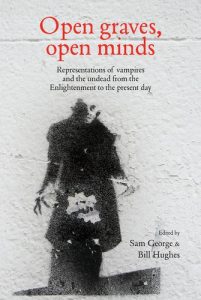
(You may also notice that some of the ideas about the gaze are similar to Sara Wasson and Sarah Artt’s article ‘The Twilight Saga and the pleasures of spectatorship: the broken body and the shining body’, in the Open Graves, Open Minds book which Bill and Sam edited. They expand, far more articulately, some of the ideas which I was trying to express. If you haven’t read their article Open Graves, Open Minds is now available as a paperback from Manchester University Press).

The Female Gaze and Edward Cullen (an excerpt from

“The sudden influx of Gothic literature, especially female gothic literature, as a new and invasive form of literary fashion was seen to reflect the sudden interest in commodity culture; E.J. Clery suggests that ‘rise in supernatural fictions must be understood in relation to the contemporary rise of consumerism’.[1] Readers were consumers with the power to affect the market.  If the eighteenth century was a time when the fears of consumerism came to the fore and was absorbed into the Gothic tradition, then contemporary Gothic literature must be as equally affected by the twenty-first century’s obsession with commercialism, advertising and celebrity culture. In this section, I will explore the ways in which Meyer’s vampires are commodified through their representation which is an amalgamation of celebrity culture and consumer society using close-reading of the text in order to immerse ourselves in the language of the author and not the language of the critics. Once again the role of Bella, as Gothic heroine, is used to show the ambivalent status of consumerism surrounding and inundating the Twilight series as contemporary Gothic.

On first viewing the Cullens, Bella describes their physiognomies as ‘faces you never expected to see except perhaps on the airbrushed pages of a fashion magazine’ (Twilight, p. 17). Her analogy for the beauty of the Cullens takes its power from the fashion world; they then become living art as she describes them as ‘painted by an old master as the face of an angel’ (Twilight, p. 17). The two comparisons, one contemporary and the other ancient, suggest the timeless quality of the vampire’s beauty: one which mirrors the eternal aesthetic of a piece of art as well as that of the celebrity, who through plastic surgery and lifestyle seemingly defies age. Patrick Day has suggested that Anne Rice ‘took the step of asserting that the vampire is a kind of celebrity [in Interview with the Vampire].[2] What Anne Rice started Meyer perfects: her vampires live their lives as though they are continually within an advert. Bella’s father Charlie sees the children as being ‘well behaved and polite’ while the Cullens ‘stick together the way a family should’ (both Twilight, p. 31). Though he accepts that they seem to be different, Charlie picks up on the idealised family image that the Cullens attempt to portray to the world. The Cullens appear to be an inversion of the Munsters, the gothic nuclear family made popular in the 1960s television programme of the same name.[3] The tension in the programme was that members of the family were never quite aware why other people found them strange since they were a loving family despite their odd appearances. If the message of this programme was not to judge on appearances then the Cullens represent an inversion of this: they are painfully aware of what makes them different and wear a mask of normalcy which they hope will conceal their dark secret.

At school, the rest of the children treat the Cullens as though they are the ultimate ‘popular’ kids; something that alienates them as a group by elevating them to an unachievable level of perfection. When Bella asks her school friend Jessica for Edward’s name, Jessica announces: ‘He’s gorgeous, of course, but don’t waste your time. He doesn’t date. Apparently none of the girls are good-looking enough for him’ (Twilight, p. 19). Later that day Bella bemoans the fact that: ‘It seemed excessive for them to have both money and looks … The isolation must be their desire’ (Twilight, pp. 27-28). Where Bella is quick to define the Cullens in regard to their ‘excessive’ beauty and money, Jessica sees herself as lacking compared to them; she will never be good enough for them. If as Monica Germana argues the word ‘‘human’ suggests notions of imperfection and fallibility’ then the Cullens are too good to be true; their fatal flaw is hidden from view so that any human looking at them is only able to see the stunning image that they project.[4]

Nor is it simply their physical attributes which set the Cullens apart from the rest of society. The objects that surround the Cullens are fetishized in order to continue the idea that they are like us, but not quite and that they have a quality which we, as the reader, will be unable to emulate. In a similar way the association of objects with the Cullens comes to represent the manner in which, according to Day, the ‘drama of intimacy with the self … can be understood as the aesthetic counterpart to a commodity culture in which acquiring things is a primary way of defining who we are’.[5] Bella immediately notices that the Cullens drive to school in ‘the shiny new Volvo’, the car which she noticed when she first pulled up in the school parking lot (Twilight, p. 27). Once she has spent time with the Cullens she discovers that they own a number of beautiful cars. Edward gifts Alice with a ‘canary yellow Porshe’ (Eclipse, p. 146). Rosalie drives a ‘a glossy red convertible’ which she doesn’t use because: ‘We try to blend in’ (both Twilight, p. 174). The Cullens seem defined by their cars which though beautiful and fast are redundant. Fred Botting sees this dissatisfaction as symptomatic of the contemporary vampire who is trapped by: ‘The consumption that never comes, the deathlessness that leaves consuming incomplete and its satisfaction ultimately unsatisfactory, [which] situates vampires in the realm of commodities and as defining figures of the consumer’.[6] Akin to the humans they emulate, these vampires try to fill the gap represented by their ‘outsider’ identity with beautiful objects thereby highlighting their difference to those around them and exacerbating the feeling of lack. Like the cars that they drive they always appear a little too perfect, a little too shiny, to be human.

The clothes that the Cullens wear help to maintain the void of difference between humans and vampires, despite their attempts of masquerade as human: Meyer’s vampires are ‘all dressed exceptionally well; simply, but in clothes that subtly hinted at designer origins’ (Twilight, p. 27). Thorstein Veblen made the remark: ‘Conspicuous consumption of valuable goods is a means of reputability to the gentleman of leisure’.[7] By the time the Cullens emerge this consumption not only shows reputability but also respectability. Thus though the Cullens may be attempting to pass as human they are unable to prevent themselves from standing out since like their clothing they appear to be human but more so, an excess of the human notion of beauty and aestheticism. The use of fashion is particularly important according to Catherine Spooner since through ‘clothing, the imperatives of consumerism and the pleasures of performance intersect’.[8] The pleasure of performance is warped in the existence of the Cullens. As Botting argued, the satisfaction of consumption can never be achieved because the final consumption is always evaded through deathlessness; in the same way, for the Cullens, performance becomes imperative and yet it limits their subjectivity. This performative element of the Cullens lifestyle is enveloped into their clothing. In a consumer society, an item of clothing is imbued with more power than reflects its’ relative cost. Josh Stenger argues that clothes of a desired person, such as an actor, can act as a substitute ‘commensurate with Freudian understandings of a fetish object, working to signify and in some cases even replace the impossible-to-consummate sexual attraction to an actor or character’.[9] Thus when Edward gives Bella his coat, something that passes for a simple act of gallantry according to most love stories, she notices that: ‘It smelled amazing’ (Twilight, p. 147). The clinging of the scent to Edward’s coat makes Bella highly sensitive to the fact that she appears to be wearing a part of him; when she takes the coat off she does so while ‘taking one last whiff’ (Twilight, p. 167). At the beginning of Edward and Bella’s relationship this sensual pleasure in the coat is deeply fetishistic; Bella cannot touch Edward yet but she can touch and ‘sniff’ what he has owned. He is replaced with an object that represents him and which Bella can consume visually and sensuously when in reality it is Edward who should be consuming Bella.

In relation to the Cullens’ consumption, Bella is quick to note that ‘they weren’t eating though they each had a tray of untouched food in front of them’ (Twilight, p. 16). Immediately afterwards we are told that Alice throws away an ‘unopened soda, [an] unbitten apple’ (Twilight, p. 17). These words draw on literary language inducing the quality of the Cullens eternal beauty. The image of the apple immediately connects to the story of Adam and Eve – indeed the cover to the first book is a pair of female hands offering a red, shining apple – evoking the idea of loss of innocence. Whilst the fact that the apple is unbitten promises things to come; like the ‘Plump unpecked cherries’ of Christina Rosetti’s ‘Goblin Market’, the reader is excited by the possibility that the apple may be eaten along with the consequences of this action.[10] The close correlation between the soda can and the apple continues the tension in Bella’s descriptions of the Cullens which flit from contemporary allusions about celebrity culture to the world of classical art. The Cullens uncomfortably combine the two in their physical appearance. Meanwhile, Meyer’s use of the prefix ‘un-’ suggesting a suspension in action, a not-quite-getting, calling to mind Keats language in ‘Ode to a Grecian Urn’ as he talks of the ‘Bold Lover, never, never canst thou kiss,/ Though winning near the goal’.[11] Perfection it would appear comes in the constant deferment of action and maintaining of suspense. The Cullens becomes like the Grecian Urn itself: exquisite objects whose meaning is written onto their surface appearance at the expense of their own subjectivity.

Bella is drawn the stunning surface appearance of the Cullens. The novels maintain a continuous tension between who desires to emulate who: as the humans surrounding the Cullens, in particular Bella, idolise them and desire to copy them so the Cullens continually attempt to mirror human society. In the final novel, once Bella has been transformed into a vampire, the Cullens take it in turns to ‘give her a few pointers on acting human’ (Breaking Dawn, p. 501); Rosalie assures Bella that she would ‘trade everything I have to be you’ because Bella is human (Eclipse, p. 166). Bella finds this incomprehensible since Rosalie is immortal. Yet as we discover all the transformation stories of the Cullens represent a human death deferred; they did not make the choice to become a vampire. Rosalie suggests that theirs is not the charmed life which Bella associates with their vampiric lifestyle; Rosalie argues that: ‘If we [her family] had happy endings, we’d all be under gravestones now’ (Eclipse, p. 154). Bronfen’s analysis of death suggests that the human understanding, and fear, of death is that the body or corpse must be separated from its soul while the corpse is replaced ‘by a symbolic substitute – in the form of an effigy or a gravestone’.[12] If a human being is unable to achieve this safe form of death than what is left is an uncanny form of undeath such as the vampire. Though humans may be afraid of death and wish to overcome it by being a vampire – a constant object in a world of change – so too the vampire recognises their liminal existence on the edges of reality and longs to be the changing subject that humans represent.

This representation in death as gravestones is prefigured in life in the form of birth certificates; bank accounts; and passports. Each human life is duplicated in these contracts. This causes a problem for the modern vampire: due to their eternal life any true form of identification would reveal their existence and yet they cannot live a ‘normal’ life as part of society unless they own them. This relationship between modern vampires and legal papers starts, not unsurprisingly, with Dracula, a novel that is both a story of the victory of good over evil and technological innovations winning against ancient methods.[13] The novel starts with Jonathan Harker, a newly qualified solicitor, going to Transylvania in order to sort out the paper work that allows Dracula to buy a house in England, and therefore gain entrance, legally, to the western world. Once the vampire had evolved through the novels of Anne Rice, we are once again reminded of the importance of capital and a good lawyer when Lestat choose Louis as his victim. Louis realises that Lestat ‘had ushered me into the preternatural world that he might acquire an investor and manager for whom these skills of mortal life became most valuable in this life after’.[14] It seems as though the modern vampire must continually hide themselves behind paper work so as not to reveal their true identity. J. Jenks, the lawyer who acquires fake documents for the Cullens, soothes Bella by saying that: ‘All [the passports and driver’s license] will pass the most rigorous scrutiny by experts’ (Breaking Dawn, p. 669); unlike the vampires themselves their paper replacements are able to ‘pass’ within normal society. It seems an ironic twist that despite the Cullens’ apparent morality and the clear distinction made between them and other vampires, they must resort to the behaviour of gangsters. Perhaps more troubling is the fact that Meyer chooses to write these scenes as though they are from a film noir. Rosalie’s words cut through this romantic image straight from a movie and enunciate the powerful divide of desire between humans and vampires. Catherine Belsey suggests that the vampire is defined by a desire which is ‘a perpetual, conscious condition, and it is above all the desire to regain humanity, for all its limitations and contradictions’.[15] As a human reader, we cannot quite believe Rosalie’s words since we are drawn into the glamorous life that the vampires lead which dazzles like a world that is like ours but better, improved; much in the same way that the suggestions by celebrities that the celebrity lifestyle is not as fabulous as it appears are often met with derision. The relationship between vampire and human is maintained by this two-way desire. Only a lucky few, like Bella, are able to achieve a state of eternal happiness where this desire has been quenched.

Bella’s character complicates the construction of the vampires as fetishised objects and the commodification of their lifestyle. Her presence elicits the confusion of who consumes who. She is already a consumer of commercialised Gothic when she meets Edward; on her first visit to the Cullens’ house, he teases her saying: ‘Not what you expected, is it? … No coffins, no piles skulls in the corners … what a disappointment this must be for you’ (Twilight, p. 287). He is well aware that she has grown up in the ‘saturation of Gothic motifs in contemporary culture’, a mainstreaming of Gothic tropes that mirrors the attempts of the Cullens to lead a ‘normal’ life.[16] Bella’s treatment of Edward, and his subsequent response, shows the underlying objectification of the Gothic within the novel; whilst Bella’s metamorphosis into a vampire suggests the possibility of play within the commodifed world of Twilight. Indeed, many of the key moments within the novels are inversions of Laura Mulvey’s thesis in ‘Visual Pleasure and Narrative Cinema’ (1975) which states that within narrative cinema the female takes the role of the passified image onto which the active male gaze projects its fantasies; a model which cannot be reversed.[17] Mulvey’s disavowal of the male object and female subject denies the power of Bella’s consuming gaze within the relationship and Edward’s pleasure in being viewed by her, as a beautiful, supernatural object. Nor does it accept that the novels, written by a female author, seem to circumnavigate the perceived threat of active masculinity by eliciting ‘voyeuristic or fetishistic mechanisms’ in order to objectify Edward, much as narrative cinema removes the castration threat of women by passifying them through the male gaze.[18] The vampire’s fangs as symbols of phallic power threatening to penetrate and consume the female protagonist, in this case Bella, function as victimisation. Yet Bella’s aggressive gaze de-fangs Edward so that he reacts as the submissive object. Kenneth Mackinnon argues effectively that when faced with an example of male eroticisation many people will react with ‘a peculiarly academic form of disavowal’ preferring to argue that any representation of the male body as object is not meant for them.[19] Within the Twilight novels and movies, the female gaze is focalised through Bella; and with the direction of Catherine Hardwick in the first movie, Edward becomes ‘slim and muscly, pale and defined, wearing makeup, lusciously coiffed, looking exactly like … a girl’.[20] Many detractors have been quick to argue that Edward is ‘gay’ despite his intense love for Bella; it would appear that they are reacting to his placement as the feminized object there to be viewed.[21] The reader or viewer is left in no doubt that the visual pleasure gained from Edward is entirely meant for them.

Throughout the novels, we are continually reminded that Bella’s gaze is intensely objectifying in relation to her vampire acquaintances. Indeed the space between the Cullen clan and Bella is often created by Bella herself. Despite Edward’s many protests that she does not understand the potential threat of the vampires with whom she mingles, Bella does maintain a distance from his family through her idealisation of them; much like a star struck teenage girl, Bella treats the Cullens as though they are her favourite celebrities. When looking at Edward she continually views him not as a whole but in constituent parts; her gaze becomes the means by which she cuts him into pieces and the language with which she describes him a system of rhetoricized violence. Her descriptions are similar to blazon poetry, much favoured by the poets of courtly love, which catalogues the physical merits of women in a manner that entirely objectifies them. On opening the door to Edward, Bella describes the way in which: My eyes traced over his pale white features: ‘the hard square of his jaw, the softer curve if his full lips – twisted up into a smile now, the smooth marble span of his forehead – partially obscured by a tangle of rain-darkened bronze hair …’ (Eclipse, p. 17). Though Edward may be the vampire it would seem that through Bella’s gaze he is slowly being visually consumed like a beautiful piece of meat. It is telling that after ravishing him visually she then falls back to her celebrity metaphors. Edward’s face is ‘a face any male model in the world would trade his soul for’ (Eclipse, p. 17). By evoking the image of the male model – the most nameless and personality free symbol of celebrity culture – Bella continues to concentrate on the outward appearance of Edward. She fetishizes Edward and his vampiric nature. It would appear that Bella is not always concerned with what Edward is thinking and, much like the novel creates tension through the absence of sex, Bella’s gaze on Edward creates the gap between the viewing subject and the viewed object that cannot be overcome.

In Midnight Sun, a currently unpublished, draft version of Twilight, the first novel in the series, written from Edward’s point of view, Edward comments on the manner in which he is objectified by Bella and other people around him. Due to his telepathic ability he is accustomed to ‘simply watch[ing] myself through someone’s following eyes’ (Midnight Sun, p. 211). Diane Fuss makes the point that women looking at photographs in fashion magazines are meant to identify with the female model. This identification is meant to function ‘as a cultural mechanism for producing and securing a female subject who desires to be desired by men – the ideal, fully oedipalized, heterosexual woman’, taking its argument from Mulvey’s model of visual pleasure.[22] Edward’s ability to see himself through other people’s point of view means that he is able to be, simultaneously, the object being viewed and the subject viewing; the means by which he can learn to temper his appearance and actions to suit the viewing public. Since Bella is immune to Edward’s telepathy he can only be aware of the ‘intangible sensation of watching eyes’ which he finds ‘strangely exciting’ (both Midnight Sun, p. 211). This excitement suggests that he enjoys the sensation of being the passified object.

The pleasure derived from Bella’s gaze differs from the oppressive quality of the Cullens’ life in which they constantly appear to be in the spotlight – performing not for enjoyment but through obligation. This sudden shift for Edward into the gaze being a source of pleasure necessitates the series of tableaus he sets up in which he can be viewed. The much celebrated scene in the meadow is orchestrated in a manner that seems to take a great deal from a striptease. Bella is placed in a central viewing position and Edward steps forward to be viewed. In the sunlight he appears only too happy to let Bella stare at him and she notes that he ‘lay perfectly still in the grass, his shirt open over his sculpted, incandescent chest … [while his] glistening, pale lavender lids were shut’; he is like a ‘perfect statue, carved in some unknown stone’ (both Twilight, p. 228). The entire pose, with his eyes shut so that Bella can gaze in peace, seems to be caught between shameless exhibitionism and an art exhibition. Yet, when Bella moves closer to him he runs back into the shade where he looks at Bella, ‘his eyes dark in the shadows (Twilight, p. 231). Though he maintains that he is the predator in their relationship, his reaction to Bella is like a scared animal. Like both artwork and striptease, he is there to be viewed but not touched. Edward’s method of suicide, after the apparent death of Bella, also involves uncovering his sparkling body in full view of people. Without Bella, the gaze becomes destructive once more.

Bella’s gaze as a source of pleasure causes her suitors Jacob and Edward to commodify themselves through the gifts that they give Bella in the third novel, Eclipse. At Bella’s birthday party cum graduation celebration, Jacob presents her with a bracelet on which there is a ‘miniature wolf … carved out of some red-brown wood that matched the colour of his skin’ (Eclipse, p. 374). He tells Bella that he made it for her so that she would always remember him since he reasons that: ‘out of sight, out of mind’ (Eclipse, p. 375). His belief that an object can take his place suggests that he sees an explicit relationship between himself as a person and this commodity. This relationship between love and commodities is something that Edward picks up on later. On seeing Bella’s present from Jacob, he asks if he can have ‘a little representation … A charm – something to keep me on your mind’ (italics within the original text. Eclipse, p. 413). Like Jacob he wants to be represented by an object. Bella soothes Edward by telling him: ‘you’ve given me you’ (italic in original text. Eclipse, p. 413). Her words suggest that Edward is himself a commodity that can be given out as and when he wishes. In the end, the present that Edward gives Bella is a heart-shaped diamond ‘cut in a million facets, so that even in the subdued light shining from the lamp, it sparkled’ (Eclipse, p. 438). Edward tells Bella that he thinks it is ‘a good representation … It’s hard and cold’ (Eclipse, p. 439). His analysis of the connection between the diamond and himself is centred around physical appearance; if diamonds are a girl’s best friend than, on appearance value, so is Edward. There is a direct connection between the skin of Jacob and Edward and the present which they give Bella; the male leads are continually shown to be titillating objets d’art, and both young men want to be owned by Bella. Nor is it unimportant that Aro, the collector of interesting vampires, sends Bella an immensely expensive diamond necklace as both a wedding present and a reminder of the promise made that she will be transformed into a vampire herself. Aro plays on the link between diamonds and vampires by showing that Bella will soon become an ornament as attractive as the diamonds he gives her.

Meyer’s use of metonymic relationship between object and young male lover implies that there is a relationship between love and commodities. Belsey argues that: ‘While sex is a commodity, love becomes the condition of happiness that cannot be bought, the one remaining object of desire that cannot be sure of purchasing fulfilment’.[23] In her construction of Western capitalism defined by an obsessive consumerism, love remains unsullied. Meyer’s vampires and their connection to celebrity culture and a society of commodities makes it clear that love within the world of beautiful supernatural creatures is as open to commodification as sex. Botting draws our attention to ‘the devaluation of romance: affectless, feeling is anesthetised by an excess of images and commodities, their dizzying glitter stimulating and satisfying desire to the point of its consumption’.[24] In a series that abounds with commodities and ‘glittering’ vampires, where the love affair remains on the point of being consummated for three novels, it is apparent that both our own satisfaction and Bella’s is being continually deferred through the beauty that is placed before us. Belsey makes the apt point that the relationship between vampires and humans is tainted by the desire for blood in a manner that taints the love affair; blood lust ‘represents the ultimate debasement, pleasure radically divorced from love’.[25] Thus vampires make their human lovers into the ultimate object, something that can only be consumed debasing the potential for a love between equals. Fuss enunciates this expression of desire through consumption in relation to the gaze: ‘Vampirism … marks a third possible mode of looking, a position that demands both separation and identification, both a having and a becoming – indeed a having though a becoming’.[26] Vampirism is defined by the fact that the vampire wants the other, the human, and achieves this craving to have through feeding from the victim, as object of desire; while also reproducing them self by making the victim in their image as a vampire. In the Twilight series Meyer inverts this relationship so that Edward’s body, and in many ways Jacob’s as well, must become the object that is consumed by Bella’s gaze and desire. Bella takes pleasure from the spectacle put before her; and yet she is not satisfied until she becomes a vampire herself; after the ‘having’ of Edward as an object there must be the ‘becoming’ like him.

[1] Clery, The Rise in Supernatural Fiction, p. 5.

[2] Day, Vampire Legends, p. 43.

[3] Information on The Munsters (1964-1966) found on The International Movie Database http://www.imdb.com/title/tt0057773/ [accessed 1st August 2010].

[4] Dr Monica Germana, ‘Of Humans and Monsters’ (18th March 2010), Guest Blog on The Gothic Imagination, University of Stirling Website http://www.gothic.stir.ac.uk/guests/viewblog.php?id=70 [accessed 11th August 2010].

[5] Day, Vampire Legends, p. 47.

[6] Fred Botting, Gothic Romanced: Consumption, Gender and Technology in Contemporary Fiction (London: Routledge, 2006), pp. 90-91.

[7] Thorsten Veblen, The Theory of the Leisure Class (London: Penguin Books, 1994), p. 75.

[8] Catherine Spooner, Contemporary Gothic (London: Reaktion Books, 2006), p. 87.

[9] Josh Stenger, ‘The Clothes Make the Fan: Fashion and Online Fandon When “Buffy the Vampire Slayer” Goes to eBay’, Cinema Journal. Vol. 45, No. 4 (Summer, 2006), pp. 26-44 (p. 33).

[10] Christina Rossetti, ‘Goblin Market’, The Norton Anthology of English Literature: The Victorian Age (Eighth Edition), Vol. E, ed. by Stephen Greenblatt (General Editor), M. H. Abrams, Carol T. Christ and Catherine Robson (London: W. W. Norton & Company, 2006), pp. 1466-1478 (p. 1466).

[11] John Keats, ‘Ode to a Grecian Urn’, Lyric Poems (New York: Dover Publications, 1991), pp. 36-37 (p. 37).

[12] Bronfen, Over Her Dead Body, p. 295.

[13] Christopher Herbert, ‘Vampire Religion’, Representations, No. 79 (Summer, 2002), pp. 100-121 (p. 101).

[14] Rice, Interview with the Vampire, p. 39.

[15] Catherine Belsey, ‘Postmodern Love: Questioning the Metaphysics of Desire’, New Literary History, Vol. 25, No. 3, 25th Anniversary Issue (Part 1) (Summer, 1994), pp. 683-705 (p. 701).

[16] Monica Germana, ‘Skulls, Skulls everywhere: consuming the Gothic in the 21st Century’ (22nd February 2010), Guest Blog on The Gothic Imagination, University of Stirling Website http://www.gothic.stir.ac.uk/guests/viewblog.php?id=67 [accessed 5th August 2010].

[17] Laura Mulvey, ‘Visual Pleasures and Narrative Cinema’, Visual and Other Pleasures, ed. by Stephen Heath, Colin MacCabe and Denise Riley (Hampshire: Macmillan Press, 1989), pp. 14 – 28 (p. 19).

[18] Mulvey, Ibid., p. 25.

[19] Kenneth Mackinnon, ‘After Mulvey: Male Erotic Objectification’, The Body’s Perilous Pleasures: Dangerous Desires and Contemporary Culture (Edinburgh: Edinburgh University Press, 1999), pp. 13-29 (p. 16).

[20] Bidisha, ‘Bitten by the female gaze’, The Guardian Online (19th January 2009) http://www.guardian.co.uk/commentisfree/2009/jan/19/women-gender [accessed 4 th February 2010].

[21] See Appendix 3.

[22] Diana Fuss, ‘Fashion and the Homospectatorial Look’, Critical Inquiry, Vol. 18, No. 4, Identities (Summer, 1992), pp. 713-737 (p. 713).

[23] Belsey, ‘Postmodern Love’, p. 683.

[24] Botting, Gothic Romanced, p. 85.

[25] Belsey, ‘Postmodern Love’, p. 700

[26] Fuss, ‘Fashion and the Homospectatorial Look’, p. 730″.

Posted in Critical thoughts, Generation Dead: YA Fiction and the Gothic news | Tagged , , , , | 2 Comments

Why I believe in the story of ‘Old Stinker’ the Hull Werewolf

Werewolf, sepia 2
Sabine Baring-Gould claims that ‘English folklore is singularly barren of werewolf stories , the reason being that wolves had been extirpated from England under the Anglo Saxon kings, and therefore ceased to be the object of dread to the people’ (Book of Werewolves, 1867, p. 77). This is what makes the sightings of the Hull werewolf, known as ‘Old Stinker’, in the last few days all the more intriguing. OGOM has been busily reporting on coverage of this contemporary phenomena (see for example ‘Werewolf Sightings in Yorkshire’  and ‘Ancient Werewolf Known as ‘Old Stinker’ Sparks Folk Panic in the UK‘). In literature accounts of werewolfism or lycanthropy can be traced back to the epic of Gilgamesh in 1200 (whereas wolf fables begin with Aesop’s ‘The Boy Who Cried Wolf ‘ in 620- 520 BC). Virgil’s Eclogues are thought to be the first account of voluntary werewolfism (42-39 BC) but lycanthropy is more commonly seen as ‘a curse’ or a sign of bestiality, or at worst of cannibalism. Those who were executed in werewolf trials in the middle ages were believed to have a taste for human flesh. With the advent of psychoanalysis werewolfism came to more commonly represent the ‘beast within’ or everything animal that we have repressed in terms of our human nature.  The werewolf is the spectre brother or shadow self of the wolf and the history of werewolfism can easily be juxtaposed with humankind’s treatment of wolves. The much talked about case of Peter Stumpf, who was executed for being a werewolf in 1589, corresponds with the extinction of the wolf in England in the 1500s (although the extinction of wolves across Europe did not occur until 1800s). Wolves held out in Ireland until the 1700s (though they were extinct in Scotland by the late 1600s). These dates are well documented by Garry Marvin and others. In 2015 OGOM reported on attempts to re-wild the wolf in the UK and elsewhere at the Company of Wolves conference. We began to question what would happen if wolves returned to our forests and this was prominent in the many media reports of the conference in The Independent, The Guardian and elsewhere.
In the 1880s British traveller Emily Gerard accounted for the Romanian belief in werewolves by equating it with fear of the wolf, ‘as long as the flesh and blood wolf continues to haunt the Transylvanian forests, so long will his spectre brother survive in the minds of the people’ (The Land Beyond the Forest, 1888). The emergence of the Hull werewolf ‘Old Stinker’ in the last few days has reopened debates about the werewolf’s relationship to the ‘flesh and blood wolf’. At OGOM we often get asked what causes belief in werewolfism (and vampirism) and what is most pertinent and magical about this latest folk panic is that ‘Old Stinker’ is thought to inhabit a landscape which saw some of the last wolves in England. He represents then, not our belief in him as a supernatural shapeshifter, but our collective guilt at the extinction of an entire indigenous species of wolf. Far from dismissing the myth, my instincts are to embrace it and see it as a manifestation of our cultural memory around wolves. Contrary to the assertions of Gerard, the ‘Old Stinker’ story tells us that belief in werewolves lives on beyond the actual lives of the wolves who were thought to inspire them. Rather than being dismissed as a rather fishy tale, ‘Old Stinker’, can inspire the wolf warrior in all of us and allow us to lament the last wolves who ran free in English forests. ‘Old Stinker’ is far from being a curse, in fact he is a gift;  he can reawaken the memory of what humans did to wolves, raise awareness of re-wilding debates, and redeem the big bad wolf that filled our childhood nightmares, reminding us that it is often humans, not wolves or the supernatural, that we should be afraid of. 
20150904_120117
Posted in Critical thoughts, OGOM News, OGOM: The Company of Wolves, Reviews | Tagged , , | 5 Comments

The Gothic influence of Snow White’s Evil Queen

The website Tor.com has published a very interesting article, ‘Ayesha, White as Snow: H. Rider Haggard’s She and Walt Disney’s Evil Queen’. As the title suggests, the author of the piece, Gilbert Colon, looks at the similarities between Haggard’s eponymous protagonist and the presentation of the Evil Queen in the Disney animation. The article pays close attention to costuming which I found very interesting as, in my opinion, the Evil Queen has one of the best outfits in Disney (followed, of course, by Maleficent).

Posted in Books and Articles | Tagged , , , , | Leave a comment

Open Graves, Open Minds reporting on the Werewolf of Hull

Yesterday I was interviewed for the Mark Forrest Show which was doing a segment on the Werewolf of Hull or, as it is now commonly referred to, ‘Old Stinker’. You can listen to my five minutes of fame here. (I’m on at 2 hrs 44 mins but the report starts about 10 minutes before that).

I fear my scepticism and academic nerdiness was a little too much but hopefully you enjoy my insights. I’d like to think I came across as a British version Dana Scully: “I want to believe”. I can’t say I’m that convinced that searching for a folkloric creature that isn’t necessarily a werewolf on a full moon seems that effective given that the original Old Stinker pre-dates the relationship between the lunar cycle and lycanthropy but I look forward to being proved wrong. I’ve also proved that I must never go into PR as I entirely forgot to plug the OGOM Project; I’m absolutely terrible at aggrandisement.

Posted in Fun stuff, Press Coverage | Tagged , , , | 2 Comments