I am very happy to post another insightful introduction to Dan Waters’s novel from one of my ‘Generation Dead: YA fiction and the Gothic’ students Claire Anderson. Claire completed the module in 2015-16. This is very readable and engaged. I hope you enjoy it. It should inspire those students taking the module with Kaja this year who will submit their own introductions for assessment in November.
Claire Anderson
Critical Introduction to Dan Waters’s Generation Dead with Suggested Further Reading
Dan Waters and Generation Dead
Generation Dead is Dan Waters’s debut novel, published in 2008. It could be described as a paranormal romance with a high-school setting, though it is certainly much more than that. Waters uses the emerging figure of the zombie as a means of interrogating not only adolescent concerns, but wider issues of humanity and identity; therefore appealing to a vast audience of all ages and backgrounds. Waters was inspired to write Generation Dead through a deep reaction he had to witnessing the phenomena of teen video-violence, where he saw the inhumane acts of human beings attacking one another to generate views on sites such as Youtube. In an interview for ‘teenink.com’ Waters shared that ‘writing about human cruelty via zombies was my brains way of coping with subject matter that, frankly, scared me to death.’[1]
Physical violence visually described can epitomise discrimination and Waters interrogates this within Generation Dead, but there are the unseen implications of discrimination which he also unearths, just like a zombie from the grave. The effects of limited political rights, for example, and the power of the language of prejudice. Groups of people, most often minorities, have always been and continue to be, persecuted throughout the world (whether concerning race, gender, sexuality, physical disability, mental disability, class, or culture). Waters is sending his heart out to all of their struggles through this story.
When asked in the interview for ‘teenink.com’ whether there was a message within Generation Dead Waters replied:
In my mind, the book is more about raising questions than giving answers or imparting messages […] that said, the one message that I’d be really, really pleased that people take away from the book is to be kinder to each other, […] if the book keeps one person from being bullied or a future Youtube victim then I guess I can claim rights to having a message.[2]
Clearly Waters is a sensitive soul who cares deeply about humanity and is using his talents as a writer to interrogate serious issues. Generation Dead is a great read for all audiences, but is definitely deserving of further scholarly attention, primarily for its use of the ‘sympathetic zombie’ as a symbol to tackle ‘identity politics’ and what it really means to be human and to love.
The Emergence and Evolution of the Zombie Figure
The zombie’s origins can be traced back to the folklore and culture of Haitian voodoo, and are first represented in this way within literature by William Seabrook in The Magic Island, published 1929. Seabrook was an American explorer and occultist who documented his travels in Haiti and subsequently introduced the figure of the zombie to western culture through his book. His writings inspired the first zombie film, White Zombie, which was produced by Victor and Edward Halperin and released in 1932. This first zombie concept was characterised by the idea of a wizard figure or ‘witch-doctor’ manipulating the subject and using them as a mindless tool for their own ends, which given the U.S. occupation of Haiti during 1915-1934 suggests that ‘the Haitian zombie is deeply embedded within the historical imaginaries of slavery and colonialism.’[3]
Later, George A. Romero re-conceptualised the zombie figure within his series of films beginning with Night of the Living Dead in 1968 and through to Survival of the Dead in 2009, wherein he ‘severed the figure from its Caribbean origins’[4] and in a sense brought the zombie to America. He removed the witch doctor concept and focused more on innate brutality and desire, creating a truly terrifying zombie. This image of the zombie has featured popularly within film and created a legacy for George A. Romero as a father of the zombie figure. Within Generation Dead one of the many names used to refer to the zombies is the ‘Children of Romero’ which pays homage to this zombie ancestry. Although the zombie does have its legacy, it has had more of a ‘film-centric focus’[5] as opposed to a literary one. Yet despite the zombie figures success within film, it has still been overshadowed by its relatives; the vampire figure and the werewolf figure, which have both been far more prominent within literature and film. These three figures each have a common purpose, in that they stand as a representation for the ‘Other’, but it has been argued that the vampire and werewolf are easier figures to ‘romanticise’ as ‘vampires symbolize sex and embody hedonism and werewolves symbolise the struggle between civilised and barbaric man, [but] zombies are death. They embody it and represent it simultaneously. […] They frighten us not because they will kill us, but because they are death itself, arriving not with a bang, but with a moan.’[6]
The previous quote’s allusion to T.S. Eliot’s Wasteland leads nicely on to how the zombie figure relates to Postmodernism. In Clive Bloom’s Day of the Dead, he asserts that the ‘living dead [zombies] are the perfect postmodern symbol, a blank on to which any contemporary fear may be inscribed. Zombies are us.’[7] Certainly with the expansion of capitalist mentality, which in a sense is already in a mode of global colonisation, the figure of the zombie as a slow moving, self-serving, brain-less entity could be seen to represent humanity. In Generation Zombie Stephanie Boluk and Wylie Lenz have suggested that ‘as it stands at the end of history, the zombie is simultaneously a vision of capitalism’s fulfilment in the form of a stasis of perpetual desire, as well as a model of proletarian revolution, depicting the emergence of a new class-less society.’[8] This new class-less society they mention has not been given much hope through the zombies past representation, which is why a text like Water’s Generation Dead is of paramount importance in planting that seed of hope. Creating a sympathetic zombie and showing how they can be integrated into society is ultimately a way of metaphorically reviving humanity through showing that love is the epitome of what it means to be human.
The Zombie and Identity within Generation Dead
Before focussing on the Zombie and its relation to identity, we need to first make mention of the Gothic and its relation to adolescence and how Waters portrays this within Generation Dead. Alison Waller in Constructing Adolescence in Fantastic Realism has described adolescence as ‘always “other” to the more mature stages of adulthood, often perceived as liminal in transition’[9] which may explain why it so closely relates to the Gothic mode which is arguably all about “otherness”. Gothic has become much more than a category to some, it has become a sub-culture. In Raymond William’s Culture and Society 1780-1950, he outlines the evolving definitions of ‘culture’ and concludes that as a term it has grown to represent ‘a whole way of life, material, intellectual and spiritual’[10] and that it has also come to be ‘a word which often provoked either hostility or embarrassment’[11]. The main character Phoebe belongs to the Goth subculture — an often overlooked and misunderstood minority, which is an interesting position to place the protagonist in. Sub-culture might not always be considered to belong to the same category as some of the other groups which are discriminated against, but the hate-crime resulting in the death of Sophie Lancaster in 2007[12] (the year before Generation Dead was published) is certainly proof of the seriousness about blind discrimination towards sub-cultures. The artwork for the cover of Generation Dead is a single black rose, which may serve as a subconscious foreshadowing of the poem later published for/about Sophie Lancaster written by Simon Armitage in 2012 which was titled ‘Black Roses’.
The Gothic subculture revolves around the element of performativity, and within Contemporary Gothic Catherine Spooner describes the dark/morbid dress as articulating ‘a tension between mainstream mass entertainment and a subcultural rebellion’[13], going on to explain that ‘through clothing, the imperatives of consumerism and the pleasures of performance intersect’.[14] The picture of Gothic subculture that she presents represents both a form of peaceful protest as well as a longing for identity, which correlates with the struggle that the zombies within Generation Dead face. Interestingly though, the zombies and the Goths don’t automatically come together through similarity, in fact we are told that ‘The goth look wasn’t nearly as popular as it once was, probably due to the appearance of the living impaired, but to Phoebe that just gave the style a subtle hint of irony’.[15] Perhaps though this just goes to show that the Gothic subculture may have more in common with the vampire figure than that of the zombie, as Clive Bloom and many others tell us, ‘vampires are the undead, but zombies are the living dead.’[16] It seems that Phoebe feels empowerment through her style and a sense of uniqueness which is certainly more in line with the immortal status of the vampire than that of the disempowered decaying zombie. The descriptions we are given of her also conjure up visuals of iconic vampire imagery, such as her ‘funerary clothing’[17] and ‘long dark hair’[18], both reminiscent of the character Morticia Addams from the 1964 television series and the 1991 film The Addams Family. Phoebe is also given the fitting nickname of ‘Morticia Scarypants’ by Pete Martinsburg which further supports this intertextual reference.
There are many intertextual references to Goth subculture throughout Generation Dead which the reader can look out for, including gothic music, such as The Creeps and other imaginary artists fabricated in a humorous fashion, such as M.T Graves and his solo album ‘All the graves are empty except mine’.[19] But the portrayal of gothic subculture is most specifically made through Phoebe and her friends. Phoebe refers to herself and Margi as ‘weird sisters’[20] to which Margi replies ‘minus one’ implying that Collette was the third weird sister in reference to Shakespeare’s Macbeth.
The zombies also stand as a symbol for discrimination against disability – both physical and mental. And the Hunter Foundation within the text seems to be at the core of inspiring discussion about marginalising different or disabled people particularly through language use. Angela Hunter when giving a speech at the school outlines all the pejorative terms used to describe the zombies, such as ‘zombies, corpsicles, dead heads, the undead, worm food, shamblers, the living dead, [and] the Children of Romero’[21] many of which imply limited cognitive or physical ability. Angela Hunter goes on to describe how ‘In much the way that the term handicapped was widely recognized as being insulting to differently abled persons, so too is living impaired an insult to those who live differently biotic lives’.[22] The Hunter foundation however might not be as genuine as it seems in their intentions, despite drawing attention to how categorically using language leads to segregation, they themselves actually are guilty of the same thing, in coining the term ‘differently biotic’, it seems that Waters is suggesting that categorical language is a device of segregation, and perhaps we should all just be seen as primarily human. The Hunter Foundation seeks to find ways of improving the zombies functioning and assimilation into society, but in a discussion later in the text between Phoebe and Tommy, he explains to her why those who come back with limited abilities struggle so much, and that it is because of lack of love. He mentions how Colette’s parents ‘skipped town when she came back’[23] and Phoebe’s own guilt for abandoning her friend resonates silently, which perhaps could serve as a message that different or disabled people could thrive within society if they were shown acceptance and love.
Gender is also explored within Generation Dead, albeit in a subtle way. Karen is an interesting character in that, like Tommy, she is less distinguishable as a zombie through her more human traits and characteristics, such as her beauty and movement. Bill Hughes in ‘Legally recognised undead: essence, difference and assimilation in Daniel Waters Generation Dead’ mentions that there is ‘a hint of sexual ambiguity’[24] surrounding Phoebe’s attraction to Karen, which being present in a casual way adds weight to the normality of sexual attraction between the genders and steps away from the discrimination of essentialism. Margi’s attitude towards Phoebe’s attraction to Tommy in the beginning further highlights the closed-mindedness of believing that love can only blossom in essentialist terms, which also mirrors the attitudes many people have about same-sex relationships.
Tommy as a character has served as a malleable and powerful device within Generation Dead, providing a point of reference for an array of struggles. But perhaps most powerfully he represents racial struggle. The civil rights movement of the 60’s was a pivotal moment of change within America which had implications worldwide. Bill Hughes draws attention to the parallels between the struggles of Tommy Williams as a zombie wishing to be on the football team, and those of athletes such as Jesse Owens[25] who were also treated unfairly because of race irrespective of talent. Not only is this paralleled through the audience’s reaction to Tommy, but also through the other players and most sinisterly, through the coach, who even goes as far as threatening Adam with being kicked off the team for showing comradery to a fellow team player who happened to be a zombie.[26] The use of Tommy’s blog adds an emotional dimension to the text as the shred blog posts are articulate and heartfelt. One post in particular where Tommy explains his struggles with the football team and his decision to leave he says, ‘I wish I could tell you what I’m sure many of you would like to hear – that I threatened him, that I frightened him with the promise of an undead horde visiting him in the night. But I didn’t. I offered to quit.’[27] Through this commendable form of peaceful protest, coupled with the religious rhetoric which is infused within Tommy’s blog posts, we are reminded of Martin Luther King’s peaceful and religious approach to campaigning for change during the civil rights movement. The importance of the use of Tommy’s blog within the text is strengthened even further as it extends beyond the book and has become a work in its own right. Waters has continued Tommy’s blog at ‘mysocalledundeath.com’ which is an excellent way of getting the modern day readership more involved and really bringing his characters to life (or back to life…) And of course it can’t be denied that the enormity of the internet in this age and how it has contributed many negatives to the world, such as teen video-violence, should also be harnessed for the spreading of positivity. Brendan Riley in The E-Dead Zombies in the Digital Age, has suggested that the internet is highly tied to the modern zombie figure, saying that ‘more people have been infected by global digital virus pandemics than have been harmed by biological ones (though no one has died, yet, from an internet virus)’.[28]
‘Choose Life, Choose Love’ is the message Waters chooses to summarise his Generation Dead series in an interview for Fantastic-Book-Review[29], which is of course an intertextual reference to Irvine Welsh’s Trainspotting (1993) but is also more than that, Waters is telling us that life is love.
Suggested Further Reading
Daniel, Waters, Kiss of Life (London: Simon and Schuster, 2009)
Daniel, Waters, Passing Strange (London: Simon and Schuster, 2010)
Daniel, Waters, Stitches (London: Simon and Schuster, 2012)
Daniel, Waters, Break My Heart 1000 Times (New York: Hyperion, 2012)
Daniel, Waters’ personal blog http://www.danielwaters.com
Daniel, Waters, Tommy’s blog http://www.mysocalledundeath.blogspot.co.uk
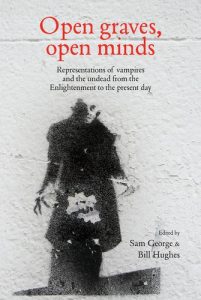
Sam, George and Bill Hughes, Open Graves, Open Minds: Representations of Vampires and the Undead from the Enlightenment to the Present Day, (Manchester: Manchester University Press, 2013).
www.opengravesopenminds.com and the University of Hertfordshire’s involvement with the project through Sam George’s modules.
Joni Richards, Bodart, They Suck, They Bite, They Eat, They Kill: The Psychological Meaning of Supernatural Monsters in Young Adult Fiction (Washington: Rowman and Littlefield, 2011).
Fred Botting, ‘Love Your Zombie: Horror, Ethics, Excess’, in The Gothic in Contemporary Literature and Popular Culture (London: Routledge, 2014).
Clive, Bloom, ‘Day of the Dead’, Times Higher Education (2010), http://www.timeshighereduction.com/features/day-of-the-dead/412166.article.
Stephanie, Boluk and Wylie, Lenz, Generation Zombie: Essays on the Living Dead in Modern Culture, (North Carolina and London: McFarland &co. Inc, 2011).
Notes
[1] Writes, Chrissi, Generation Dead Book Review and Author Interview by Daniel Waters, http://www.teenink.com/reviews/book-reviews/article/178181/Gerneration-Dead-Book-Review-Author-Interview-Daniel-Waters/, (accessed: 30/05/16).
[2] Ibid.
[3] Boluk, Stephaine, and Lenz, Wylie,’Introduction’, Generation Zombie: Essays on the Living Dead in Modern Culture (North Carolina and London: McFarland &co. Inc, 2011). P3-4.
[4] Ibid, p.5.
[5] Ahmad, Aalya, ‘Gray is the New Black: Race, Class, and Zombies’, Generation Zombie: Essays on the Living Dead in Modern Culture (North Carolina and London: McFarland &co. Inc, 2011). P.130.
[6] Riley, Brendan, ‘The E-Dead Zombies in the Digital Age’, Generation Zombie: Essays on the Living Dead in Modern Culture (North Carolina and London: McFarland &co. Inc, 2011). P.196.
[7] Bloom, Clive, ‘Day of the Dead’, Times Higher Education (2010), http://www.timeshighereduction.com/features/day-of-the-dead/412166.article.
[8] Boluk, Stephaine, and Lenz, Wylie,’Introduction’, Generation Zombie: Essays on the Living Dead in Modern Culture (North Carolina and London: McFarland &co. Inc, 2011). P.7.
[9] Waller, Alison, Constructing Adolescence in Fantastic Realism (Oxfordshire: Routledge, 2009). p.1.
[10] Willliams, Raymond, Culture and Society 1780-1950 (London: Doubleday, 1960). P.14.
[11] Ibid.
[12] http://www.sophielancasterfoundation.com/
[13] Spooner, Catherine, ‘Teen Demons’, Contemporary Gothic (London: Reaktion books, 2006). p.87.
[14] Ibid.
[15] Waters, Daniel, Generation Dead (London: Simon & Schuster, 2008). P.46.
[16] Bloom, Clive, ‘Day of the Dead’, Times Higher Education (2010), http://www.timeshighereduction.com/features/day-of-the-dead/412166.article.
[17] Waters, Daniel, Generation Dead (London: Simon & Schuster, 2008). P.30.
[18] Ibid.
[19] Ibid. p113.
[20] Ibid. p.114.
[21] Ibid. p.101.
[22] Ibid. p.102.
[23] Ibid. p.380.
[24] Hughes, Bill, ‘Legally Recognised Undead: Essence, Difference, and assimilation in Daniel Waters Generation Dead’ in Sam George and Bill Hughes Open Graves, Open Minds (Manchester: Manchester University Press, 2013), pp. 245-263.
[25] Ibid.
[26] Waters, Daniel, Generation Dead, (London: Simon & Schuster, 2008). P.57.
[27] Ibid. p.233.
[28] Riley, Brendan, ‘The E-Dead Zombies in the Digital Age’, Generation Zombie: Essays on the Living Dead in Modern Culture (North Carolina and London: McFarland, 2011). P.197.
[29] Interview by Fantastic-Book-Review with Daniel Waters concerning Generation Dead, http://www.fantasticbookreview.co,/2009/05/author-interview-daniel-waters.html.