Hekate and witches

Hallowe’en is witching time but OGOM has recently been directing its attentions to witchcraft for a while now, leading up to the next OGOM conference, covering the topic (all very vague at the moment, but watch out for news). The always-fascinating Folklore Thursday people have an excellent article here on Hekate and her transition from pre-Olympian Greek goddess to the sinister witch figure of Renaissance drama.

Posted in Critical thoughts | Tagged , , , | Leave a comment

The Werewolf as Spectre Wolf

Here’s a quick update on my werewolf research trending ahead of Halloween. I’m going to be doing some radio over the next few days and I’ll be taking part in The Big Conversation on Friday which is where academics pitch their research to a wider audience and attempt to create a dialogue worldwide. I will be writing my piece tonight.

Also I wanted to make mention of this wonderful painting. Whilst I was in Manchester I made a special trip to see this work in Salford and it is the perfect image for my focus on the werewolf as spectre wolf. It was painted in 1904 by John Charles Dollman.

20161027_175228_resized

The story so far:

Paranormal/popular science coverage:

http://mysteriousuniverse.org/2016/10/new-explanation-for-recent-uk-werewolf-sightings/

http://phys.org/news/2016-10-guilt-werewolf-sightings-expert.html

Local News

http://ilovemanchester.com/2016/10/21/ghosts-monsters-and-werewolves-manchester-goes-gothic.aspx

http://www.yorkshirepost.co.uk/news/truth-behind-those-sightings-of-hull-s-beast-of-barmston-drain-werewolf-1-8193524

http://www.hulldailymail.co.uk/hull-werewolf-sightings-caused-by-collective-guilt-expert-says/story-29837064-detail/story.html

University News Pages

http://publicnow.com/view/16976EF7B3DFBDB8E64557D5DFD0D282CCFA163A

https://www.herts.ac.uk/about-us/news/2016/october/our-collective-guilt-is-leading-to-a-rise-in-werewolf-sightings,-says-expert

Look out for me on the airwaves over the weekend and don’t leave home without your wolf bane. I’ll be posting again on Halloween. Have a hauntingly good weekend. I can’t wait to hear what everyone is up to leading up to the witching hour!

Posted in OGOM: The Company of Wolves, Press Coverage, Publications | Tagged , , , , | Leave a comment

Generation Dead: Consuming the Vampire – Holly Black’s ‘The Coldest Girl in Coldtown’

At the end of the lecture on Sedgwick, I told the group that in many ways Holly Black’s The Coldest Girl in Coldtown (2013) was the opposite to the Sedgwick text, My Swordhand is Singing (discussed here). This meant that following my lecture, my first question in the seminar was: ‘How does this text differ from Sedgwick’s novel?’ There were the obvious differences: it is set in the USA during the twenty-first century, the vampires are far more humanised and attractive, and the protagonist is young woman. However, it was the similarities within the text were particularly interesting in light of understanding YA Gothic.

As in My Swordhand is Singing, the protagonist had a difficult family. In both cases, the mother had died when the lead character was young, leaving them with an alcoholic father and significant guilt issues. The trope of the dead mother recurs throughout Gothic texts. As I mentioned in the first lecture, traditionally the mother was seen to provide emotional and moral sustenance within the household. An absent or dead mother was a sign that the protagonist was now vulnerable to nefarious outside sources. In the case of both Sedgwick and Black’s novels, the death of their mother forces them to grow up faster and take on responsibilities more associated with adulthood. Peter regularly has to take on his father’s responsibilities when Tomas has been drinking too much. Tana takes on a protective role towards her sister, Pearl, and takes the role of the mother in regards to running the household. Moreover, both their fathers appear to hold some resentment towards their children and both Peter and Tana believe that their fathers hold them responsible for the death of their wife. This means that neither character is strongly emotionally connected to their father allowing them to leave their homes in order to fight/ fall in love with vampires.

Unlike Sedgwick’s novel, the vampire is a figure of desire who is preternaturally attractive rather than a bloated corpse. In Black’s text, it is a vampire, Gavriel, who is the main object of Tana’s affections. Throughout the novel, she realises that despite the danger he poses – he is both a vampire and insane – she is falling in love with him. Black repeatedly draws attention to Gavriel’s appearance making it clear that apart from his red eyes, he looks like a beautiful, teenage boy. As with many supernatural love interests, he has the prerequisite full lips, high cheek bones, and scintillating eyes. Yet, although Black includes both Tana’s ex-boyfriend, the bad boy Aiden, and Gavriel, as with Sedgwick, students agreed that romance was not the main driving force in the novel. Instead, the novel follows Tana’s attempts to save both Aiden and Gavriel, before she gets caught in Gavriel’s plot to kill his maker, and then finally she finds herself having to save Pearl.

The focus on the heroine rather than the romance, especially her need to save her little sister, show the influence of YA dystopian novels. Black’s novel was published after Suzanne Collin’s Hunger Games series (2008-2010) following which dystopia had become the new ‘buzzword’ in YA publishing. Black’s novel fuses YA Gothic with YA dystopia via a heady mixture of consumerism and youth culture. The premise for The Coldest Girl in Coldtown is that vampirism had once been a ‘gift’ given only to a small number of people and vampires acted like feudal lords. In response to this as an act of rebellion, a young vampire starts biting humans haphazardly in order to spread vampirism. In Black’s world, vampirism is an infection spread through the bite (rather like in Meyer’s Twilight series). Having been bitten, the individual starts craving human blood. If they can resist drinking human blood for eighty-eight days (an almost inhuman task), they will remain human, if not they will die and come back a vampire. Those who are bitten are said to have ‘gone Cold’. As the vampire infection spread, the American government set up Coldtowns: highly policed urban spaces that are surrounded by walls. Here vampires and those who have gone Cold are confined.

The narrative centres on one particular Coldtown which is ruled over by Lucian Moreau, a beautiful, blond, flamboyant vampire. Capitalising on the fact that the human population are at once entranced and disgusted by vampires, he sets up cameras around his mansion and creates a reality television empire. (In the novel, the two most popular reality television shows are Hemlock the Bounty Hunter, who kills/ captures vampires and is a play on Dog the Bounty Hunter [2003-2012], and Lucien Moreau’s vampire show). The parallels between Lucien and Anne Rice’s Lestat are clear. In Queen of the Damned (1988), Lestat decides to become a rock star. You can visit ‘the nearest record store and ask to see the album which has only just arrived – also entitled The Vampire Lestat, with predictable modesty. Or if all else fails, switch on your cable TV, if you don’t disdain of such things, and wait for one of Lestat’s numerous rock video films which began to air with nauseating frequency only yesterday’ (Queen of the Damned, pp. 13-14). Lestat embodies the rise of MTV culture in the eighties. Lucien, however, is a vampire for a new age.

In this way, whilst the Coldtowns can be read as prisons or internment camps, they can also be viewed through Michel Foucault’s description of the Panopticon. The presence of the guards armed with flame throwers suggests a prison. However, the desire of Lucien and the other vampires to present themselves for visual consumption, and the desire of the humans to consume the vampire as a beautiful dead object, confuses the power structure. Reality television and social media at once empower and imprison both human and vampire alike. This is made clear in Black’s novel as an industry arises from vampirism – there’s a mall on the outskirts of the biggest Coldtown and young people flock to enter it in order to have to chance to party all night and perhaps live forever. (I am purposely paraphrasing the tag line from Lost Boys [1987], here). As part of this, Goth(ic) is also presented as something to both perform and consume. Death, and an obsession with one’s own death, is romanticised throughout the novel. Through its depiction of popular consumer culture and social media, the text critiques and celebrates how subcultural identity is formed.

Within the text, the twin, Midnight and Winter, epitomise the need to create your own narrative through the use of social media. They sport fake names, blue hair, and an unhealthy desire to be turned into a vampire before their next birthday by going into a Coldtown. After she is attacked by a ‘cold’ Aiden, Midnight vlogs about the experience. Black writes:

‘Tana had to admire the way Midnight was able to turn what happened

into a madcap story, into a part of the Legend of Midnight. Even the

not-so-good stuff was spun on its head to be enviable […]. But standing

in front of Midnight, knowing what actually happened, Tana could see

that Midnight wasn’t just telling a story to other people, she was telling

a story to herself’

(Holly Black, The Coldest Girl in Coldtown, p. 98).

Social media becomes a way of creating a new version of yourself. Midnight and Winter accessorise their Goth-persona with their social media presence. In many ways, their clothing and piercings act like the latest filter on SnapChat or Instagram. Our discussion of their characterisation during the seminar led me to ask, are Winter and Midnight actually Goths? Or just performing Goth? Which led to one student answering, “Is there a difference?” Black’s novel, with its depiction of consumerism and capitalism gone full-vamp, seems to suggest that the distinction is no longer clear.

At the end of the seminars, I asked the students whether they would want to be a vampire, in Black’s world. (It was universally agreed that Sedgwick’s vampires held no temptation). Some of the answers were flippant. (“Of course, flawless skin every day is too much to resist”). To the heartbreaking. (“You’d watch everyone you loved die”). Regarding Black’s novel and the presence of the Coldtowns, one student commented that they wouldn’t want to be a vampire because whilst it looked like freedom in the form of rampant hedonism and eternal life, your incursion in the Coldtowns meant that you were far more constrained than in your human life. Vampirism in Black’s is the ultimate gilded cage.

Posted in Critical thoughts, Generation Dead: YA Fiction and the Gothic news | Tagged , , | 1 Comment

Gothic Manchester Festival: OGOM’s Werewolf research hits the media ahead of Halloween

cowwolves

Just back from the Gothic North and catching up on some stories in the media following the inspiring and fun event that was the Manchester Gothic Festival (which had some excellent papers and its own live mouse at the venue). There is an initial write up here:

http://ilovemanchester.com/2016/10/21/ghosts-monsters-and-werewolves-manchester-goes-gothic.aspx

My research seemed to be grabbing some headlines ahead of  the symposium so there was a nice buzz around my talk and I did some interviews with the Yorkshire Post, Hull Daily Mail etc.

http://www.yorkshirepost.co.uk/news/truth-behind-those-sightings-of-hull-s-beast-of-barmston-drain-werewolf-1-8193524

http://www.hulldailymail.co.uk/hull-werewolf-sightings-caused-by-collective-guilt-expert-says/story-29837064-detail/story.html

Thanks to Gothic MMU I returned  to the South to find that I was headline story on the University of Hertfordshire news pages for this week  and there was some public debate around the werewolf sightings and my analysis of them.

Now where is my wolf bane…my garlic…..soooo busy ahead of Halloween.

Thanks to MMU for inviting me to speak and for hosting the festival. There will be some tributes, a full review and media updates to follow soon!!!


Posted in OGOM News, OGOM: The Company of Wolves | Tagged , , , , | 8 Comments

Generation Dead: The Elusive Vampire

Somewhat later than planned, here is the promised blog on the Generation Dead lecture and seminar on Marcus Sedgwick’s My Swordhand is Singing (2006). The suggested secondary reading for this lecture/ seminar was Sedgwick’s essay on the process of writing this novel. Sedgwick discusses how he had to ‘unlearn’ the vampire and chose to travel to Romania in order to learn more about the folklore of the undead. In many way, Sedgwick is the anti-Stoker, attempting to undo the misappropriation of Eastern European folklore. Unlike Sedgwick, Stoker never visited Transylvania. As part of this undoing, Sedgwick chose not to call his undead monsters ‘vampire’ instead referring to them as ‘revenants’ or ‘hostages’ because the term ‘vampire’ is now highly coloured by popular culture images. During the seminar, I asked students what was important about naming the monster. Drawing on sociology, one student pointed out that labelling the monster identifies it. Furthermore, applying a label, assumes a certain amount of knowledge about the creature being labelled, and differentiates ‘Us’ (the people labelling) from ‘Them’ (the labelled monster). By changing the label and not using the term ‘vampire’, Sedgwick creates a sense of ambivalence as the reader is no longer clear of the rules that apply to this creature.

At the end of the lecture, I asked students what struck them most about the differences between this novel and Twilight, the text we had read the previous week. The most pressing concern was that the vampire was truly monstrous and disgusting. It was noted that more recent depictions of vampires allow you to forget that they are re-animated corpses. Instead, they are beautiful – often more beautiful than human characters. One of the key themes in Sedgwick’s text is the acceptance of death as part of life. In the novel, the grotesque corpses coming back to prey on their family members suggest an inability to mourn properly. The death of the loved one is not accepted and so they haunt the living in a very real way by becoming revenants. Sedgwick’s ‘vampires’ embody our inability to accept the reality of death and end with the death of the revenants. Whereas Meyer’s vampires promise the gift/ curse of eternal life, or deathlessness.

In all the seminars for this module, the question is always posed: “Is this YA Gothic?” The responses from the students was very interesting. Two key ideas came out regarding the content of the text. Firstly, the setting is rural Romania in the early seventeenth century which means that the text has no contemporary trappings. Most of the other texts on the course purposely embed modern technology and pop culture references into the narrative in order to reflect the day-to-day life of their adolescent audience. In comparison, Sedgwick’s novel feels timeless and the isolation of the rural community in the middle of the forest gives the narrative a fairy tale feel, which is also reflected in his understated and lyrical writing-style. A number of the students commented that the text felt more like it was YA fantasy rather than YA Gothic.

The issue of romance was also raised in regards to YA Gothic as a genre. There is very little romance in My Swordhand is Singing and, as was pointed out in the seminar, the elements of romance do not drive the narrative as is often the case in YA Gothic. Rather the action is based around the vampire-slaying storyline. This lack of romance made some students question whether the text was YA Gothic in the ‘traditional’ sense. Moreover, the revenant/ vampires were not cast as the objects of desire rather they were the objects of fear and disgust. This challenged other YA Gothic narratives in which the ‘monster’ is usually also the lover. While some of the students saw the lack of sexual content as a sign that the text was possibly for younger readers, others said that they had been genuinely scared when reading it and felt that it was too scary for children.

In relation to the presentation of the Gothic Other or the outsider within the novel, Sedgwick’s text differs from the other YA Gothic narratives on the course. As mentioned above, the monster is not redeemed. Instead the themes pertaining to the outsider are explored through the treatment of human characters. Peter and his father, Tomas, live just on the outskirts of the community and, despite their integral role as woodcutters, they are only tolerated by the villagers because, having not been born in the village, they are perceived as outsiders. To make this alienation clearer, they literally live on an island – although this also serves another function. The arrival of gypsies brings another group of people that are treated as outsiders. What was noted in the seminars is that outsider-ness was a sliding scale. The gypsies are more ‘other’ than Tomas and Peter which is demonstrated through their skin tone. Sofia, the gypsy girl, is darker than Peter, who is darker than Agnes, a local girl from the village. Yet, as the novel makes clear, outsiders are partially accepted as long as parameters are maintained. Peter and Tomas live slightly away from the village and the gypsies return to their camp outside the community once they have traded and entertained the villagers. Once a difficult situation arises, the arrival of the revenants, anyone who is perceived as being different or an outsider is treated with caution and suspicion.

However, as the students commented, the novel complicates the role of the outsider in two ways. Sofia tries to protect and work with Peter. When the other gypsies discover this, she is punished for engaging with people who are not from her group. Thus the construction of otherness is two-fold. More pertinently, at the end of the novel, the cruel matriarch of the village is discovered to have been a revenant for some time. She has been a double-agent, preventing a full investigation into the extent of the revenant problem. Indeed, all the revenants are the villagers rather than those perceived as outsiders – who are actually the saviours and monster-hunters. My Swordhand is Singing presents a situation in which true evil is at the heart of the community, a community which is fearful, isolated, and small-minded.

Posted in Critical thoughts, Generation Dead: YA Fiction and the Gothic news | Tagged , , , | 1 Comment

CFP Supernatural Cities, Gothic Cities

Here’s an exciting CFP from our friends in Limerick and Portsmouth. Dr Tracy Fahey is co-curator of the Limerick leg of our Books of Blood Project in 2017 and Dr Karl Bell has previously been a guest of OGOM and delivered a very memorable talk on Spring-Heeled Jack.  

20160802_135309_resized_1           

 Call for Papers:

Supernatural Cities II: Gothic Cities

6th-7th April 2017

Limerick School of Art and Design, LIT, Limerick, Ireland in collaboration with the University of Portsmouth, UK.

According to Alexandra Warwick, the city is both lived experience and a powerful image, ‘read and re-read constantly, used as a metaphor of ideal and catastrophe, of promise and horror.’ (Warwick, 1999). The dark resonances of the urban landscape have frequently appeared in Gothic and supernatural representations. Since the late nineteenth century, the darker spaces of the city-scape have underpinned the development of these modes leading to a proliferation of Gothic and supernatural urban themes in contemporary popular culture.

Urban Gothic spatialities in these contexts are intimately connected to site-specific narratives and here the physical/material and the folkloric collide in the recurrence of the past in the present. As Ivan Chtecheglov puts it: “[a]ll cities are geological; you cannot take three steps without encountering ghosts bearing all the prestige of their legends.  We move within a closed landscape whose landmarks constantly draw us towards the past (1953/58).

Traditional disciplines engaged with this concept of the Gothic city include history, literature, folklore, anthropology, geography, and social theory, but the city has also become a locus for cultural and theoretical engagements in additional fields of research and practice, such as psychogeography, mythogeography, art, curatorial and design practice. With the rise of dark tourism there are also new and interesting tensions to explore between commercial, academic and ethical cultural practices. In light of this we are open to discussing new definitions of the Gothic City and of the place of the supernatural in relation to the urban experience

Addressing the interaction between these disciplines in relation to how the Gothic city can be understood, this conference aims to promote new research interventions and approaches including, but not limited to, topics such as:

  • The supernatural city in Gothic literature
  • The supernatural city in cinema
  • Urban legend and folklore
  • Dark tourism
  • Urban ruins and haunted spaces
  • Practice-led explorations of the Gothic city through art, design and curation

Please send abstracts of 200 words along with a brief biography of 50-100 words to maria.beville@lit.ie and tracy.fahey@lit.ie

Deadline for submission of abstracts is Friday December 16th, 2016.

Panel proposals are welcome.

 This conference is the second in the series, Supernatural Cities. Supernatural Cities is an interdisciplinary network of humanities and social science scholars of urban environments and the supernatural. We aim to encourage the conversation between historians, cultural geographers, folklorists, social psychologists, anthropologists, sociologists, and literary scholars as they explore the representation of urban heterotopias, otherness, haunting, estranging, the uncanny, enchantment, affective geographies, communal memory and the urban fantastical. We will share calls for papers, work on collaborative funding bids and promote relevant research.

Alongside this conversation, we also plan to present lectures, seminars, workshops and publications. We actively encourage and foster collaborations with creative practitioners

For more information on the Supernatural Cities project, contact Dr. Karl Bell, Senior Lecturer in History, University of Portsmouth karl.bell@port.ac.uk


Posted in CFP (Conferences) | Tagged , , , | Leave a comment

Generation Dead: Gothic Romanced

Firstly, apologies for the delay in writing up this blog post on my second lecture for ‘Generation Dead’, ‘Gothic Romanced: Twilight and Buffy the Vampire Slayer’, which took place last week. You can expect two blogs on ‘Generation Dead’ this week. This one will be the first and then I will writing about the third lecture, ‘The Elusive Vampire: Folklore and Marcus Sedgwick’s My Swordhand is Singing’ tomorrow. As the name suggests this lecture and seminar were dedicated to the role of romance within YA Gothic as well as the Gothic more generally. Using Buffy the Vampire Slayer as a precursor of the literary genre of YA Gothic and Twilight as a key YA Gothic text, this lecture considered to what extent romance was a driving force in all YA Gothic texts. Moreover, we considered how this related to adolescence more generally and its depiction within these texts, as well as the way that sexuality was both celebrated and condemned in regard to teenage supernatural love affairs.

I want to briefly to consider some of the key points of the lecture before moving on to the exercise that was undertaken in the seminars that followed. Following on from my discussion of Catherine Spooner’s comments in Contemporary Gothic (2006) that the Gothic has always had a link with the adolescent, Buffy the Vampire Slayer was interrogated as high-school Gothic. In this particular series, the natural and supernatural were elided to portray the heightened sensations associated with adolescence. In particular, the fear that sleeping with the guy you like will change him is represented in the vampire-with-a-soul Angel’s transformation into the soulless Angelus following Buffy losing her virginity to him. The addition of the supernatural to the mundanity of high school (or secondary school) can be read metaphorically.

Concerning Buffy’s relationship with Angel, the idea of sexuality and love as the means of either redeeming or damning an individual recurs throughout YA Gothic. Angel’s transformation can be read as punishing Buffy for having sex, or as a realistic interpretation of the dangers of navigating sex as a teenager. Thus Buffy recovers from this hurt and goes on to sacrifice Angel(us) for the good of the world. Twilight is less explicit in its presentation of sexuality (as one student commented in the seminar, reading this novel at 13 compared with 20 is a very different experience). Though Bella is clear that she desires Edward, his response is to ask that they wait until marriage and to continually stress the breakability of Bella’s fragile human body in comparison to his sparkling, hard-as-diamonds, vampiric physicality.

The indestructible quality of Meyer’s vampires is in direct comparison to how vampires bodies are presented in Buffy the Vampire Slayer. As Stacey Abbot argues, in Whedon’s series vampires ‘burn, they feel pain, they can be sick, they can be poisoned. The emphasis on the materiality of the vampire body is a means of disembedding the vampire from traditional folklore, literature and classic cinema such as Nosferatu and Dracula, which represented the vampire as an ethereal and transformative creature of superstition’ (Angel, 2009, p. 48). The first kiss between Angel and Buffy occurs after he has been hurt. Buffy rescues him and invites him into her home where he removes his shirt so that she can bandage his wound. This draws our attention not only to Angel’s torso but also to his vulnerability – he moves from a brooding man dressed in black to a fragile figure, which at this point the viewer still assumes is human. Alternatively, when Buffy loses her virginity to Angel, she is the one who is hurt, seeks sanctuary in Angel’s home, and once there he instructs her to uncover her skin so he can see where she is hurt. Though Buffy is typically shown as uninjured during her many fights with vampires and demons, as a precursor to sex, her vulnerability is visualised through the wound.

The male vampire’s body is also on show in Twilight. When Edward shows Bella that he sparkles in the sunlight, this section is portrayed as a striptease. He takes Bella to a beautiful meadow and then slowly removes his top, uncovering his skin to the sunlight and revealing that he ‘literally sparkled, like thousands of tiny diamonds’ (Twilight, 2007 reprint, p. 228), a girl’s best friend. Notably the love rivals to Angel and Edward, Spike and Jacob also barter their bodies and disrobe more regularly in comparison to the main love interests. This inverts the typical trope of the female body as the object to be viewed by the male subject. YA Gothic typically draws attention to the beauty of the supernatural object, which is usually male. They allow the illicit pleasure of voyeurism but, in regard to the depiction of sexuality, remain ‘safe’ by creating clear parameters of acceptable sexual relations – typically within the confines of a loving relationship adhering to the structures of romance.

In order to further explore the overlap between YA Gothic and romance, during the seminars, I gave the students the following extracts to look at in groups. I then gave them tasks related to these extracts which follow below. 

Extract 1

‘Full moon! There it was, peeping over the tops of the lower firs that edged the park, and a silvery haze filled the terrace, the clumps of trees, the entire landscape as far as the eye could see, and the haze blurred softly into the distance like quivering waters.

I couldn’t resist. Something was calling me, urging me so strangely. I got dressed again and stepped into the garden.

I was drawn to the meadow, to her, my Goddess, my beloved.

The night was cool. I shivered. The air was heavy with the smells of flowers and woods. It was intoxicating.

What a celebration! What music all around. A nightingale sobbed. The stars glittered very faintly in the pale blue shimmer. The meadow shone smooth as a mirror, as the ice covering a pond.

Sublime and radiant was the statue of Venus.

Yet – what was that?

A huge, dark fur streamed from the marble shoulders of the Goddess down to the soles of her feet – I stood rigid, gaping at her, and again I was seized by that indescribably anxiety and I fled’.

Extract 2

‘The moon gave a faint and uncertain light, for heavy vapours surrounded it, and, often rolling over the disk, left the scene below in total darkness. It was in one these moments of obscurity, that she observed a small and lambent flame, moving at some distance on the terrace. While she gazed, it disappeared, and, the moon again emerging from the lurid and heavy thunder clouds, she turned her attention to the heavens, where the vivid lightnings darted from cloud to cloud, and flashed silently on the woods below. She loved to catch, in momentary gleam, the gloomy landscape. Sometimes, a cloud opened its light upon a distant mountain, and, while the sudden splendour illumined all its recesses of rock and wood, the rest of the scene remained in deep shadow; at others, partial features of the castle were revealed by the glimpse – the antient arch leading to the east rampart, the turret above, or the fortifications beyond; and then, perhaps, the whole edifice with all its towers, its dark massy walls and pointed casements would appear, and vanish in an instant.

[Name], looking again upon the rampart, perceived the flame she had seen before; it moved onward; and, soon after, she thought she heard a footstep. The light appeared and disappeared frequently, while, as she watched, it glided under her casements, and, at the same instant, she was certain, that a footstep passed, but the darkness did not permit her to distinguish any object except the flame. It moved away, and then, by a gleam of lightning, she perceived some person on the terrace. All the anxieties of the preceding night returned. The person advanced, and the playing flame alternately appeared and vanished. [Name] wished to speak, to end her doubts, whether this figure were human or supernatural; but her courage failed as often as she attempted utterance, till the light moved again under the casement, and she faintly demanded, who passed.

“A friend,” replied a voice’.

Extract 3

‘“This is my world,” she explained to me as she sat in the small velvet chair before the open balcony, watching the long row of broughams stopping one by one before the hotel doors. “I must have it as I like,” she said, as if speaking to herself. And so it was as she liked, stunning wallpaper of rose and gold, an abundance of damask and velvet furniture, embroidered pillows and silk trappings for the fourposter bed. Dozens of roses appeared daily for the marble mantels and the inlaid tables, crowding the curtained alcove of her dressing room, reflected endlessly in tilted mirrors. And finally she crowded the high French windows with a veritable garden of camellia and fern. “I miss the flowers; more than anything else I miss flowers,” she mused. And sought after them even in the paintings which we bought from the shops and the galleries, magnificent canvases such as I’d never seen in [City] – from the classically executed lifelike bouquets, tempting you to reach for the petals that fell on a three-dimensional tablecloth, to a new and disturbing style in which the colors seemed to blaze with such intensity they destroyed the old lines, the old solidity, to make a vision like to those states when I’m nearest my delirium and flowers grow before my eyes and crackle like the flames of lamps. [City] flowed into these rooms.

I found myself at home there, again forsaking dreams of ethereal simplicity for what another’s gentle insistence had given me, because the air was sweet like the air of our courtyard in the [Road Name], and all was alive with a shocking profusion of gas light that rendered even the ornate lofty ceilings devoid of shadows. The light raced on the gilt curlicues, flickered in the baubles of the chandeliers. Darkness did not exist’.

Extract 4

‘“Are we related,” I used to ask; “what can you mean by all this? I remind you perhaps of some one whom you love; but you must not, I hate it; I don’t know you – I don’t know myself when you look so and talk so.”

She used to sigh at my vehemence, then turn away and drop my hand.

Respecting these very extraordinary manifestations I strove in vain to form any satisfactory theory – I could not refer them to affectation or trick. It was unmistakeably the momentary breaking out of suppressed instinct, and emotion. Was she, notwithstanding her mother’s volunteered denial, subject to brief visitation of insanity; or was there here a disguise and a romance? I had read old story books of such things. What if a boyish lover had found his way into the house, and sought to prosecute his suit in masquerade, with the assistance of a clever old adventuress? But there were many things against this hypothesis, highly interesting as it was to my vanity.

I could boast of no little attentions such as masculine gallantry delights to offer. Between these passionate moments there were long intervals of common-place, of gaiety, of brooding melancholy, during which, except that I detected her eyes so full of melancholy fire, following me, at times I might have been as nothing to her’.

Extract 5

‘The room spun in a gray swirl of confusion as the image of a man burst with startling clarity into my mind. He was in black, his features shadowed, silhouetted against the night, walking with long, tireless strides. The wind brushed against him as he moved through the woods, driven by a need I couldn’t begin to understand. I was pulled toward him, merged with him until I could feel the blood moving through his veins and the breath on his lips as he approached the town, stalking through the night with an arrogance that bespoke centuries of existence. Through his eyes I saw the lights of the town as they flickered through the pine boughs; when his breath quickened as he inhaled deeply to catch the scents of the town, so did mine. The images of his mind filled mine, thoughts of humans, warm and alive, their blood singing a sweet siren song he couldn’t resist. He leaped over a drainage ditch, moving swiftly and powerfully up a hill to the outskirts of town, muscles and sinews and tendons working with graceful efficiency. The scent of blood was strong in our nostrils now; the taste of it made our mouths water. I knew from our memory that the feel of it was like nothing I’d ever known, hot and sweet, flowing down my throat –’

Extract 6

‘“This is pretty – very pretty,” said [Name], looking around her as they were thus sitting together one day: “Every time I come into this shrubbery I am more struck with its growth and beauty. Three years ago, this was nothing but a rough hedgerow along the upper side of the field, never though to as anything or capable of becoming anything; and now it is converted into a walk, and it would be difficult to say whether most valuable as a convenience or an ornament; and perhaps in another three years we may be forgetting – almost forgetting what it was before. How wonderful, how very wonderful the operations of time, and the changes of the human mind!” And following the latter train of thought, she soon afterwards added: “If any one faculty of our nature may be called more wonderful than the rest, I do think it is memory. There seems something more speakingly incomprehensible in the powers, the failures, the inequalities of memory, than in any other of our intelligences. The memory is sometimes so retentive, so serviceable, so obedient – at others, so bewildered and so weak – and at others again, so tyrannic, so beyond control! – We are to be sure a miracle every way – but our powers of recollecting and of forgetting, do seem peculiarly past finding out”’.

Extract 7

‘I was afraid to raise my eyelids, but looked out and saw perfectly under the lashes. The girl went on her knees, and bent over me, simply gloating. There was a deliberate voluptuousness which was both thrilling and repulsive, and as she arched her neck she actually licked her lips like an animal, till I could see in the moonlight the moisture shining on the scarlet lips and on the red tongue as it lapped the white sharp teeth. Lower and lower went her head as the lips went below the range of my mouth and chin and seemed about to fasten on my throat. Then she paused, and I could hear the churning sound of her tongue as it licked her teeth and lips, and could feel the hot breath on my neck. Then the skin of my throat began to tingle as one’s flesh does when the hand that is to tickle it approaches nearer – nearer. I could feel the soft, shivering touch of the lips on the super-sensitive skin of my throat, and the hard dents of two sharp teeth, just touching and pausing there. I closed my eyes in a languorous ecstasy and waited – waited with beating heart’.

As you can see, I did not choose particularly long extracts (there was only 50 minutes for the seminar) but I did choose extracts that had a similar feel and repetition of language. I also redacted any names of people or places that might give away from which text these extracts came. I asked the students to do three things:

  • Put them in date order.
  • Suggest a genre for each extract. (I had mentioned that all of these extracts were either Gothic or romance, or both).
  • Choose which extract was most reminiscent of Twilight and explain why.

The aim of the exercise was to hone close reading skills but also draw attention to how we construct genre, and what markers for this can be found in the text itself. I’ll discuss some of the ideas that were raised without giving away the answers which can be found at the end of this blog. In regards to Task 1, putting the readings in date order, this was quite difficult to do. Students commented that often more recent Gothic, both YA and adult, texts will draw on old-fashioned language to invoke a sense of past and history. This is particularly noticeable when a vampire is talking, for example. As they read through the examples, the students tried to find ‘slips’ in language or references to modern ideas/ technology/ culture that would give away the date. In general it was agreed that Extract 5 was the most modern piece of writing but in regards to the others the results were very varied.

Moving on to Task 2, this proved to be the most difficult. (Perhaps due to me not explaining clearly enough). This task followed on from the first lecture, which you can read about here, and exploring the difficulties of trying to define YA Gothic. Starting with the discussion of the role of romance in YA Gothic texts which was covered in the lecture, the students considered whether defining a text as YA Gothic makes the assumption that it is also YA Gothic romance, with a stress on the ‘romance’ aspect. Trying to discern the differences between the extracts above in terms of genre was difficult (and I’d purposely made it so) but, as the students showed, often there are overlaps between genre. Moreover, aspects of different genres intertwine. Some of the students were quick to comment on the type of language that was used: richly descriptive terminology and the use of the sublime invoked a sense of the Gothic. In the second seminar session, students commented on the use of sensual language in YA Gothic, often concentrating on description of the beauty of the love interest (returning us to the idea of how the vampire’s body is portrayed). However, it was agreed that sometimes this use of language was not always successful and could feel a little forced. The heightened emotion used in Extract 1, Extract 4 and Extract 5 suggested romance – and adolescent angst. It was also notable that many students saw Extract 1 as supernatural romance. The description of the full moon and fur suggested that the ‘Goddess’ of the piece was actually a werewolf, and the reaction of the protagonist to seeing their Goddess – caught between desire and fear – seemed to confirm this. There was a brilliant inventiveness used by students to talk about the different genres; I think my favourite genre was ‘Hard Gothic’ which could well be the title of my first novel.

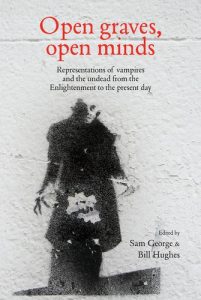
Task 3 produced the most standardised results. The top picks were Extract 2, Extract 5 and Extract 7. Extract 2 was chosen because of its description of the natural world and the use of the sublime, which suggested the setting of Forks in Twilight surrounded by gloomy forests. During the lecture I had described how Angel introduces himself to Buffy as a ‘friend’ but not necessarily her friend (‘Angel’, S1: Ep7). This was echoed in the final section of Extract 2 which students acknowledged. Both Extract 5 and 7 were clearly about vampires, and the highly emotive psychic connection between the vampire and the subject of the text in Extract 5 seemed to suggest a more contemporary interpretation of the vampire myth. Extract 7’s use of delayed gratification brought to mind the drawn-out courtship of Bella and Edward. The tension between desire and fear brought about by the vampire lover echoed Meyer’s presentation of the danger that Edward poses to Bella. Equally, and thinking about Sara Wasson and Sarah Artt’s chapter, ‘The Twilight Saga and the pleasures of spectatorship: the broken and the shining body’, in the Open Graves, Open Minds book, Extract 7 reads as a moment frozen in time – a moment just before the kiss, the bite, the consummation of the relationship – drawing out the sensations of excited anticipation.

This exercise raised some very pertinent points about the use of language within YA Gothic and how this relates to the construction of genre. It also showed that YA Gothic, whilst a relatively new genre, is not without clear antecedents. Rather than being an abomination to the Gothic, YA Gothic builds upon is Gothic heritage but draws more heavily on the youth of its protagonists and contemporary ideas about adolescence.

And for any of you who played along, the sources for these extracts are below.

Answers:

  1. Leopald von Sacher-Masoch, Venus in Furs (1870) (London: Penguin Books, 2006), p. 16.
  1. Ann Radcliffe, The Mysteries of Udolpho (1794) (Oxford: Oxford University Press, 1998), pp. 372-73.
  1. Anne Rice, Interview with the Vampire (1976) (New York: Random House, 1997), p. 205.
  1. Sheridan Le Fanu, Carmilla (1872), in Three Vampire Tales, ed. by Anne Williams (Boston: Houghton Mifflin, 2003), pp. 86-148 (p. 105).
  1. Kate MacAlister, A Girl’s Guide to Vampires (New York: Love Spell, 2003), pp. 43-44.
  1. Jane Austen, Mansfield Park (1814) (London: Penguin Books, 2003), p. 193.
  1. Bram Stoker, Dracula (1897), in Three Vampire Tales, ed. by Anne Williams (Boston: Houghton Mifflin, 2003), pp. 149-460 (p. 182).
Posted in Critical thoughts, Generation Dead: YA Fiction and the Gothic news | Tagged , , , , | 1 Comment

Angela Carter: Wolves and other beasts

I won’t apologise for another post on the brilliant Angela Carter! This is an excellent article by Kat Ellinger on the wonderful Neil Jordan/Angela Carter collaboration The Company of Wolves. It shows how the source material of the film derives from Carter’s many beast transformations in other stories, not just those in The Bloody Chamber, and looks at the cinematic influences from Czech surrealism and suchlike.

Posted in Critical thoughts, Reviews | Tagged , , , , , , , | Leave a comment

Stacey Abbott, Undead Apocalypse: Vampires and Zombies in the 21st Century

Dr Stacey Abbott of the University of Roehampton is well-known for her work on Buffy, Angel, and other cult TV series, and for research into various cultural manifestations of the Undead. She has also been a valuable participant in OGOM projects from our very first conference and publication. Her new book, Undead Apocalypse: Vampires and Zombies in the 21st Century, looks extremely interesting and illuminating, and explores the recent transformations of these figures in film and TV. Stacey is in a fascinating conversation here with Rhys Tranter on his excellent website (a trove of cultural information–well worth following).

Posted in Books and Articles, Interviews | Tagged , , , , , , | Leave a comment

Choose Life, Choose Love. Claire Anderson on Zombie Novel ‘Generation Dead’

I am very happy to post another insightful introduction to Dan Waters’s novel from one of my ‘Generation Dead: YA fiction and the Gothic’ students Claire Anderson. Claire completed the module in 2015-16. This is very readable and engaged. I hope you enjoy it. It should inspire those students taking the module with Kaja this year who will submit their own introductions for assessment in November.

Claire Anderson

Critical Introduction to Dan Waters’s Generation Dead with Suggested Further Reading

Dan Waters and Generation Dead

Generation Dead is Dan Waters’s debut novel, published in 2008. It could be described as a paranormal romance with a high-school setting, though it is certainly much more than that. Waters uses the emerging figure of the zombie as a means of interrogating not only adolescent concerns, but wider issues of humanity and identity; therefore appealing to a vast audience of all ages and backgrounds. Waters was inspired to write Generation Dead through a deep reaction he had to witnessing the phenomena of teen video-violence, where he saw the inhumane acts of human beings attacking one another to generate views on sites such as Youtube. In an interview for ‘teenink.com’ Waters shared that ‘writing about human cruelty via zombies was my brains way of coping with subject matter that, frankly, scared me to death.’[1]

Physical violence visually described can epitomise discrimination and Waters interrogates this within Generation Dead, but there are the unseen implications of discrimination which he also unearths, just like a zombie from the grave. The effects of limited political rights, for example, and the power of the language of prejudice. Groups of people, most often minorities, have always been and continue to be, persecuted throughout the world (whether concerning race, gender, sexuality, physical disability, mental disability, class, or culture). Waters is sending his heart out to all of their struggles through this story.

When asked in the interview for ‘teenink.com’ whether there was a message within Generation Dead Waters replied:

In my mind, the book is more about raising questions than giving answers or imparting messages […] that said, the one message that I’d be really, really pleased that people take away from the book is to be kinder to each other, […] if the book keeps one person from being bullied or a future Youtube victim then I guess I can claim rights to having a message.[2]

Clearly Waters is a sensitive soul who cares deeply about humanity and is using his talents as a writer to interrogate serious issues. Generation Dead is a great read for all audiences, but is definitely deserving of further scholarly attention, primarily for its use of the ‘sympathetic zombie’ as a symbol to tackle ‘identity politics’ and what it really means to be human and to love.

The Emergence and Evolution of the Zombie Figure

The zombie’s origins can be traced back to the folklore and culture of Haitian voodoo, and are first represented in this way within literature by William Seabrook in The Magic Island, published 1929. Seabrook was an American explorer and occultist who documented his travels in Haiti and subsequently introduced the figure of the zombie to western culture through his book. His writings inspired the first zombie film, White Zombie, which was produced by Victor and Edward Halperin and released in 1932. This first zombie concept was characterised by the idea of a wizard figure or ‘witch-doctor’ manipulating the subject and using them as a mindless tool for their own ends, which given the U.S. occupation of Haiti during 1915-1934 suggests that ‘the Haitian zombie is deeply embedded within the historical imaginaries of slavery and colonialism.’[3]

Later, George A. Romero re-conceptualised the zombie figure within his series of films beginning with Night of the Living Dead in 1968 and through to Survival of the Dead in 2009, wherein he ‘severed the figure from its Caribbean origins’[4] and in a sense brought the zombie to America. He removed the witch doctor concept and focused more on innate brutality and desire, creating a truly terrifying zombie. This image of the zombie has featured popularly within film and created a legacy for George A. Romero as a father of the zombie figure. Within Generation Dead one of the many names used to refer to the zombies is the ‘Children of Romero’ which pays homage to this zombie ancestry. Although the zombie does have its legacy, it has had more of a ‘film-centric focus’[5] as opposed to a literary one. Yet despite the zombie figures success within film, it has still been overshadowed by its relatives; the vampire figure and the werewolf figure, which have both been far more prominent within literature and film. These three figures each have a common purpose, in that they stand as a representation for the ‘Other’, but it has been argued that the vampire and werewolf are easier figures to ‘romanticise’ as ‘vampires symbolize sex and embody hedonism and werewolves symbolise the struggle between civilised and barbaric man, [but] zombies are death. They embody it and represent it simultaneously. […] They frighten us not because they will kill us, but because they are death itself, arriving not with a bang, but with a moan.’[6]

The previous quote’s allusion to T.S. Eliot’s Wasteland leads nicely on to how the zombie figure relates to Postmodernism. In Clive Bloom’s Day of the Dead, he asserts that the ‘living dead [zombies] are the perfect postmodern symbol, a blank on to which any contemporary fear may be inscribed. Zombies are us.’[7] Certainly with the expansion of capitalist mentality, which in a sense is already in a mode of global colonisation, the figure of the zombie as a slow moving, self-serving, brain-less entity could be seen to represent humanity. In Generation Zombie Stephanie Boluk and Wylie Lenz have suggested that ‘as it stands at the end of history, the zombie is simultaneously a vision of capitalism’s fulfilment in the form of a stasis of perpetual desire, as well as a model of proletarian revolution, depicting the emergence of a new class-less society.’[8] This new class-less society they mention has not been given much hope through the zombies past representation, which is why a text like Water’s Generation Dead is of paramount importance in planting that seed of hope. Creating a sympathetic zombie and showing how they can be integrated into society is ultimately a way of metaphorically reviving humanity through showing that love is the epitome of what it means to be human.

 The Zombie and Identity within Generation Dead

Before focussing on the Zombie and its relation to identity, we need to first make mention of the Gothic and its relation to adolescence and how Waters portrays this within Generation Dead.  Alison Waller in Constructing Adolescence in Fantastic Realism has described adolescence as ‘always “other” to the more mature stages of adulthood, often perceived as liminal in transition’[9] which may explain why it so closely relates to the Gothic mode which is arguably all about “otherness”. Gothic has become much more than a category to some, it has become a sub-culture. In Raymond William’s Culture and Society 1780-1950, he outlines the evolving definitions of ‘culture’ and concludes that as a term it has grown to represent ‘a whole way of life, material, intellectual and spiritual’[10] and that it has also come to be ‘a word which often provoked either hostility or embarrassment’[11]. The main character Phoebe belongs to the Goth subculture — an often overlooked and misunderstood minority, which is an interesting position to place the protagonist in. Sub-culture might not always be considered to belong to the same category as some of the other groups which are discriminated against, but the hate-crime resulting in the death of Sophie Lancaster in 2007[12] (the year before Generation Dead was published) is certainly proof of the seriousness about blind discrimination towards sub-cultures. The artwork for the cover of Generation Dead is a single black rose, which may serve as a subconscious foreshadowing of the poem later published for/about Sophie Lancaster written by Simon Armitage in 2012 which was titled ‘Black Roses’.

The Gothic subculture revolves around the element of performativity, and within Contemporary Gothic Catherine Spooner describes the dark/morbid dress as articulating ‘a tension between mainstream mass entertainment and a subcultural rebellion’[13], going on to explain that ‘through clothing, the imperatives of consumerism and the pleasures of performance intersect’.[14] The picture of Gothic subculture that she presents represents both a form of peaceful protest as well as a longing for identity, which correlates with the struggle that the zombies within Generation Dead face. Interestingly though, the zombies and the Goths don’t automatically come together through similarity, in fact we are told that  ‘The goth look wasn’t nearly as popular as it once was, probably due to the appearance of the living impaired, but to Phoebe that just gave the style a subtle hint of irony’.[15] Perhaps though this just goes to show that the Gothic subculture may have more in common with the vampire figure than that of the zombie, as Clive Bloom and many others tell us, ‘vampires are the undead, but zombies are the living dead.’[16] It seems that Phoebe feels empowerment through her style and a sense of uniqueness which is certainly more in line with the immortal status of the vampire than that of the disempowered decaying zombie. The descriptions we are given of her also conjure up visuals of iconic vampire imagery, such as her ‘funerary clothing’[17] and ‘long dark hair’[18], both reminiscent of the character Morticia Addams from the 1964 television series and the 1991 film The Addams Family. Phoebe is also given the fitting nickname of ‘Morticia Scarypants’ by Pete Martinsburg which further supports this intertextual reference.

There are many  intertextual references to Goth subculture throughout Generation Dead which the reader can look out for, including gothic music, such as The Creeps and other imaginary artists fabricated in a humorous fashion, such as M.T Graves and his solo album ‘All the graves are empty except mine’.[19] But the portrayal of gothic subculture is most specifically made through Phoebe and her friends. Phoebe refers to herself and Margi as ‘weird sisters’[20] to which Margi replies ‘minus one’ implying that Collette was the third weird sister in reference to Shakespeare’s Macbeth.

The zombies also stand as a symbol for discrimination against disability – both physical and mental.  And the Hunter Foundation within the text seems to be at the core of inspiring discussion about marginalising different or disabled people particularly through language use. Angela Hunter when giving a speech at the school outlines all the pejorative terms used to describe the zombies, such as ‘zombies, corpsicles, dead heads, the undead, worm food, shamblers, the living dead, [and] the Children of Romero’[21] many of which imply limited cognitive or physical ability. Angela Hunter goes on to describe how ‘In much the way that the term handicapped was widely recognized as being insulting to differently abled persons, so too is living impaired an insult to those who live differently biotic lives’.[22] The Hunter foundation however might not be as genuine as it seems in their intentions, despite drawing attention to how categorically using language leads to segregation, they themselves actually are guilty of the same thing, in coining the term ‘differently biotic’, it seems that Waters is suggesting that categorical language is a device of segregation, and perhaps we should all just be seen as primarily human. The Hunter Foundation seeks to find ways of improving the zombies functioning and assimilation into society, but in a discussion later in the text between Phoebe and Tommy, he explains to her why those who come back with limited abilities struggle so much, and that it is because of lack of love. He mentions how Colette’s parents ‘skipped town when she came back’[23] and Phoebe’s own guilt for abandoning her friend resonates silently, which perhaps could serve as a message that different or disabled people could thrive within society if they were shown acceptance and love.

Gender is also explored within Generation Dead, albeit in a subtle way. Karen is an interesting character in that, like Tommy, she is less distinguishable as a zombie through her more human traits and characteristics, such as her beauty and movement. Bill Hughes in ‘Legally recognised undead: essence, difference and assimilation in Daniel Waters Generation Dead’ mentions that there is ‘a hint of sexual ambiguity’[24] surrounding Phoebe’s attraction to Karen, which being present in a casual way adds weight to the normality of sexual attraction between the genders and steps away from the discrimination of essentialism. Margi’s attitude towards Phoebe’s attraction to Tommy in the beginning further highlights the closed-mindedness of believing that love can only blossom in essentialist terms, which also mirrors the attitudes many people have about same-sex relationships.

Tommy as a character has served as a malleable and powerful device within Generation Dead, providing a point of reference for an array of struggles. But perhaps most powerfully he represents racial struggle. The civil rights movement of the 60’s was a pivotal moment of change within America which had implications worldwide. Bill Hughes draws attention to the parallels between the struggles of Tommy Williams as a zombie wishing to be on the football team, and those of athletes such as Jesse Owens[25] who were also treated unfairly because of race irrespective of talent. Not only is this paralleled through the audience’s reaction to Tommy, but also through the other players and most sinisterly, through the coach, who even goes as far as threatening Adam with being kicked off the team for showing comradery to a fellow team player who happened to be a zombie.[26]  The use of Tommy’s blog adds an emotional dimension to the text as the shred blog posts are articulate and heartfelt. One post in particular where Tommy explains his struggles with the football team and his decision to leave he says, ‘I wish I could tell you what I’m sure many of you would like to hear – that I threatened him, that I frightened him with the promise of an undead horde visiting him in the night. But I didn’t. I offered to quit.’[27] Through this commendable form of peaceful protest, coupled with the religious rhetoric which is infused within Tommy’s blog posts, we are reminded of Martin Luther King’s peaceful and religious approach to campaigning for change during the civil rights movement. The importance of the use of Tommy’s blog within the text is strengthened even further as it extends beyond the book and has become a work in its own right. Waters has continued Tommy’s blog at ‘mysocalledundeath.com’ which is an excellent way of getting the modern day readership more involved and really bringing his characters to life (or back to life…) And of course it can’t be denied that the enormity of the internet in this age and how it has contributed many negatives to the world, such as teen video-violence, should also be harnessed for the spreading of positivity. Brendan Riley in The E-Dead Zombies in the Digital Age, has suggested that the internet is highly tied to the modern zombie figure, saying that ‘more people have been infected by global digital virus pandemics than have been harmed by biological ones (though no one has died, yet, from an internet virus)’.[28]

Choose Life, Choose Loveis the message Waters chooses to summarise his Generation Dead series in an interview for Fantastic-Book-Review[29], which is of course an intertextual reference to Irvine Welsh’s Trainspotting (1993) but is also more than that, Waters is telling us that life is love.

 Suggested Further Reading

Daniel, Waters, Kiss of Life (London: Simon and Schuster, 2009)

Daniel, Waters, Passing Strange (London: Simon and Schuster, 2010)

Daniel, Waters, Stitches (London: Simon and Schuster, 2012)

Daniel, Waters, Break My Heart 1000 Times (New York: Hyperion, 2012)

Daniel, Waters’ personal blog http://www.danielwaters.com

Daniel, Waters, Tommy’s blog http://www.mysocalledundeath.blogspot.co.uk

Sam, George and Bill Hughes, Open Graves, Open Minds: Representations of Vampires and the Undead from the Enlightenment to the Present Day, (Manchester: Manchester University Press, 2013).

www.opengravesopenminds.com  and the University of Hertfordshire’s involvement with the project through Sam George’s modules.

Joni Richards, Bodart, They Suck, They Bite, They Eat, They Kill: The Psychological Meaning of Supernatural Monsters in Young Adult Fiction (Washington: Rowman and Littlefield, 2011).

Fred Botting, ‘Love Your Zombie: Horror, Ethics, Excess’, in The Gothic in Contemporary Literature and Popular Culture (London: Routledge, 2014).

Clive, Bloom, ‘Day of the Dead’, Times Higher Education (2010), http://www.timeshighereduction.com/features/day-of-the-dead/412166.article.

Stephanie, Boluk and Wylie, Lenz, Generation Zombie: Essays on the Living Dead in Modern Culture, (North Carolina and London: McFarland &co. Inc, 2011).

Notes

[1] Writes, Chrissi, Generation Dead Book Review and Author Interview by Daniel Waters, http://www.teenink.com/reviews/book-reviews/article/178181/Gerneration-Dead-Book-Review-Author-Interview-Daniel-Waters/, (accessed: 30/05/16).

[2] Ibid.

[3] Boluk, Stephaine, and Lenz, Wylie,’Introduction’, Generation Zombie: Essays on the Living Dead in Modern Culture (North Carolina and London: McFarland &co. Inc, 2011). P3-4.

[4] Ibid, p.5.

[5] Ahmad, Aalya, ‘Gray is the New Black: Race, Class, and Zombies’, Generation Zombie: Essays on the Living Dead in Modern Culture (North Carolina and London: McFarland &co. Inc, 2011). P.130.

[6] Riley, Brendan, ‘The E-Dead Zombies in the Digital Age’, Generation Zombie: Essays on the Living Dead in Modern Culture (North Carolina and London: McFarland &co. Inc, 2011). P.196.

[7] Bloom, Clive, ‘Day of the Dead’, Times Higher Education (2010), http://www.timeshighereduction.com/features/day-of-the-dead/412166.article.

[8] Boluk, Stephaine, and Lenz, Wylie,’Introduction’, Generation Zombie: Essays on the Living Dead in Modern Culture (North Carolina and London: McFarland &co. Inc, 2011). P.7.

[9] Waller, Alison, Constructing Adolescence in Fantastic Realism (Oxfordshire: Routledge, 2009). p.1.

[10] Willliams, Raymond, Culture and Society 1780-1950 (London: Doubleday, 1960). P.14.

[11] Ibid.

[12] http://www.sophielancasterfoundation.com/

[13] Spooner, Catherine, ‘Teen Demons’, Contemporary Gothic (London: Reaktion books, 2006). p.87.

[14] Ibid.

[15] Waters, Daniel, Generation Dead (London: Simon & Schuster, 2008). P.46.

[16] Bloom, Clive, ‘Day of the Dead’, Times Higher Education (2010), http://www.timeshighereduction.com/features/day-of-the-dead/412166.article.

[17] Waters, Daniel, Generation Dead (London: Simon & Schuster, 2008). P.30.

[18] Ibid.

[19] Ibid. p113.

[20] Ibid. p.114.

[21] Ibid. p.101.

[22] Ibid. p.102.

[23] Ibid. p.380.

[24] Hughes, Bill, ‘Legally Recognised Undead: Essence, Difference, and assimilation in Daniel Waters Generation Dead’  in Sam George and Bill Hughes Open Graves, Open Minds (Manchester: Manchester University Press, 2013), pp. 245-263.

[25] Ibid.

[26] Waters, Daniel, Generation Dead, (London: Simon & Schuster, 2008). P.57.

[27] Ibid. p.233.

[28] Riley, Brendan, ‘The E-Dead Zombies in the Digital Age’, Generation Zombie: Essays on the Living Dead in Modern Culture (North Carolina and London: McFarland, 2011). P.197.

[29] Interview by Fantastic-Book-Review with Daniel Waters concerning Generation Dead, http://www.fantasticbookreview.co,/2009/05/author-interview-daniel-waters.html.

Posted in Generation Dead: YA Fiction and the Gothic news | Tagged , , , | Leave a comment