How Old Are Vampires Really? Body of 500 Year Old Vampire Inspires New Debate

The body of a five hundred year old ‘vampire’ will go on display in an ancient cemetery in the town of Kamien Pomorski this month. The vampire corpse was discovered two years ago in Northern Poland and is currently being debated again in the British Press. Archaeologists have confirmed that it has a stake through its leg (presumably to prevent it from leaving its coffin) and a rock in its mouth (to stop any unfinished blood sucking).
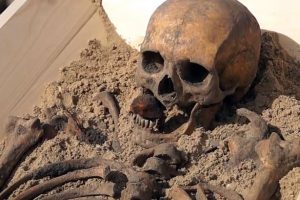
PAY-Vampire-Skeleton

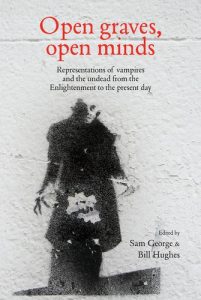
The discovery of this vampire corpse interests me on a number of accounts. One of the first questions I ask my ‘Reading the Vampire’  MA students when embarking on our journey into literary vampirism is how old are vampires really? Do they have a country of origin? When was the first literary vampire? When did the word ‘vampire’ first enter the English language? Also how does one become a vampire according to early folk belief?

In the earliest accounts vampires are revenants or returners, often taking the form of a diseased family member who reappears in the unfortunate guise of a vampire. ‘Unfinished business’, even something so trivial as the want of clothing or shoes, is enough to make the dead return to the world of the living. Agnes Murgoci (1926) argues that the journey from death to the afterlife is a perilous one and there is a belief in Romania that it takes forty days for the soul of the deceased to enter paradise. In some cases it may even linger for years, the thought of which creates great anxiety within families and during this time there are a myriad of ways that deceased family members can succumb to vampirism. A number of which are listed by Petrovici in his study of the Romanian folkloric vampire (1982).  Dying unmarried, dying unforgiven by one’s parents, dying a suicide, a murder victim, having a breeze blow across a corpse before burial, having a dog or cat walk under or over a corpse before burial, leaving a mirror facing into a room, not turned to the wall at this precarious time, or even simply being a bad person. Any of these factors can lead to a person returning as a vampire.

The precautions taken in the recently discovered vampire burial in Poland do cohere with practices that I know about, such as piercing the corpse, nailing down the tongue, putting a needle in the heart and placing small stones and incense in the mouth and under the finger nails to stop blood sucking and clawing. This vampire corpse dates back to the 1500s and it might go some way towards answering the question how old are vampires really? I have always wondered if vampires are ‘as old as the world’, as Frayling has claimed or whether they are born in the eighteenth century when the first European accounts by Dom Augustine Calmet and Joseph Pitton de Tournefort appear. Calmet’s Treatise on the Vampires of Hungary and Surrounding regions was published in French in 1746 and in London in 1759, eventually appearing as The Phantom World in 1850. Tournefort’s Voyage to Levant  dates back to 1702. This text always excites my imagination as it combines my three research strands, botany, vampirism and eighteenth-century literature in ways I had never imagined (apart from maybe in the work of Rousseau).  In Myconos a botanising man of science comes face to face with a plague of bloodsucking vampires. Greece, and Hungary feature prominently in early accounts and this is mirrored in Romantic literature when Byron makes Greece the setting of his unfinished vampire story A Fragment published in 1819.

The British Vampirologist Montague Summers (1880-1948) referred to vampires as ‘citizens on the world’, a phrase taken from Goldsmith. They exist for him outside of temporal or geographical boundaries, but many recent accounts such as Erik Butler’s (2010), contradict this, locating the vampire in Eastern Europe in the eighteenth century. We do know that 1732 was the vampire’s annus mirabilis. There were twelve books and four dissertations on the subject published over that year, as well as the term’s enshrinement in the English language (though this date again is disputed).  Fifteen years after Tournefort the London Journal reported some enquiries into ‘vampires’ at Madreyga in Hungary (a story later referred to by John Polidori) and thus was recorded the first use of the word in English (according to Roger Luckhurst). The earliest known reference to ‘vampyres’ in English prior to this was thought to be in Travels of Three English Gentleman in 1734 (rpr. 1745) [OED claim]. It is worth noting that Tournefort uses ‘vroucolacas’ (re-animated corpse) but the term ‘vampire’ does appear in English translations of Calmet.  The number of different words for ‘vampire’ can be frustrating for scholars but it provides rich source material for writers. Here are just a few of them:

Krvoijac, vukodlak, wilkolak, varcolac, vurvolak, liderc nadaly, liougat, kullkutha, moroii, strigoi, murony, streghoi, vrykolakoi, upir, dschuma, velku, dlaka, nachzehrer, zaloznye, nosferatu

The history of the vampire is a disputed and uncertain one but the recently authenticated vampire corpse in Poland provides evidence for vampire beliefs and burials as early as the sixteenth century. In providing the links to real life practices of deviant burials archaeology is making a vital contribution to the future of gothic studies. There is little appeal or attraction for these early revenant figures and unlike the English aristocratic vampire (Frayling’s ‘Satanic Lord’) early folkloric vampires are peasants and tend to appear en mass like modern day zombies. Paul Barber describes the folkloric European vampire as

A plump Slavic fellow with long fingernails and a stubbly beard, his mouth and left eye open, his face ruddy and swollen. He would wear informal attire – a linen shroud – and would look for all the world like a dishevelled peasant (Vampires, Burials and Death, 1988)

At this moment in history the troubling sexuality of the nineteenth-century vampire is as yet unexplored.  The story of how the seductive Romantic Byronic vampire comes to leave his calling card in polite society in London in the nineteenth century is beyond intriguing and I just can’t wait to get started on the history of the literary vampire with my new students. If you are beginning the course in the autumn do comment or add any thoughts.

If you’d like to know how vampires transition from dishevelled peasants into alluring aristocrats and how they are then reborn as today’s beautiful undead why not study vampires as part of your MA? There is still time to apply for the MA Modern Literary Cultures online at www.go.herts.ac.uk/maliterature. You can register your interest via the MA Programme Leader Dr Anna Tripp at a.f.tripp@herts.ac.uk. You need to do this by the end of July or beginning of August at the latest and remember don’t leave home without your garlic!
20160725_160742_resized

Posted in MA Reading the Vampire module news, OGOM Research | Tagged , , , | 6 Comments

Museum of Witchcraft and Magic

The Museum of Witchcraft and Magic: this looks a fabulous place and I’ll have to visit it one day.

Posted in exhibitions | Tagged , , | Leave a comment

Maggie Stiefvater events in UK, July-August 2016

The marvellous Maggie Stiefvater, author of YA paranormal romances that transcend the genre with their literary style and complexity, is appearing for three talks in the UK soon–in London, Manchester, and Glasgow. Stiefvater is the author of the excellent Wolves of Mercy Falls werewolf novels, which both Kaja Franck and I have forthcoming chapters on. Shiver, the first book of this series, is a core text on Sam’s Generation Dead YA Gothic undergraduate module. She has also written The Scorpio Races (involving kelpies) and two brilliant dark faerie romances, Ballad and Lament. These talks are to promote the magical Raven Boys series.

Posted in Events, Generation Dead: YA Fiction and the Gothic news | Tagged , , | Leave a comment

Angela Carter: Children’s books and fairy tales

A great piece here from the TLS: Angela Carter reviewing children’s picture book versions of fairy tales with typical earthy wit, bemoaning the toning down of the more brutal aspects of their sources. And a saddening extract from a review on young women in US urban gangs.

Posted in Reviews | Tagged , , , , , | Leave a comment

Travels in Transylvania: Bram Stoker’s Ambiguous Legacy

Last week I was in Romania at the University of Timisoara for the Beliefs and Behaviours in Education and Culture conference. My keynote was on the representation of Romanian folklore in British and Irish fictions of the undead. Stoker never travelled to Transylvania, his material for Dracula is entirely informed by the books he was reading from travelogues to histories and importantly for me, folklorist accounts of the region. His knowledge of folklore came from British traveller Emily Gerard’s ‘Transylvanian Superstitions’ (1885) and Sabine Baring Gould’s Book of Were-Wolves (1865). I am interested in how we might assess his ambiguous legacy regarding the representation of Transylvania in twenty-first century fiction (in particular in intertextual writings such as the YA gothic genre). Amongst the other plenaries were Prof. Ingrid Schoon, presenting on ‘Diverse Strategies and Successful Adaption in the Transition to Adulthood’, which I found useful for teaching my Young Adult Fiction module which explores adolescence, and Prof. Clive Bloom whose paper was entitled ‘Dracula and the Pyschic World of the East End of London’. 

I also gave a presentation on the Open Graves, Open Minds project at an educational workshop with Dr Marius Crisan. Marius is the author of the Birth of the Dracula Myth: Bram Stoker’s Transylvania (2013). I first met him at the Bram Stoker Centenary celebrations in 2012. He is a gracious and kind host and a dedicated teacher of Romanian literature.

Prof. Bloom had some potentially ground breaking material to share with us about an Icelandic version of Dracula that was published in 1901. The book which translates as ‘The Power of Darkness’ has a preface by Bram Stoker, but the story is different to the Dracula we know. In this version Dracula is the same person as Jack the Ripper and the murders are described as ‘butcher work’. There is much more of a focus on the East End of London, in particular on prostitution and uncleanness, or lack of purity. Prof. Bloom will elaborate on these findings at the Dracula conference in Dublin in September. This is very interesting indeed as it would appear to anticipate shows such as Penny Dreadful and postmodern works such as Newman’s Anno Dracula both of which mash-up the characters of Dorian Gray, Dracula, Jack the Ripper etc. to great effect. How strange it would be if Stoker had intended this all along. My only reservation is that in relocating the killings to the East End of London during the reign of Jack the Ripper the supernatural elements of the vampire myth are severely undermined. It will be interesting to see how this is received in Ireland in the autumn.

After the conference there was time for excursions to the countryside in ‘The Land Beyond the Forest’, to the Banat region where I encountered some woodland houses that would not be out of place in a fairy tale.

20160625_095509_resized_3

20160625_101427_resized_1

There was also a beautiful eighteenth-century church made of wood, with paintings and religious icons.

20160625_104614_resized_2

20160625_104142_resized_1

20160625_103849_resized_2

I was struck by how plentiful the country is, everywhere is full of walnut and cherry trees and there are grape vines growing in every porch. I even saw melons and skeps for bees and of course the plums from which they make their famous brandy known as pălincă.

20160625_104758_resized_1

20160625_095909_resized_4

The town of Timisoara is important to the history of Romania. It was gifted a striking statue of Romulus and Remus suckled by a She-Wolf to mark its relationship with Rome. It was here that Ceauceascu opened fire on civilians and disappeared the people who opposed him. If you look closely at the buildings in the main square you can see that they are riddled with bullet holes and there is a plaque honouring those that died outside the cathedral below. Ceauceascu reputedly banned the novel and film of Dracula so those coming of age in Romania in the 1980s would not be familiar with the country’s most infamous resident.

20160623_190502_resized_1

20160623_194654_resized_1

20160623_194749_resized_1

I want to thank Dr Marius Mircea Crisan and Dr Roxana Andreea Toma for their kind hospitality and for introducing me to some wonderful Romanian cuisine. We joked about Harker’s comments about Transylvanian food in Dracula. References are made to robber steak, paprika stew, eggplant stuffed with forcemeat (‘impletata’) etc. but it is clear that he never tried the Banat pancake or he would most certainly have noted the recipe for Mina!  This is from the region of South West Romania, known as Banat, it reflects the rich and exotic history of the place. The pancake is baked in the oven, stuffed with raisins, vanilla, and quark cheese, and topped with walnuts and a fluffy light meringue. It really does have the power to transport you to a world that can only be imagined (until you have journeyed there).  Needless to say, I thoroughly enjoyed my trip (my second to this region), and I’m inspired to continue my research into folklore and fiction.  Transylvania did not resemble ‘The Dark Side of Twilight’ but I did find myself at ‘the centre of some sort of imaginative whirlpool’, in a land full of wonder where castles are commonplace and people are not afraid to dream.

20160627_201245_resized

Tell not a breath of how I met my death,

Say I could not tarry, I have gone to marry

A princess – my bride is the whole world’s pride

(From ‘The Miorita’, the Romanian folksong represented in Marcus Sedgwick’s novel, My SwordHand is Singing, p. 33).

Posted in Conferences, Critical thoughts, OGOM News, Reviews | Tagged , , | 4 Comments

Strange Worlds: The Vision of Angela Carter, RWA, Bristol, 10 Dec 16 – 19 Mar 17

Angela Carter is a key figure in the OGOM Project (as you might guess from the many postings here about her). Her explorations of the marvellous and the fabulous, her intertextuality and play with genres, her concerns with the metamorphoses of animality and humanity, her role as a putative ancestor of paranormal romance (as I argue elsewhere) all resonate with our interests.

This exhibition at the RWA in Bristol of art which inspired her and art inspired by her, plus other artefacts such as manuscripts and photographs, looks fascinating.

Posted in exhibitions | Tagged , , , | Leave a comment

Folklore Thursday

We’ve been following Folklore Thursday‘s entertaining and informative Tweets for some time now. As the name suggests, they post snippets on folklore-related themes every Thursday, using the hashtag #FolkloreThursday. They have been supporting the OGOM blog (with much OGOM material in the archives on their site) and we’d like to reciprocate that support. Sam will be posting an article on their activities very soon.

I’ve added a link to their website in the Related Links panel on the right-hand side here (and on our Resources page). They are well worth following and the website is very attractive.

There’s an interesting article here on the whole phenomenon of Folklore Thursday.


Posted in Resources | Tagged , , , , | Leave a comment

Folk Horror: Blood Sucking Vampire Goat Terrorises Village

Following my recent post on folk horror and the appearance earlier this year of the Hull Werewolf Old Stinker, who sparked a folk panic in the UK, stories are breaking that a legendary Chupacabra has been caught and killed in the Ukraine with a pitchfork. This beast is a vampiric bloodsucking goat that feeds off livestock. The goat-sucker’s name comes from ‘chupar’, ‘to suck’, and ‘cabra’, ‘goat’. It  is a creature that can be found in the folklore  of the Americas, with its first purported sightings reported in Puerto Rico.

As in the case of the Hull werewolf, there are numerous sensational reportings and even pictures of the dead body of this folkloric creature in the press. This troubling picture comes from The Daily Mail’s feature, typically entitled ‘legendary mysterious blood sucking beast’. 

35B8A17A00000578-3662452-image-a-22_1467040939226

It does look otherworldly (more kangaroo than goat perhaps). The same story of the ‘Terrifying Chupacabra beast captured and killed by a pitchfork wielding villager’ appears in The Sun

Well now I have even more reason to fear goats. Following this, Black Phillip (below), who is becoming a regular feature on this blog, and sightings of my neighbour’s demonic goat door knocker (also below), Heidi is seeming a distant memory. There is quite a lot of unsettling material on goats as threat, as shapeshifters, as demonic etc. in my book Animals in Folklore edited J.R.Porter and W.M.S. Russell. I am keeping a close eye on this blood sucking goat story. Don’t leave home without your pitch fork!!


35B8A19500000578-3662452-image-a-23_1467040952213

CjZCIPlWsAA32krblack peter index

Posted in News, OGOM News, Reviews | Tagged , , , | 3 Comments

Who’s Afraid of the Big, Black Cat?

On Saturday my partner and I adopted two kittens from Mitcham Cats Protection league. On our arrival we were asked if we had any preference to the appearance of the cats we were going to adopt. Our answer was no. The next question was: Were we okay with black c20160621_215346-1ats? My reaction was a little non-plussed. I’m from a cat family and I’ve grown up around cats and usually black cats. (There was Fatty, Fatboy aka Fatty Jnr – and the reason why you don’t ask four year olds to name cats, and currently my parents have Adam and Acorn). The question piqued my interest: both my ‘Give me all the kitties, please’ and academic interest. I’d heard this theory before but wasn’t convinced. It seemed ridiculous. (Though I had noticed that there were plenty of black kittens listed on the website). So I asked whether it was true then that black cats weren’t adopted as often? The answer was yes and to prove it I found the postcard pictured above encouraging people to adopt a black cat.

Of course my reaction to this, other than to immediately adopt two black kittens, was to head home for research. It would appear from multiple sources that it does seem to be the case that black cats are adopted less regularly. (You can read about it here, here and here). However I also read one source that suggested though it appears to be the case that black cats (and dogs) are adopted less regularly the numbers don’t seem to add up and it may simply be a case of this myth proving itself. Thus animal shelters read the pattern onto random cases rather than reviewing all the information. Yet even if it is simply that people perceive black cats as being less likely as adopted, reading that pattern onto the situation must be based on a certain idea about what black cats symbolise.

The reasons put forth about why black cats are not adopted are varied. Some people suggest that it is because they do not show up as well in pictures so aren’t as tempting to people viewing them on websites. However most people agree that the reason is the superstitions associated with black cats. In particular the idea that black cats are omens of ill fortune and associated with witches. It is hard to verify just how old the relationship between witchcraft and cats is. Certainly there are accounts of cats being counted amongst familiars in witchcraft trials during the sixteenth and seventeenth centuries. However as with most aspects of folklore the definitive relationship – in this case between black cats and witchcraft – seems to come after the historical accounts. Moreover this relationship is often consolidated in more recent popular culture. (Think Bram Stoker’s ‘The Squaw’ (1914) or, more recently, Salem in Sabrina the Teenage Witch (1996-2003) and Thackery in Hocus Pocus (1993)).

This myth about the black cat has an even more pernicious embodiment in contemporary society however: the belief that black cats are at risk of being sacrificed on Halloween. Whilst this has been debunked, it is still the case that many animal shelters will not allow people to adopt black cats in the run up to Halloween. (As pointed out this is partially because people adopt them as ‘props’ for their witch costume). Though black cats are not being sacrificed by satanic cults for Samhain, there have been disturbing accounts of cats being killed. Most recently there were a large number of cats decapitated in Croydon. This leads me to my next thought: it’s not just black cats but cats in general that invoke an unpleasant reaction.

Cats have a reputation for being unemotional, disloyal, hard to read, indecisive, cold and unloving. They are deemed to be not as domesticated as dogs. The tales of cats sitting by their master’s graves are few and far between. Humans have tendency to create ‘types’ and seek patterns in the animals with who we share our lives. The cat is a symbol of independence. It also has a certain stand-offishness. In one of my MA essays I considered this perception of cats in particular in relation to philosophers. My research was as follows:

“There is an accepted truth about cats that they are somehow independent; the incarceration of big cats within zoos is often the one which causes the most perturbation since it is, apparently, universally acknowledged that big cats need massive areas in which to roam. The image of the big cat caught behind bars inspired Ted Hughes’ The Jaguar and Rainer Maria Rilke’s The Panther; though these poems are not necessarily concerned with the reality of ‘catness’, they relate to the symbol of the big cat and tie in with the clichéd idea that surrounds cats.[1] Hughes’ jaguar becomes a totem of shamanic power that is not limited by physical entrapment whereas Rilke’s panther suggests the prisoner, broken by years of having his freedom denied. Nor is the importance of the cat limited to artistic interactions; they have long been seen as the philosopher’s animal. Both Derrida and Montaigne wrote about the manner in which their pet cats questioned the concept of what it was to be a human-animal and what it was to an animal. Yet, as Erica Fudge asks, ‘why a cat?’ to which she immediately answers ‘a cat is much less easily tamed … rather than constructing the domestic sphere a cat might well be understood to challenge it’.[1] Mary Midgley draws the same conclusion suggesting that cats ‘are notoriously still not sociable or docile in quite the same way as dogs’.[2] Timothy Findley draws on this important aspect of the cat when recollecting his many cat companions; he suggests that each of his cats ‘had tremendous dignity – a kind of reluctant aloofness’.[3]

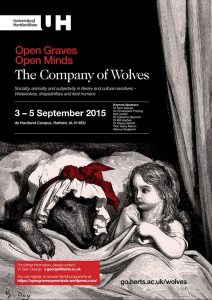
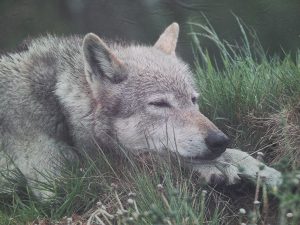
The idea of the cat as the philosophers animal finds its modern day counterpart on Twitter with #AcademicsWithCats. So why does this interest me so much? Well, at the moment I am looking at how the figure of the wolf has been constructed and what impact this has had on its relationship with humans. The relationship between wolves, the wilderness and werewolves ties in with the growing field of ecoGothic. How nature has been constructed in Gothic narratives is something which I find compelling – especially in relation to the animal as Other. My brief look at black cats, and cats more widely, has made me wonder whether this might not be my next area of research post-PhD. With this in mind, I would love any suggestions for texts that might be useful. So feel free to comment below.

As for my kittens. Well, they are small and black with a penchant for catching flies. They are called Freddy and Jason. Yes, that Freddy and Jason. We didn’t name them. Instead, I allowed a modicum of superstition into my life by deciding it was Fate sending us a sign that we simply had to adopt two tiny terrors.

freddy vs jason


Footnotes:

[1] Erica Fudge, Pets (Stocksfield: Acumen, 2008), p. 79.

[2] Mary Midgley, Animals and Why they Matter, p. 113.

[3] Timothy Findley, From Stone Orchard: A Collection of Memories (Toronto: HarperCollins Publishers, 1998), p. 81.

Posted in Critical thoughts | Tagged , , , | 5 Comments

Summer of 1816: Creativity and Turmoil

What a fabulous conference Summer of 1816: Creativity and Turmoil at the University of Sheffield was! Brilliant organisation by the wonderful Angela Wright and Madeleine Callaghan. I’m feeling that post-conference melancholy. Met some great new people and caught up with Adam James Smith, Hamish Mathison, Carly Stevenson, Kathleen Hudson, Kate Gadsby-Mace, Dale Townshend, Anthony Mandal, Anna Mercer, OGOM’s very own Matt Beresford (presenting on Byron and Polidori) and more (sorry if I’ve missed you off!), all lovely people and brilliant scholars. I missed many papers, unfortunately, but what I heard were great. The plenaries were eloquent and thought-provoking: Michael O’Neil explored the dialogic interplay between Percy Shelley, Mary Shelley, Byron; Jane Stabler had us all unexpectedly moved over Mary and Byron’s manuscripts and the emotional turmoil behind Mary’s transcription of Byron’s poems; Jerrold Hogle‘s tracing of the shifting Gothic Image through the creations of this period was fascinating and full of the generosity that characterised the conference.

It’s so inspiring to be in a community of people from all over the world, fired with internationalism and mutuality, enthused with the value of literature, which, to me, is the highest manifestation of what makes us wonderfully, distinctively human, language. And in a parochial climate that reviles intellectualism and expertise, knowing that the Enlightenment spirit of polite rational discourse endures gives me hope.

Posted in Conferences | Tagged , , , , , | Leave a comment