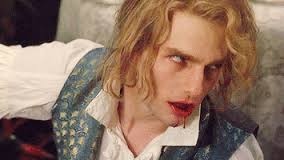
Gentleman Death in Silk and Lace: Lestat to debut on Undead TV

Fans of Lestat and of  Undead  TV must surely be celebrating today. I heard through Vanity Fair that Anne Rice is bringing her Vampire Chronicles to television. After regaining the rights to the series, the author and her son Christopher are writing a pilot script together. Lestat really is the most compelling of all vampires, a genuine existentialist and rock star. Satan-like he is always deliciously soliloquising on his own ambivalent evil and he definitely has all the best lines. I am looking forward to discussing Rice with my ‘Reading the Vampire’ MA students in January. 

 images-8  

Here are some of my favourite quotes to get you in the mood:

“I’m Gentleman Death in silk and lace, come to put out the candles. The canker in the heart of the rose.” 

 “The prince is never going to come. Everyone knows that; and maybe sleeping beauty’s dead.” 

“To be godless is probably the first step to innocence,” he said, “to lose the sense of sin and subordination, the false grief for things supposed to be lost.”So by innocence you mean not an absence of experience, but an absence of illusions.” An absence of need for illusions,” he said. “A love of and respect for what is right before your eyes.” 


Posted in MA Reading the Vampire module news | Tagged , , | Leave a comment

Popular Fiction Research Hub

There’s a great Facebook group for all those interested in popular fiction–the Popular Fiction Research Hub. The organisers, Lisa Fletcher, Beth Driscoll, and Kim Wilkins, describe it as :

A meeting place for people interested in research about the writing, publishing, reading and cultures of popular fiction

This group is administered by Beth Driscoll (University of Melbourne), Lisa Fletcher (University of Tasmania) and Kim Wilkins (University of Queensland).

We envision this Facebook group as a low-key affair, which will develop organically as more people join and shared interests emerge.

Please use it to share:
– Calls for papers
– New research projects or publications in popular fiction studies
– Calls for applications for grants, jobs, scholarships etc
– Research or teaching questions
– anything else that you think will be relevant and interesting to the group.

If you’re interested in joining, please email Lisa@Fletcher@utas.edu.au or driscoll@unimelb.edu.au.

Posted in Resources | Tagged , | Leave a comment

CFP: Thinking with Stories in Times of Conflict: A Conference in Fairy-Tale Studies, Wayne State University, Detroit, MI, August 2-5, 2017

Yet another exciting conference–on fairy tale in situations of conflict: Thinking with Stories in Times of Conflict: A Conference in Fairy-Tale Studies, at Wayne State University (whose press publish a great series on fairy tale studies), 2-5 August 2017.

Deadline is 10 January 2017.

Conflict can give rise to violence but also to creativity. In the 1690s, French fairy-tale writers imagined through their fairy tales ideal resolutions to political conflict (Louis XIV’s absolutism), as well as conflict in conceptions of gender and marriage practices. The German tale tradition was transformed by the migration of French Huguenots to Germanic territories after the Revocation of the Edict of Nantes in 1685, which prohibited the practice of Protestantism in France. The German Grimm Brothers drew from the tale tradition to create a cohesive notion of Germanic traditions and to contest French domination in the nineteenth century. Postcolonial writers such as Salman Rushdie, Patrick Chamoiseau, Nalo Hopkinson, and Sofia Samatar draw from wonder tale traditions in ways that disrupt Western narrative traditions. And multimedia storytelling that dips both into history and the fantastic has advanced decolonial and social justice projects. These are only a few examples of the ways in which authors think with stories in times of conflict.

With this conference we hope to bring fairy-tale scholars together to reflect upon the genre in relation to questions that include but are not limited to: migrants and migration in different geographical locations and historical periods; political and social upheaval; and transformations with an eye to alternative futures. One of our goals is to encourage a dialogue between creative and scholarly thinking with wonder tales in times of conflict.

Posted in CFP (Conferences) | Tagged , , , , , | Leave a comment

CFP: Special Issue on the Trickster, Marvels & Tales

CFP– Special Issue on the Trickster

Subversive, deceptive, wily, and comical, the trickster spans national traditions, genres, and historical periods. Often represented as a deity, animal, or human, between upper and lower worlds, the trickster functions as the creator and destroyer of worlds, embodies the sacred and the profane, and brings together the scatological and the spiritual. In other tales, the trickster is a lowly and seemingly unpromising hero or a fool whose antics disrupt the social order only temporarily. A complex figure, the trickster has been deployed in the cause of decolonial and postcolonial resistance in Native American, African, Caribbean, Oceanic, and African American lore, among others. Although the trickster is often imagined to be male, female trickster figures (Scheherazade, the wife of Djuha, Coyote Girl) often challenge the gender norms of their societies.

This issue of Marvels & Tales seeks to explore the various dimensions of the trickster from a wide selection of national traditions, genres, and historical periods, as well as to encourage multidisciplinary approaches to fairy tales and conversations about traditional narrative genres across disciplines. We invite papers of 5,000-7,500 words, relevant translations, and new texts. Please send your submission to Cristina Bacchilega at cbacchi@hawaii.edu or Anne Duggan at a.duggan@wayne.edu.

Deadline: January 31st, 2017
Issue: 32.1 Spring 2018

Posted in Call for Articles | Tagged , , , , | Leave a comment

Strange Worlds: The Vision of Angela Carter, Royal West of England Academy, Bristol, 10 Dec 2016-19 Mar 2017

It’s rare that I don’t post anything on Angela Carter. And so here’s an event, or series of events, in Bristol on Carter that looks really amazing: Strange Worlds: The Vision of Angela Carter. There’s an exhibition of works that inspired Carter and other related material, plus talks and events.

A major exhibition that celebrates the life, work and influences of Angela Carter twenty five years after her death.

In bringing together art and literature, Strange Worlds: The Vision of Angela Carter explores the enormous impact of author and journalist Angela Carter – one of the most distinctive literary voices of the last 100 years.

Echoing Carter’s recurring themes of feminism, mysticism, sexuality and fantasy, the exhibition includes historically significant works by Marc Chagall, William Holman Hunt, Paula Rego, Dame Laura Knight, Leonora Carrington and John Bellany, on loan from major national collections.

The exhibition also features works by major contemporary artists who were either directly influenced by Carter, or who explore themes found throughout her work. These include Ana Maria Pacheco – who will exhibit her macabre and unsettling installation, The Banquet – Alice Maher, Eileen Cooper RA, Tessa Farmer, Nicola Bealing RWA, Marcelle Hanselaar and Lisa Wright RWA.

Delving into the latent meanings of childhood fairytales and the twisted imagery of gothic mysticism, this exhibition pays homage to the dark and compelling drama of Carter’s visual imagination – brutal, surrealist and savage.

The exhibition will include painting, sculpture, drawing, installation, printmaking and film alongside illustrations from Carter’s books, manuscripts, photographs and personal artefacts that give a fascinating and intimate insight into her life and work.

Strange Worlds: The Vision of Angela Carter is curated by Dr Marie Mulvey-Roberts of UWE, and the artist and writer Fiona Robinson RWA. This exhibition is part of Bristol 800 – a city-wide festival that celebrates significant Bristol anniversaries along with other commemorative and special events.

Posted in Events | Tagged , , , , , | Leave a comment

CFP: Re-orienting the Fairy Tale, Kanagawa University, Japan, 29-30 March 2017

This conference on Re-orienting the Fairy Tale, subtitled ‘Contemporary Fairy-Tale Adaptations across Cultures’, looks wonderful and covers the area of research I’m concentrating on at the moment–fairy tale adaptation in various media is a key concern of all of us at OGOM in general. Alas, it’s too far for me, but perhaps others of you will have the opportunity to enter what looks like a splendid cross-cultural dialogue.

This international conference, the first of its kind in East Asia, seeks to re-orient the fairy tale and to advance comparative fairy-tale studies on a global scale. To do so, it will facilitate conversations among fairy-tale researchers with Western and non-Western cultural backgrounds, stage interactive dialogues between critical and creative practices, and connect common threads across different media and disciplines.


Posted in CFP (Conferences) | Tagged , , , , , , , , , | Leave a comment

Fairy Tales, feminism, and strangeness

A handful of interesting items on fairy tale here. First, a very scholarly but readable and fascinating account of the classic English fairy tale, ‘Mr Fox’ (a Bluebeard variant).

Then, there’s a review, ‘A Dwarf Becomes a Wolf Girl in This Fairy-Tale Novel‘ of a new novel Little Nothing by Marisa Silver; the review title gives the plot away a little. It sounds very interesting–especially, of course, in the light of our ‘Company of Wolves’ research interests at OGOM–and steeped in folkloric tradition and motifs.

Next, an article by Zoe Williams that should feed debate, on how fairy tales can and should be revised to promulgate a feminist message. She starts from the new remake with Emma Watson of Beauty and the Beast, a tale that is a crucial germination point for paranormal romance (watching the trailer, the film promises to be visually stunning). I can’t help feeling Williams’s arguments to be somewhat reductive, though, and prefer the controversial ambiguities of Angela Carter’s set of variations on the theme in The Bloody Chamber.

There’s also a brilliant article, ‘Why we love weird fairy tales’ on the sheer strangeness of fairy tales–from Basile’s seventeenth-century Tale of Tales to Carter and others’ contemporary rewritings. I think this strangeness gets suppressed in Williams’s functional approach. (I have a feeling I’ve posted this before, but it’s very interesting and a pointer to much intriguing reading.)


Posted in Books and Articles, Critical thoughts | Tagged , , , , , , | Leave a comment

Snow Queens and OGOM Research

We’re aiming to make the OGOM website a great resource for scholars of the Gothic and fantastic, students, and people in general who are interested in these topics.

One of the things we’re trying out is a repository of all the research that emerges from the OGOM Centre, including public talks, conference papers, articles, and work in progress. I’ve added two pages for this under the Resources menu option. To try out the idea, I’ve made available my recent talk for the ‘The Gothic North’ symposium, ‘Boreal Magic: Snow Queens, Frozen Landscapes, and Restoring Equilibrium in Paranormal Romance’. You can download the talk as a PDF and the slides as a PowerPoint file.

Please don’t hesitate to give us suggestions on how we can improve this–I’m sure there may be more elegant ways of doing this!

Posted in Resources | 2 Comments

Kaja’s Pulp Fiction Werewolves

Kaja and I have both been asked to write features for the Folklore Thursday website. Mine is on vampires and the OGOM project and is very late (sorry Willow) but Kaja’s is out now and is an excellent read. Have a look here Old Tails in New Bottles: Folklore’s Influence on Pulp Fiction Werewolves. Love the FT project!

illustration-for-sabine-baringgoulds-the-book-of-werewolves


Posted in OGOM Research, OGOM: The Company of Wolves | Tagged , , , | 1 Comment

Books of Blood: Adventures in the Archives

I have been in the archives of the Wellcome Collection housed at the Science Museum this week to finally view the objects we have shortlisted for our Books of Blood Exhibition and Festival. The objects are kept behind locked doors in giant safe-like rooms in an old Post Office Savings Bank near Olympia. The entrance is gated off with its own intercom and I have to say it is possibly the most curious and disturbing place I have ever visited.  I saw everything from medical mannequins with their insides exposed, to early prosthetic limbs (some with children’s shoes attached), oh and a room full of iron lungs.  It’s gruesome but there are also wonderful folkloric objects relating to belief from around the world including the most incredible collection of ritual masks I have ever seen (at least one was of a wolf). There were also a number of models of martyrs with their bloody histories on display (Michael Landy’s Saints Alive comes to mind here – I loved that show). I had already spent many an hour browsing online catalogues and databases but nothing had prepared me for the size and scope of the collections (as only a small percentage have been digitised and some of the rooms have not been opened for many years). It was a bit like entering Tutankhamen’s tomb so many treasures did I see (and I did encounter bandages if not fully blown mummies!).

I was working alongside Bryony who is an expert in conservation in relation to these rare objects. Our first task was to find the keys to the correct doors and cabinets –  they must have amounted to around thirty as within each locked door are several locked cabinets and there were literally hundreds of keys of all shapes and sizes hanging up. We set out along a labyrinth of corridors like modern day Marley’s ghosts rattling our chains.

The first object I saw was the mandrake which was concealed in straw in an old box tied with string on the bottom of a whole cabinet of shelves (all containing similar boxes).  Mandrake roots have long been associated with pagan beliefs and magic. They have often been attributed with special powers or healing properties. They have also had a range of medical applications. Mandrakes are anthropomorphic objects whose shape resembles that of a human. They are said to scream when pulled from the ground. We joked that this one is playing the pipes but given its shape and its associations with fertility a rather ruder explanation comes to mind! It is certainly a very potent symbol of male fertility though it is worth noting that in ancient Greece, wine infused with mandrake root was used to numb patients before surgery.  I feel very privileged to have seen this. It dates from the 1500s.

20161117_112638

Also from this period is this wonderfully carved ivory skull representing life and death. One side shows a human face crawling with worms; the other side shows a skull crawling with toads after the worms have eaten away at the flesh. Not much is known about this skull but it is thought that it is a memento mori – literally a reminder of death and the shortness of life. The skull is carved with the most exquisite skill and despite its diminutive size it is absolutely stunning.

20161117_112422

The third object I am going to reveal that we have selected for the show is very curious indeed. It is the model head of an executed Chinese Yangstze river pirate. It is made of plaster. The long ponytail is real human hair. It is particularly gruesome because it depicts the head in great anatomical detail. Arteries, veins and spinal cord are accurately modelled across the severed neck. The head also has its own bloodstained carrying box. The origins and purpose of the model are uncertain. It was possibly used in an exhibition early in the last century. After over a hundred years in the archive its time to open up that box again (though getting these through customs and up to Limerick will be one of the most challenging things I have ever attempted).

20161117_101641

My time in the archives has been extraordinary. I’ll be blogging further about the remaining chosen objects. I only hope our funding comes good so that we can bring these remarkable objects out of the archives and into the light and allow you to see them as part of our touring Books of Blood show.  Thanks to Dr John Rimmer and Dr Tracy Fahey my co-conspirators in blood for their input and unwavering support.  Let’s do it!


Posted in exhibitions, OGOM: Books of Blood | Tagged , , , , , | 2 Comments