‘Changelings. The eagerness of FAIRIES to possess themselves of human children is one of the oldest parts of the fairy beliefs and is a specific form of FAIRY THEFT. Mentions of the thefts of babies are to be found in the MEDIEVAL CHRONICLES of Ralph of Coggeshall and Jacobean times, and right down to the beginning of the present century. The fairies’ normal method was to steal an unchristened child, who had not been given proper PROTECTION, out of the cradle and to leave a substitute in its place. This ‘changeling’ was of various kinds. Sometimes it was a STOCK of wood roughly shaped into the likeness of a child and endowed by GLAMOUR with a temporary appearance of life, which soon faded, when the baby would appear to die and the stock would be duly buried. More often a fairy child who did not thrive would be left behind, while the coveted, beautiful human baby was taken. More often still the changeling would be an ancient, withered fairy, of no more use to the fairy tribe and willing to lead an easy life being cherished, fed and carried about by its anxious foster-mother, wawling and crying for food and attention in an apparent state of paralysis’.
(Katharine Briggs, Encyclopaedia of Fairies [1976], pp. 69-70)
Later this year, Sam will be giving a keynote at the ‘Investigating Identities in Young Adult (YA) Narratives’ symposium (16 December 2017, University of Northampton). This looks like it will be an exciting and innovative event. Unfortunately, I am unable to make it but looking at the CFP made me think about one of my favourite figures in recent YA literature – the changeling.
The figure of the changeling is an unsettling and uncanny element of folklore. The changeling is an imposter hidden in the heart of the family. Changelings can be a fairy child or convincing automaton which has replaced the human child, the ‘stocks’ which Briggs describes above. Though they are first accepted, their true nature is revealed through their monstrous appetites, violent behaviour or simply as they disintegrate. Desperate parents must trick the changeling, often through abuse, into revealing their true nature in the hope of their true child being returned. Briggs and others have acknowledged that the folk beliefs surrounding the changeling may be a way of dealing with childhood illness, absolving parents of guilt for the destruction of their child. She writes: ‘Infantile paralysis or any other unfamiliar disease among the various BLIGHTS AND ILLNESSES that came on suddenly would be accounted for by supposing that the child had been changed, and as a rule the parents would be advised to beat it, expose it on a fairy hill or throw it on to the fire’ (Briggs, Fairies, p. 71). Such a reading lends a heartbreaking element to the final sentences of the changeling folk tale ‘The Trow Steals a Child’. The changeling child screams solidly for eight days. Thus, ‘Jamie [the child’s uncle] knew it was a changeling, so he set the cradle outside the house-door, beyond the shadow of the lintel, and the changeling was no more. There was just an image left lifeless in the cradle’ (County Folk-Lore, Vol. 3, collected by G. F. Black[1903], p. 29). Rather than mourning the loss of the child or the pain of the child placed on a fire, changeling folklore concentrates on the horror of the parent rather than the experience of the changeling.
However, in recent YA literature the role of the changeling has shifted. By focalising the novels through the changeling, the reader is asked to shift allegiances. In YA texts, the changeling has come to symbolise young adult identity. Contemporary adaptations of changeling folklore depict this creature as unaware of their true nature. Their growing alienation and sudden awareness of the fairy world forces them to decide who they are and where they belong. Tropes which encapsulate teenagers struggle with their changing identity. These narratives navigate the fear that the teenager’s emerging identity will not be accepted by loved ones as well as the freedom that self-discovery brings.
While changelings abound in folklore and have been reimagined for a new generation of readers, I also noted during my research another interesting meaning. According to UrbanDictionary.com, a ‘changeling’ is a term for someone who trolls a community on their online forums and after they have been blocked, returns under a new identity to continue their harassment. The new identity of the troll is of interest to me as well but it is the overlap in contemporary culture of the troll and the changeling which is rather poetic. In the various folklore tales of the changeling which I have found, troll children are often swapped for human children. This is especially true of Scandinavian changelings. One example is the following tale from Denmark:
‘Another changeling was got rid of in the following manner. The mother, suspecting it to be such from its refusing food, and being so ill-thriven, heated the oven as hot as possible. The maid, as instructed, asked her why she did it.
“To burn my child in it to death,” was the reply.
When the question had been put and answered three times, she placed the child on the peel, and was shoving it into the oven, when the troll-woman came in a great fright with the real child, and took away her own, saying, “There’s your child for you. I have treated it better than you treated mine,” and in truth it was fat and hearty’.
(Thomas Keightley, Fairy Mythology [1850], pp. 125-126).
Though I suspect that the connection between online trolls and changelings is not a direct adaptation of Scandinavian belief systems, it still intrigues me to see this relationship forged anew in 21st century culture.
The variety of forms of changelings can be seen in recent YA incarnations. Below is a brief discussion of three of my favourite texts that feature changelings as the protagonist of the stories. As this is the start of a research project, please forgive the bullet points.
The Replacement (2010) by Brenna Yovanoff
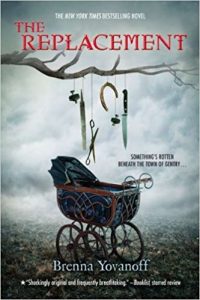
- Mackie Doyle, the protagonist of the text, is a ‘replacement’ or a changeling. He and the other characters are aware of his non-human status but it is tacitly accepted.
- Mackie is slowly dying as he is allergic to iron, blood and consecrated ground.
- The community in which Mackie lives, Gentry is haunted by fairies who steal the local children. The adults fail to protect these children as they refuse to entirely accept that there is a threat. Instead they use folklore to attempt to protect their children without acknowledging the supernatural happenings taking place beyond the human world.
- Mackie attempts to save himself and his friend’s sister who has been taken. In order to do this, he must acknowledge his identity as fairy and human.
- Though Mackie appears to be accepted by the community, this acceptance is fractured as the violence of the fairies escalates. The ideas of community and identity are pushed to their limits allowing Mackie to understand who he is and who he must become.
Cuckoo Song (2014) by Frances Hardinge
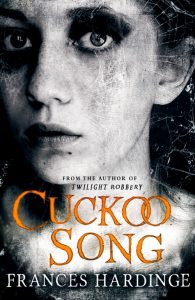
- Unlike Mackie, Triss is unaware of her identity until two men attempt to drown her. When she comes round from the ordeal, she is filled with a sense that her family are not really her family. Something which is confirmed through her little sister Pen’s behaviour towards her. It is only someway into the book that she realises she is a changeling.
- Hardinge writes Triss to be a ‘stock’ rather than a fairy child and she slowly falls apart throughout the novel. She has a monstrous appetite and suffers with pica, eating non-food items which seem to sustain her.
- The novel is set in the aftermath of the Great War and Triss’ older brother Sebastian has been killed in the conflict. Her parents are dealing with this trauma which may explain their behaviour towards their eldest daughter whom they mollycoddle, in an increasingly suffocating manner. Triss’ new identity is as much a boon as a curse as it allows her to escape her confinement with the home.
- Hardinge effectively engages with folkloric beliefs: Triss’ parents are advised to force her to betray her true nature by drinking out of eggcups (something which is discussed in Briggs’ work) and then they are told they must burn her in order to rescue their human daughter.
- As in The Replacement, adults are either evil, threatening to kill Triss, or they are ineffective, blind to what is taking place around them.
- Triss goes on to save the human version of herself working alongside her little sister Pen. Unlike the adults, once Pen realises Triss’ true nature, she becomes more forgiving. It appears that Pen only needed to know the truth to learn to accept Triss for who she is. The adults want to pretend that everything is just fine.
- The only exception to the adults’ behaviour is Sebastian’s girlfriend, Violet. Violet is a modern young woman and her proto-feminist ideals seem out of time in her community. She sees through the hypocrisy of Sebastian’s parents and their inability to acknowledge and process their grief over his death. Violet’s behaviour marks her as different and for this reason she becomes a saviour to Triss, helping her escape and start a new life.
Tithe: A Modern Faerie Tale (2002) by Holly Black
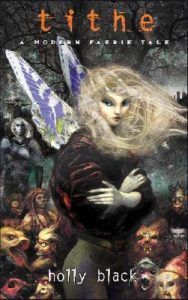
- As with Triss, Kaye Fierch is unaware of her status as a changeling at the beginning of the novel, although she is aware that she can see fairies.
- Kaye is a pixie and her true identity only becomes apparent when she saves the life of an elf knight, Roiben, becoming entangled in the complexities of fairy court life.
- Like Mackie, Kaye is allergic to iron unless she has been glamoured. She has magic of her own and is able to create her own glamour.
- As with the previous novels, the fairy world is shown to be strange, amoral, and yet also scintillating to humans. However, Black’s narrative acknowledges to a far greater degree, the pleasure (laced with BDSM overtones) of losing oneself in fairy land – especially for dissatisfied teenagers. Kaye, like Mackie and Triss, must learn new rules of behaviour in order to navigate these new worlds, unlearning many human mores. In many ways, this parallels the way in which our understanding of human morality and behaviour is challenged as we enter the adult world.
- In a later novel in the series, Kaye admits her identity to her human mother. Her mother reacts badly, turning her out of the house. Kaye promises to return her mother’s ‘real’ daughter. When she does so, her mother has had time to reassess her feelings and accepts both Kaye and her human daughter. The suggestion is that family is not blood but emotional connection. Kaye decides to split her time between the human world, where she has many close friends, and the fairy world, where she continues her romantic relationship with Roiben.
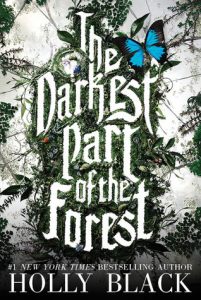 Holly Black returns to the idea of changelings in her later novel The Darkest Part of the Forest (2015). However, in this text the changeling is not a central character as such. Rather he is the love interest of the lead female character. I want to mention this text briefly because Black overlaps European changeling mythology with the Nigerian figure of the Abiku which features in Yoruba folk tales. In the novel, the changeling character Jack remembers his Nigerian grandmother telling him the story of Bola’s son which Black found in A. B. Ellis’ The Yoruba-Speaking Peoples of the Slave Coast of West Africa (1894), which features a very hungry changeling child. Like the North European changeling, the Abiku is often betrayed by the monstrous appetite and must be physically threatened in order to return the human child. Unlike the North European changeling, in this story, the Abiku is a spirit which inhabits the child and it is beaten out of it at the end of the tale. The Abiku is also connected to the idea of reincarnation and are referred to as the ‘born to die’. These are children who ‘are generally believed to have made pacts from the spirit world, to visit the earth briefly. And as such they initially please their earthly parents by their rapid growth, beauty, intelligence or cleverness, only to die prematurely when they would be of use to their parents’ (African Indigenous Religious Traditions in Local and Global Contexts [2015], ed. by David O. Ogungbile p. 220). The body of these ‘born to die’ children must be marked in order to prevent them from returning. In this regard, they differ from North European folklore and Black elides the two. In the novel, Jack’s human mother burns him with a poker, in the style of European folklore, in order to have her human son returned. When the fairy mother brings her child back, she insists that she will keep both boys as she cannot believe the indifference of the fairy mother. Jack goes on to make a connection with his fairy mother. He is continually aware of his ‘difference’ but ultimately chooses the human world and his human love, Hazel.
Changelings, I believe, are the perfect way of discussing the difficulties of teenage identity and their sense of isolation. By putting the changeling in the role of the protagonist, making the subject of the text, the reader can inhabit their experience. Thus the alienation of the changeling mirrors the sense of isolation felt by teenagers and the fracturing of their identity. However, rather than accepting this state as an inevitability, the changelings make choices about who they are, allowing the them to actively navigate the creation of their own identity. Modern changelings, like teenagers, must make active choices in defining their own identities.
If anyone has any comments or thoughts on the above, I would be delighted to hear them. Alternatively, please let me know your favourite changeling texts.