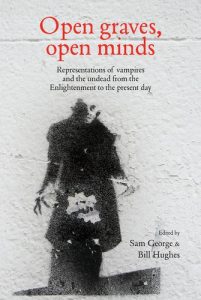
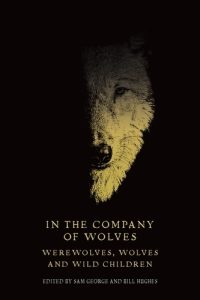
The Open Graves, Open Minds Project began by unearthing depictions of the vampire and the undead in literature, art, and other media, then embraced werewolves (and representations of wolves and wild children), fairies, and other supernatural beings and their worlds. The Project extends to all narratives of the fantastic, the folkloric, and the magical, emphasising that sense of Gothic as enchantment rather than simply horror. Through this, OGOM is articulating an ethical Gothic, cultivating moral agency and creating empathy for the marginalised, monstrous or othered, including the disenchanted natural world.
Some wonderful news to stave off all the gloom, OGOM’s Kaja has given birth to twins named Frederick Ewen Franck-Howells and Casper Wolf Franck-Howells. Big names for little people!! On behalf of OGOM I’d like to send huge congratulations to Kaja and Duncan on the birth of their first born (hopefully there is no evil fairy waiting in the wings to carry off the children). Twins though – uncanny, there’s got to be a gothic link!! Casper will in future undoubtedly be known as Wolf Howells awww woohoo!!!
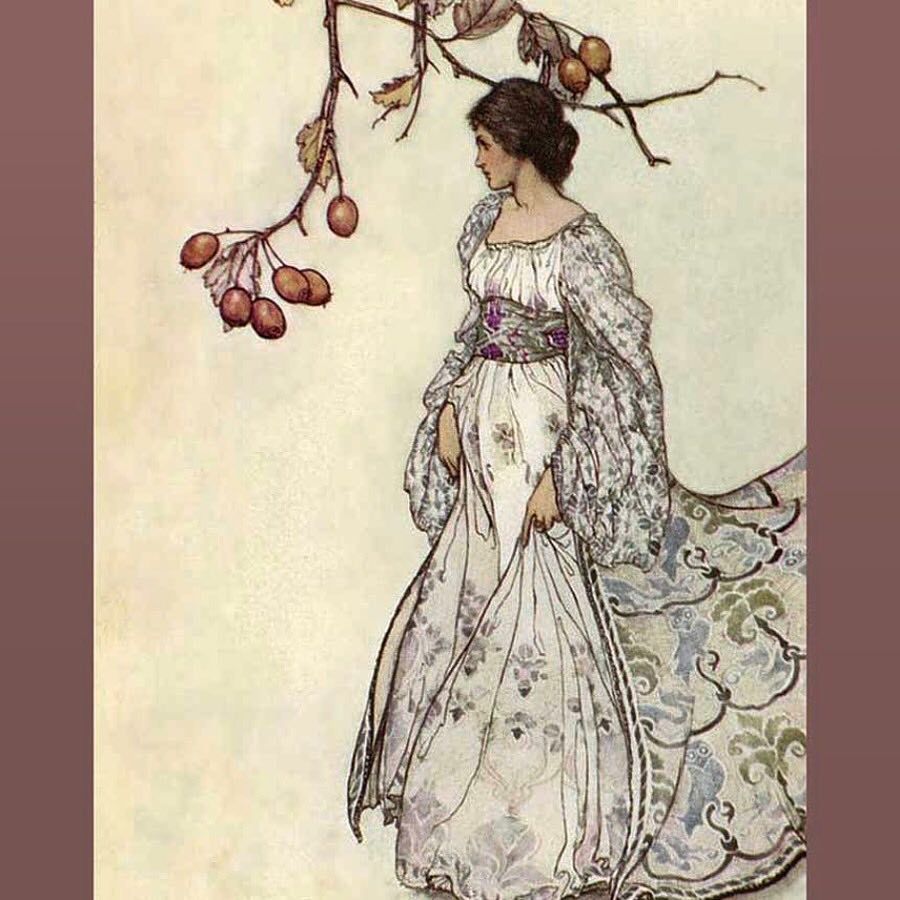
Arthur Rackham, Queen Mab, Romeo and Juliet (1906)
the fae are the mythical creatures of the hour. Sometimes they’re portrayed as monstrous, sometimes as tricksters, sometimes as sensuous love interests
So says Samantha Shannon, who is herself a superb fantasy novelist. So the next OGOM event, our conference on Gothic Fairies, couldn’t be more timely: ‘Ill met by moonlight’: Gothic encounters with enchantment and the Faerie realm in literature and culture, University of Hertfordshire, 8‒10 April 2021. The deadline for submissions is 30 October 2020. We want you to collaborate with us to investigate the fairy as it exists in all those shifting, ambivalent characteristics that Shannon depicts (as we have done previously with the vampire and the werewolf). It will be a fabulous event–there is even a Fairy Ball!
Shannon’s quote comes from this review of Jeanette Ng’s wonderful dark fairy romance, Under the Pendulum Sun, an evocative and atmospheric novel which works allusions from the Brontës into a deeply unsettling tale of Victorian missionaries and changelings in the land of Faerie. We expect this book to be one of the texts for discussion at the conference.
But then you may hate fairies. Holly Black (who is one of my favourite writers of YA fantasy and has written some brilliant and very Gothic fairy novels) may change your mind. Here, she recommends some of her favourites. Black captures the ambivalent nature of the Gothic Fairy, the ambivalence which we hope to explore at the conference and which is rooted in the folklore as well as the most interesting literary representations of fairies:
What I love about faerie books is much like what I love about faerie folklore. I love the idea of magic being out there, trickster magic, uncertain as the weather, potentially dangerous, but also beautiful.
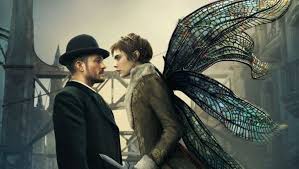
One of the manifestations of Gothic Fairies that we have loved recently is the TV series Carnival Row, with its steampunk ambience and world of racial and imperial tensions between human and fae. This is another text which we’re sure will appear in research presented at the conference. So we’re pleased to see, in this article, that the second season will be coming back, along with the excellent His Dark Materials and some other fantasy series. There are also some new shows in the genre which look exciting, particularly Shadow and Bone–an adaptation of Leigh Bardugo’s exciting reworking of Russian folklore.
We’re hoping that fairy literature of the Romantic period will be a conference theme. The realm of Faerie can dramatise all sorts of utopian and radical yearnings. Percy Shelley used the fae figure of Queen Mab in his revolutionary 1813 poem of the same name which became a primary text for working-class radicals. I found a very useful introduction to Queen Mab from the British Library (their website is a brilliant resource for literary scholars).
Finally, anyone who is acquainted with fairy folklore will know the dangers of eating or drinking fairy fare. I am hoping to talk about this topic at the conference. However, this reliable witness, in an account of the persisting presence of the sidhe in Ireland, seems to have escaped these perils:
“I met them on a few occasions, I chatted to them. They say you should never take a drink from the fairies, but I took a drink from them.”
We recognise this is a very uncertain time and we at OGOM hope everyone is well and safe. Despite the barriers, academic life goes on and we have a few CFPs to advertise, plus some new resources added to the website.
What happens to a distinctly European literary mode such as the Gothic in the hands of authors whose encounters with Europe have been mediated, for centuries, by Orientalism, colonialism, and war – but who also lay claim to dark and macabre traditions in their own literatures? This is the compelling question that activates Middle Eastern Gothics
To celebrate the release of the second issue of Gothic Nature, we are holding a one-day symposium, generously hosted by the English and Creative Writing Department at The University of Roehampton, to bring together academics, artists, activists, and enthusiasts working in various ways with the subject of Gothic Nature. We are particularly keen to hear from those seeking to build on discussions raised in Issue One, as well as those eager to provide insights on themes as yet largely unexplored – such as the decolonisation of the ecoGothic, the Gothicity/horror of environmental science, media, and medicine, and the increasing imbrications between ecohorror/ecoGothic and environmental activism
For our 2020 conference, the LSFRC invites papers exploring borders in SF. We understand this theme broadly but are particularly interested in papers which address borders as politicised tools used to uphold empires, divide communities and police the bodies of those most marginalised. Our understanding of SF is likewise broad, and we in no way intend to use the traditionally acknowledged borders to the genre to exclude those whose work cannot be neatly defined by the term ‘science fiction.’
5. New Resources: we have added two interesting and useful links to the list that appears in the right-hand sidebar on the Home and Resources pages. One is to Dr Sam Hirst’s excellent site on Gothic Romance, which has a blog and details of book groups and online courses.
The second is to Texas A&M University’s Science Fiction and Fantasy Research Database, which is an excellent site that is ‘designed to help students and researchers locate secondary sources for the study of the science fiction and fantasy and associated genres. These include: historical material; books; articles; news reports; interviews; film reviews; commentary; and fan writing’.
Finally, I have added some more past papers of my own from conferences on our Repository page for talks and papers. These, I hope, may be a useful starting point for research, and give an idea of the direction OGOM research has taken. They cover aspects of the development of Gothic-inflected genres from Walpole’s The Castle of Otranto, through Dracula to Paranormal Romance. There are close readings of the contemporary YA novels, Alyxandra Harvey’s My Love Lies Bleeding (2009) and Julie Kagawa’s The Iron King (2010).
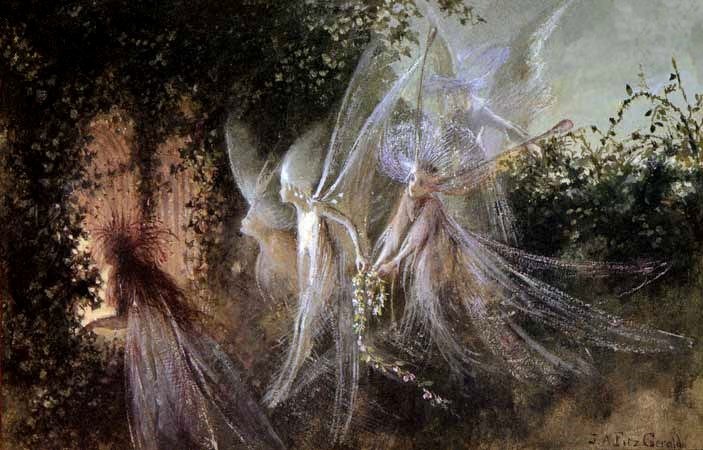
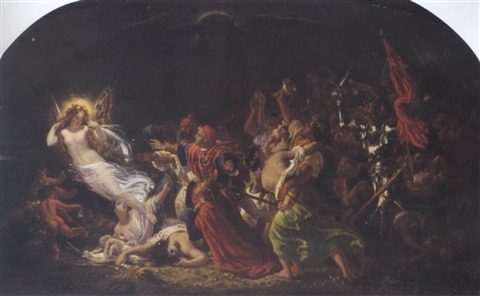
John Anster Fitzgerald (1832-1906), Fairies Looking Through a Gothic Arch
The Open Graves, Open Minds (OGOM) Project was launched in 2010 with the Vampires and the Undead in Modern Culture conference.We have subsequently hosted symposia on Bram Stoker and John William Polidori, unearthing depictions of the vampire in literature, art, and other media, before embracing shapeshifting creatures and other supernatural beings and their worlds. The Company of Wolves, our ground-breaking werewolf and feral humans conference, took place in 2015. This was followed by The Urban Weird, a folkloric collaboration with Supernatural Cities in 2017. The OGOM Project now extends to all narratives of the fantastic, the folkloric, the fabulous, and the magical.
To celebrate the tenth anniversary of OGOM, we turn our attention to fairies and other creatures from the realm of Faerie.
Keynote Speakers
Prof. Diane Purkiss (University of Oxford), ‘Where Do Fairies Come From? Shifts in Shape’
Prof. Dale Townshend (Manchester Metropolitan University), “The fairy kind of writing’: Gothic and the Aesthetics of Enchantment in the Long Eighteenth Century’
Prof. Catherine Spooner (University of Lancaster), ‘Glamourie: Fairies and Fashion’
Prof. Owen Davies (University of Hertfordshire), ‘Print Grimoires, Spirit Conjuration, and the Democratisation of Learned Magic’
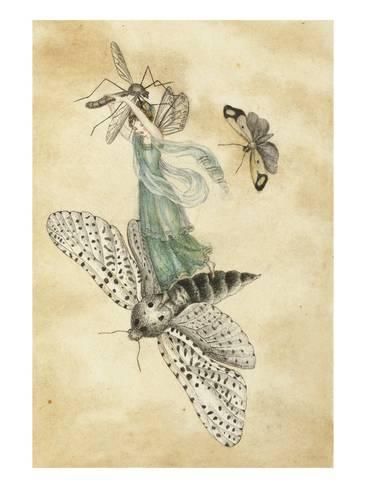
Dr Sam George (OGOM University of Hertfordshire), ‘Fairy Lepidoptera: the Dark History of Butterfly-Winged Fae’
The conference will also feature A Fairy Workshop on networking and outreach in the field of folklore studies for postgraduate students and ECRS with Dr Ceri Holbrook (Magical Folk, 2018) and a mini Fairy Film Festival in St Albans. And, to complete the anniversary celebrations, there will be A Fairy Ball where delegates will be encouraged to abandon their human natures and transform into their dark fey Other.
As Prof. Dale Townsend has observed, the concept of the Gothic has had an association with fairies from its inception; even before Walpole’s 1764 Castle of Otranto (considered the first Gothic novel), eighteenth-century poetics talked of ‘the fairy kind of writing’ which, for Addison, ‘raise a pleasing kind of Horrour in the Mind of the Reader’ and ‘and favour those secret Terrours and Apprehensions to which the Mind of Man is naturally subject’. Johnson, in his Preface to Shakespeare (1765), talks of ‘the loves of Theseus and Hippolyta combined with the Gothic mythology of fairies’. ‘Horror’ and ‘terror’ are key terms of affect in Gothic criticism; Townsend urges us, however, to move away from this dichotomy. While we are certainly interested in the darker aspects of fairies and the fear they may induce, this conference also welcomes attention to that aspect of Gothic that invokes wonder and enchantment.
Fairies in folklore, unlike the prettified creatures we are familiar with, are always rather dangerous. Old ballads such as ‘Tam Lyn’ and ‘The Demon Lover’ reveal their unsettling side. The darker aspects of fairies and their kin may be glimpsed in the early modern work of Michael Drayton, Edmund Spenser, Robert Herrick, and, of course, Shakespeare. They have found their way into the Romanticism of Keats and Shelley, modulated by the Gothic. Fairies blossomed in the art and literature of the Victorians; though it is here perhaps that they are most sentimentalised, there is also much darkness. The paintings of Richard Dadd and John Anster Fitzgerald are tinged with Gothic as are classic works of fairy literature such as Christina Rossetti’s Goblin Market and J. M. Barrie’s Peter Pan. The nineteenth century also saw a surge in the dramatisation of fairies with the féerie (or ‘fairy play’), which set the scene for fairy ballets such as Les Sylphides as well as cinematic productions. Following the rise of the vampire lover in contemporary paranormal romance, dark fairies (alongside pixies, trolls, and similar creatures from the world of Faerie) have also been found in the arms and beds of humans. The original menace of traditional Faerie has been restored in the form of ambivalently sinister love objects. This has emerged from precursors such as Hope Mirrlees’s Lud-in-the-Mist (1926), Sylvia Townsend Warner’s Kingdoms of Elfin tales from the 1970s and the pioneering urban fantasy of Emma Bull’s War for the Oaks (1987), to more recent works like Neil Gaiman’s Stardust (1997) and Elizabeth Hand’s Mortal Love (2004). Young Adult writers such as Holly Black, Maggie Stiefvater, Julie Kagawa, Melissa Marr have all written fairy romances with more than a tinge of Gothic darkness and there are excellent adult paranormal fairy romances such as Jeanette Ng’s Under the Pendulum Sun (2017). Gothic Faery has manifested in other media: Gaiman’s Stardust has been filmed; cinematic interpretations of the phenomenon of the Cottingley Fairies have been made (with Photographing Fairies giving it a Gothic twist), and, recently, the dark fairies of Carnival Row have appeared on TV.
Max Weber and, subsequently, the Frankfurt School discerned a state of disenchantment in modernity, whereby industrialisation and instrumental rationality had erased the sense of the sacred in life with ambiguous effects. The appeal of fairy narratives in the modern era may be their power to re-enchant our desacralised world. Fairy narratives in the alienated world of modernity often represent untamed nature and lead us to explore environmental concerns. The Land of Faerie, Tir na Nog, the Otherworld can be a setting for Utopia. These tales may also uncover the repressed desires of inner nature, emancipatory yearnings, the spirit of revolution, creative inspiration, pure chaos, or Otherness in general. Yet often this is ambivalent; the Gothic darkness of enchantment may evoke a hesitancy over surrendering to nature or the irrational as well as having a restorative allure.
Topics may include but are not restricted to:
‘The fairy kind of writing’ in 18C Gothic poetics
The Gothic fairy in Romanticism; Victorian fairies in art and literature
Dark fairies in paranormal romance
Fairies in YA literature
Fairies and urban fantasy
Fairies in ballads and medieval romance
Fairies on stage
Fairies in music
Faery, disenchantment, and modernity
Fairy folklore
Fairies, nature, and eco-Gothic
Cinematic fairies and the Gothic; Fairies and place
Utopia and the Otherworld
Gothic folklore; Goblins, hobs, and other malevolent fairy folk
Intertextuality and fairy narratives
Fairies and theology
Fairies and (pseudo)science
Light and shade: fairies, film, and optics
Fairy morality
The Faerie world and the aesthetic dimension
Fairy festivals and the carnivalesque
Changelings and identity
Fairies and the Other
Fairies and fashion
Fairies and nationalism
Fairy-vampires and other hybrids
Steampunk Fairies
Abstracts (200-300 words) for twenty-minute papers or proposals for panels, together with a short biography (150 words), should be submitted by 30 October 2020 as an email attachment in MS Word document format to all of the following:
Dr Sam George, s.george@herts.ac.uk; Dr Bill Hughes, bill.enlightenment@gmail.com; Dr Kaja Franck, k.a.franck@gmail.com; Daisy Butcher, daisy2205@yahoo.co.uk
Please use your surname as the document title. The abstract should be in the following format: (1) Title (2) Presenter(s) (3) Institutional affiliation (4) Email (5) Abstract.
Panel proposals should include (1) Title of the panel (2) Name and contact information of the chair (3) Abstracts of the presenters.
Presenters will have the opportunity to submit to OGOM publications. They will be notified of acceptance for the conference by 30 November 2020.
I am being interviewed here by Brian from Toothpickings. I talk about vampires and werewolves, the folklore of these creatures and its transmutation into literature. I also make some very tenuous links between this, the Enlightenment, Jane Austen and paranormal romance. We discuss OGOM’s latest publication, In the Company of Wolves: Werewolves, Wolves, and Wild Children and I give some details of Sam’s ‘Reading the Vampire’ MA module, soon to be available on line.
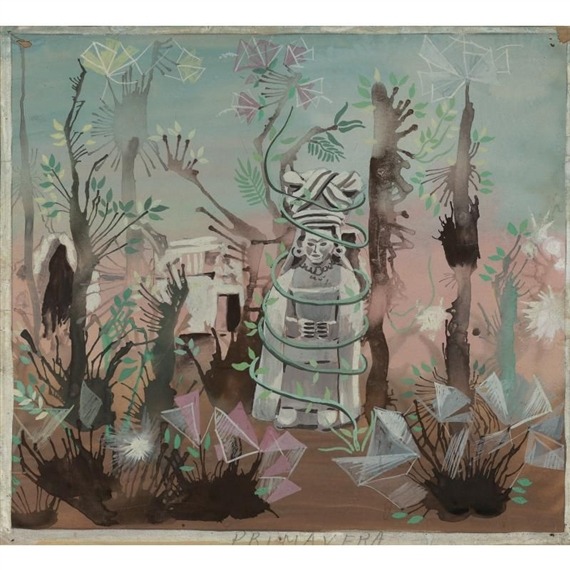
Remedios Varo, Primavera, Las Cuatro Estaciones [Spring, the Four Seasons] (1943)
‘We live in Gothic times’, said Angela Carter. Gothic narratives are one powerful way of facing oppressive darkness. But the fantastic mode in general can also reveal utopian possibilities, new worlds beyond the darkness. We are living through a bleak period; OGOM has always been fascinated by the dialectic between shadows and illumination in fabulous narratives and we hope, despite the current crisis, to keep on exploring those pathways and sharing our research – here on this website and on OGOM Twitter (where we have started the #GothicSpring hashtag), and other media.
Unfortunately, as with everyone else, we have had to postpone some activities. The Dark Side of the Fae symposium, where Sam was due to talk on Fairy Lepidoptera, has sadly been cancelled but the event will happen at a later date. Our popular Gothic Tours of St Albans are cancelled for the time being – but they’ll be back. And, despite everything, we are still planning a major OGOM Conference for next spring – we are still working on the details, but start dreaming of Gothic fairies! We are hoping to participate in the nationwide Being Human – New Worlds Festival in November. And we are also working on further OGOM publications.
We at OGOM – Sam, Bill, Kaja, and Daisy – hope you are safe and well during these dreadful times and hope that a new life will blossom soon from out of these days of gloom.
I am delighted to announce that I will be speaking at a two-day symposium on fairy folklore organised by Holly Elsdon at the Centre for Folklore, Myth and Magic in Todmorden in May. You can see a brief glimpse of the line up below. The venue is Todmorden Town Hall and the Golden Lion for the evening events. Tickets are on sale now via www.thefolklorepodcast.com . Twitter @CentreMyth
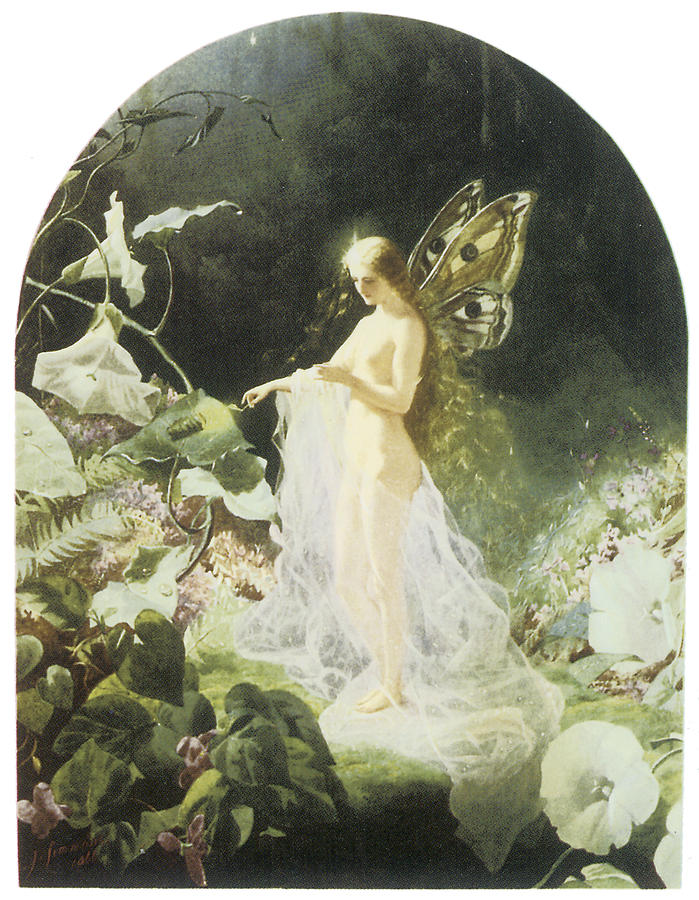
‘Titania’, John Simons, 1866
The title of my talk and an abstract is given below:
Dr Sam George – ‘Fairy Lepidoptera: the Dark History of Butterfly-Winged Fae’
Today, fairies are often
viewed as benevolent nature spirits, a consolation for modernity or the loss of
wild environments, but this has not always been the case. In 1887, Lady Wilde gave voice to the Irish belief that fairies
are the fallen angels, cast out of heaven. Fascinated by angels, ghosts, and
vampires, Victorians, then Edwardians, saw fairies as souls of the dead. In an
age of widespread religious doubt, thought turned to the persistence of the
dead and to occult methods of communicating with them, and, rather than
dispelling fairies, memories of the dead in WWI heightened a belief in airy
spirits and spirit photography.
It was in this climate that the
Cottingley fairy photographs emerged in 1917. Sir Arthur Conan Doyle’s defence
of them was influenced by Theosophical views of fairies as evidence of a
shadowy spirit world. Dell-dwelling and butterfly-winged, the Cottingley
fairies were important too because they seemingly
confirmed that fairies were allied to the Lepidoptera or butterfly order (an
idea that became an established part of Theosophical thought).
Thomas Stothard’s 1798 illustrations to The Rape of the Lock are reputedly the first to give fairies butterfly wings, establishing a convention. Stothard’s images appear to be derived from putti but he followed his textual source in placing his insect-winged sprites halfway between angels (disembodied) and fairies (embodied). Such butterfly-winged fae provide another link to fairies as spirits of the dead. The butterfly is thought to be the shape assumed by the soul when it leaves the body during sleep or at death. In Joseph Noel Paton’s The Pursuit of Pleasure: A Vision of Human Life (1885), the daughter of Cupid and Psyche, is represented by a fairy with butterfly wings.
Joseph Noel Paton, ‘The Pursuit of Pleasure’, 1885
Representations of fairies shift from disembodied angels to manifestations as insectile
Lepidoptera and shadowy spirits of the dead. In tracing this history, I anticipate
ways of thinking about fairies in the present in narratives such as Carnival Row (2019). Here the fae’s
insect wings and delicate beauty mask their dark history as fallen and
endangered descendants of the Tuatha de
Danann (taking us back to Lady Wilde’s accounts).
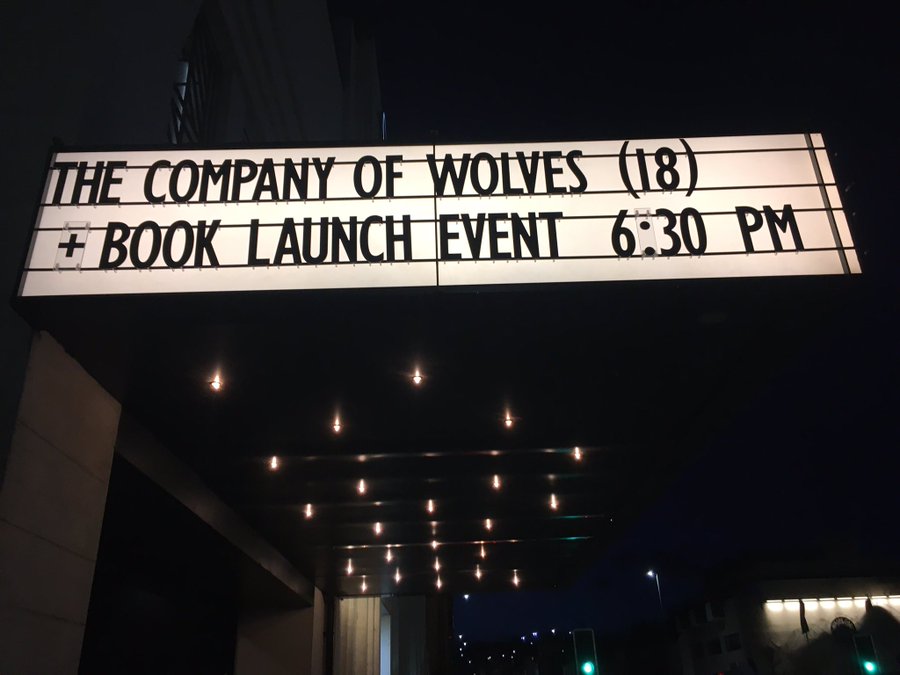
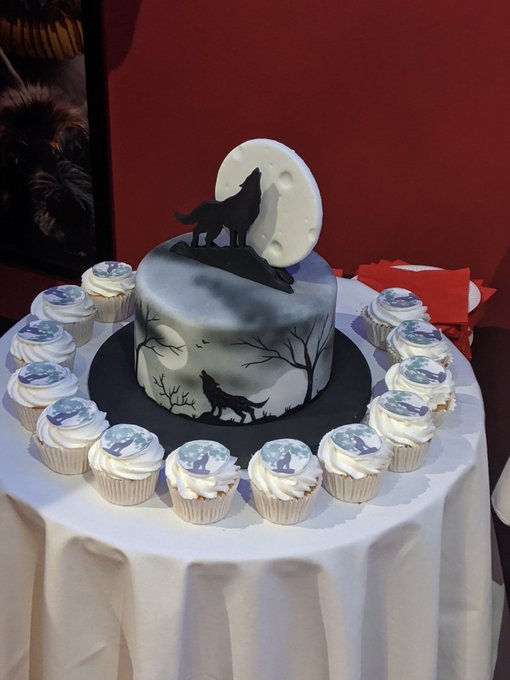
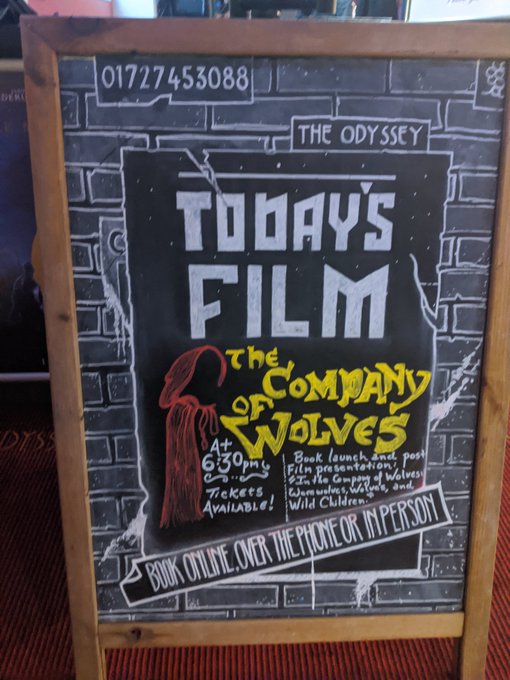
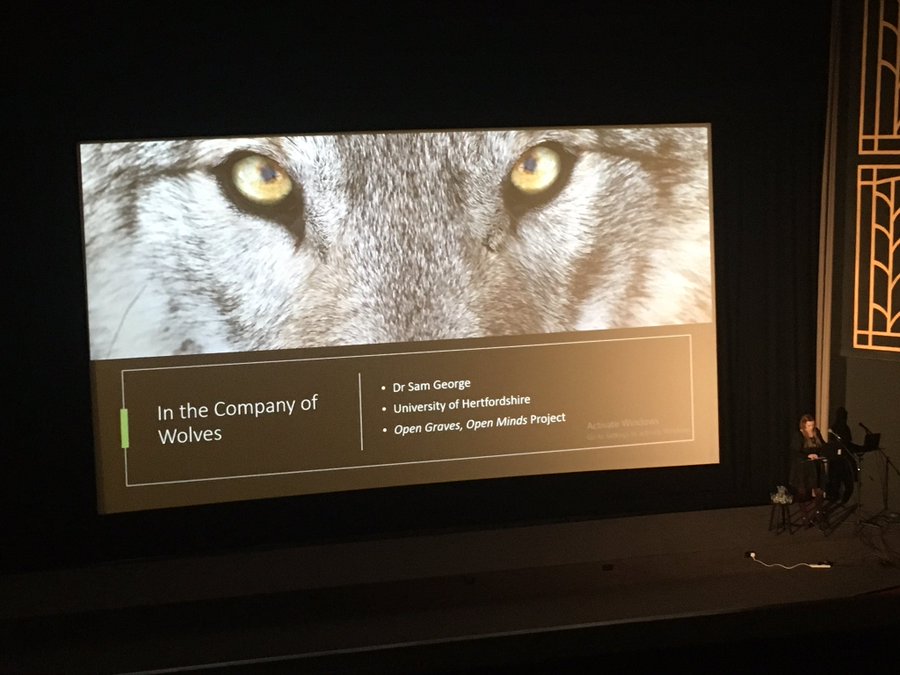
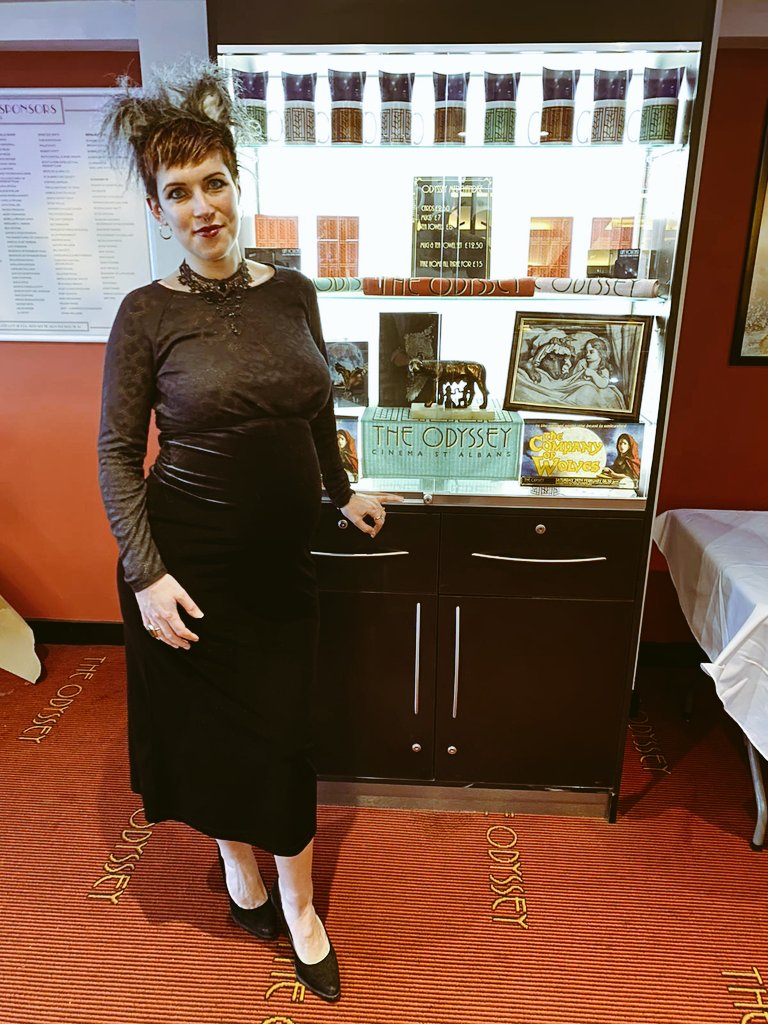
OGOM would like to say a huge thank you to everyone who found themselves in the company of wolves at our book launch for Werewolves, Wolves and Wild Children at the Odyssey Cinema, St Albans on 29 February. The book sales were off the scale and just look at the werewolf cake – probably the most awesome cake you are likely to see. Kaja really excelled in delivering this beast – woo hoo!
OGOM werewolf cake
I was honoured to be invited to introduce Neil Jordan’s Company of Wolves film prior to the book launch. You can read a transcript of my intro here.
poster advertising event
Our presentation on the book followed the screening in the auditorium. My half was on the OGOM project, the werewolf conference that had inspired the book, and my own research on wolf children, or children raised by wolves, for the chapter ‘When Wolves Cry: wolf children, story telling and the state of nature’ .
Bill then presented on the narrative of the book and the individual chapters and contributors. The book itself is a beauty not a beast we think you will agree!
After that it was time for the audience to release their inner werewolf and then on with the book signing and cake….
Book stall care of MUPMatthew Frost our legendary editor from MUP Matthew and his moustache showcase the cake
We’d like to thank everyone who made this book possible – all the contributors, and Matthew Frost and his team at Manchester University Press. Thanks to Kaja for organising the fabulous cake. And thanks also to the Odyssey Cinema for helping us celebrate this event: that’s Anna Shepherd, Christian Willis, Ben, and all the other staff. Thanks also to the press office at the University of Hertfordshire, Victoria Bristow and Ellie Spear. Also the UH Research Office for their support. Finally, Dr Rowland Hughes and Tara Stebnickey for helping with our impact case study and for making this and our wider project on redeeming the wolf a roaring success.
Kaja looking wolfish – love the ears!
In the build up to the launch and during it we used the hashtag #InTheCompanyofWolves you can view our Twitter ‘moment’ with all our posts and images here.
We were pleased that the launch event picked up some local coverage and was so well attended (over 150 tickets sold). You can browse some of the press stories below:
We will be showing Company of Wolves, a British Gothic fantasy horror directed by Neil Jordan, based on Angela Carter’s lycanthropic reworkings of ‘Little Red Riding Hood’, and starring Sarah Patterson, Angela Lansbury, Stephen Rea, and David Warner.
Following this there will be an exclusive preview and presentation in the auditorium on our new book and a signing session. We’ll also be inviting you to stay for a few drinks and enjoy our celebratory wolf-themed cake. Woo hoo!!
To join in the celebrations and unleash your inner werewolf you can book via this link
‘Never
stray from the path, never eat a windfall apple, and never trust a man whose
eyebrows meet in the middle’ (Angela Carter).
The book developed from our Company of Wolves Conference you can view the impressive programme here
To find out just why it was so special have a look at some of these wonderful news stories:
I am delighted to announce that I will be a guest speaker at The Dark Side of the Fae: A Fairy Symposium, Todmorden Town Hall, 30th-31st May. The title of my talk will be ‘Fairy Lepidoptera: the Dark History of Butterfly-Winged Fae’. Save the Date!! Further details can be obtained from Holly Elsdon: folkloremythmagic@gmail.com
Marina Warner
Marina Warner is a writer of fiction, criticism and history; her works include novels and short stories as well as studies of art, myths, symbols and fairytales.
Centre for Myth Studies, University of Essex
The Centre It promotes the study of myth, from ancient to modern, and raises awareness of the importance of myth within the contemporary world.
Mythopoeic Society
The Mythopoeic Society is a non-profit organization devoted to the study of mythopoeic literature, particularly the works of members of the informal Oxford literary circle known as the “Inklings.”
Sheffield Gothic
Sheffield Gothic is a collective group of Postgraduate Students in the School of English at The University of Sheffield with a shared interest in all things Gothic.
American Gothic Studies
American Gothic Studies is the official journal of the Society for the Study of the American Gothic (SSAG), which promotes and advances the study of the American Gothic
Echinox Journal
Caietele Echinox is a biannual academic journal in world and comparative literature, dedicated to the study of the social, historical, cultural, religious, literary and arts imaginaries
Folklore
Journal of The Folklore Society. A fully peer-reviewed international journal of folklore and folkloristics, in printed and digital format
Gothic Nature
Gothic Nature: New Directions in Ecohorror and the Ecogothic
Gothic Studies
The official journal of the International Gothic Association considers the field of Gothic studies from the eighteenth century to the present day.
International Journal of Young Adult Literature
an academic peer-reviewed journal dedicated to publishing original and serious scholarship on young adult literature from all parts of the world.
Irish Journal of Gothic and Horror Studies
The Irish Journal of Gothic and Horror Studies (ISSN 2009-0374) is a peer-reviewed, interdisciplinary, electronic publication dedicated to the study of Gothic and horror literature, film, new media and television.
Journal of Popular Romance Studies
The Journal of Popular Romance Studies is a double-blind peer reviewed interdisciplinary journal exploring popular romance fiction and the logics, institutions, and social practices of romantic love in global popular culture.
Journal of the Fantastic in the Arts
An interdisciplinary journal devoted to the study of the fantastic in Literature, Art, Drama, Film, and Popular Media
Monsters and the Monstrous
Monsters and the Monstrous is a biannual peer reviewed global journal that serves to explore the broad concept of “The Monster” and “The Monstrous” from a multifaceted inter-disciplinary perspective.
Studies in the Fantastic
Studies in the Fantastic is a journal devoted to the Speculative, Fantastic, and Weird in literature and other arts
Supernatural Studies
Supernatural Studies is a peer-reviewed journal that promotes rigorous yet accessible scholarship in the growing field of representations of the supernatural, the speculative, the uncanny, and the weird.
The Lion and the Unicorn
The Lion and the Unicorn, an international theme- and genre-centered journal, is committed to a serious, ongoing discussion of literature for children.
Victorian Popular Fictions Journal
Victorian Popular Fictions is the journal of the Victorian Popular Fiction Association. The VPFA is a forum for the dissemination and discussion of new research into nineteenth- and early-twentieth-century popular narrativeo
Related Links
Aarne-Thompson-Uther Index
The Aarne-Thompson-Uther Index is a classification numeric system created to group similar folktales from different cultures
ACADEmy
LSAD centre for research into Art, Curatorial Studies, Applied Design and Art and Design Education
African Religions
With the Yoruba Religion Reader and similar resources
Angela Carter Society
Promoting the study and appreciation of the life and work of Angela Carter
Art Passions
Art Passions: Fairy Tales are the Myths We Live By
Asian Gothic
Asian Gothic appears as an attempt to make sense of the vast and diverse body of Asian literature, film, television, games, comics and other forms of cultural production by reading these texts from a Gothic perspective
British Association for Romantic Studies (BARS)
The UK’s leading national organisation for promoting the study of Romanticism and the history and culture of the period from which it emerged.
British Association for Victorian Studies (BAVS)
The British Association for Victorian Studies (BAVS) is a multidisciplinary organisation dedicated to the advancement and dissemination of knowledge about the Victorian period.
Byron Society
The Byron Society celebrates the life and works of Lord George Gordon Byron (1788-1824), a poet, traveller and revolutionary
Cambridge Research Network for Fairy-Tale Studies
The Cambridge Research Network for Fairy-Tale Studies is an open space at the University of Cambridge aimed at connecting researchers with an interest in fairy tales across different disciplines and scholarly perspectives.
Carterhaugh School
We give lectures and teach courses on fairy tales, folklore, witches, writing, and more. Basically, your ultimate fantasy college courses
Centre for Myth Studies, University of Essex
The Centre It promotes the study of myth, from ancient to modern, and raises awareness of the importance of myth within the contemporary world.
Deborah Hyde
Deborah Hyde wants to know why people believe in weird stuff. She attributes her fascination with the supernatural to having spent her childhood with mad aunties. She approaches the subject using the perspectives of psychology and history.
Fairyist: The Fairy Investigation Society
A website that will gather together sources, links, bibliographical references and discussions on fairies and related supernatural creatures
Folklore Society
The Folklore Society (FLS) is a learned society, based in London, devoted to the study of all aspects of folklore and tradition, including: ballads, folktales, fairy tales, myths, legends, traditional song and dance, folk plays, games, seasonal events, ca
Ghoul Guides
Home to the Ghoul Guides – a digital multimedia project devoted to exploring, understanding, and enjoying the wonders and weirdness of the Gothic
Gothic Feminism
Gothic Feminism is a research project based at the University of Kent which seeks to re-engage with theories of the Gothic and reflect specifically upon the depiction of the Gothic heroine in film
Gothic Herts Reading Group
This site is our one-stop platform for discussing our latest Gothic texts, from journal articles and press pieces, to full length books both old and new
Gothic Women Project
2023: The Year of Gothic Women. An interdisciplinary project devoted to spotlighting undervalued and understudied women writers
Haunted Shores
Haunted Shores Research Network, dedicated to investigating coasts and littoral space in Gothic, horror, and fantastic multimedia
Hellebore magazine
HELLEBORE is a UK-based small press devoted to British folk horror and the occult. Maria J. Pérez Cuervo publishes the magazine twice a year, on Beltane and Samhain
MEARCSTAPA
monsters: the experimental association for the research of cryptozoology through scholarly theory and practical application
Mermaids of the British Isles
a history of mermaids in the arts and cultural imagination of our early islands, which will map the place of these beguiling, and often deadly, figures in the national maritime imaginary, and explore our ancestors’ persistent reimagining of the mermaid
Open Folklore
Open Folklore is devoted to increasing the number of useful resources, published and unpublished, available in open access form for folklore studies and the communities with which folklorists partner
PCA Vampire Studies
A site dedicated to the Vampire Studies Area of the Pop Culture Association
Pook Press
Publisher of Vintage Illustrated Fairy Tales, Folk Tales and Children’s Classics
Romance Scholarship DB
This Romance Scholarship Database is therefore intended as a tool to assist popular romance scholars in their research into modern popular romance novels
RomanceWiki
A wiki resource for romance fiction authors, texts, and publishers
Science Fiction and Fantasy Research Database
The Science Fiction and Fantasy Research Database is a freely available online resource designed to help students and researchers locate secondary sources for the study of the science fiction and fantasy and associated genres.
Sophie Lancaster Foundation
The charity, known as The Sophie Lancaster Foundation, will focus on creating respect for and understanding of subcultures in our communities.
Supernatural Cities
Supernatural Cities is an interdisciplinary network of humanities and social science scholars of urban environments and the supernatural.
Supernatural Studies Association
The Supernatural Studies Association is an organization dedicated to the academic study of representations of the supernatural, the speculative, the uncanny, and the weird across periods and disciplines.
The Association for the Study of Buffy+
The mission of the Association is to promote the scholarship of Buffy+ Studies, focusing on inclusivity, intersectionality, and excellence. We define Buffy+ Studies as the scholarly exploration of Buffy the Vampire Slayer and its related texts.
The Society for the Study of the American Gothic (SSAG)
The Society for the Study of the American Gothic (SSAG) was established in 2023 to promote and advance the study of the American Gothic through research, teaching, and publication
The Thinker's Garden
we also love Plotinus and the Renaissance Platonists, as well as the Transcendentalists and Romantics. We are also drawn to the peculiarities of the Theosophists and hermeticists of the nineteenth century
Vamped
Vamped is a general interest non-fiction vampire site. We publish interviews, investigations, lists, opinions, reviews and articles on various topics.
Vampire Studies Association
TThe Vampire Studies Association (VSA) was founded by Anthony Hogg . . .“to establish vampire studies as a multidisciplinary field by promoting, disseminating and publishing contributions to vampire scholarship
Victorian Popular Fiction Association
The Association is committed to the revival of interest in understudied popular writers, literary genres and other cultural forms.
Wells at the World's End
I am reading through the complete works of H G Wells, in chronological order. This blog is for my jottings, as I go along.
YA Literature, Media, and Culture
YALMC is a resource for those of us researching, writing, writing about, interested in Young Adult Literature, Media, and Culture.
YA Studies Association (YASA)
The YA Studies Association (YASA) is an international organisation existing to increase the knowledge of, and research on, YA literature, media, and related fields