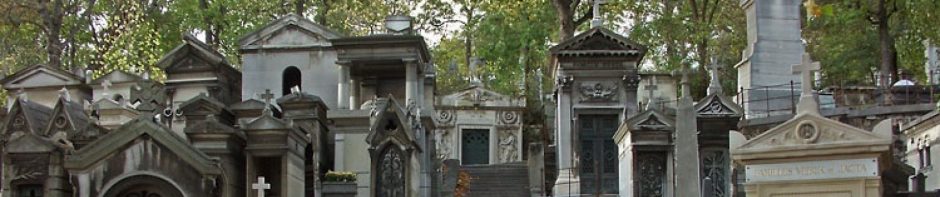
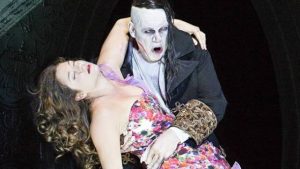
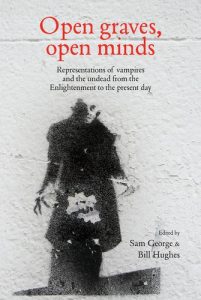
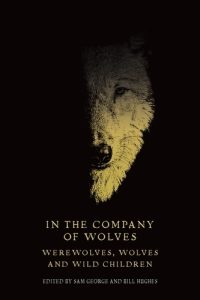
The Open Graves, Open Minds Project began by unearthing depictions of the vampire and the undead in literature, art, and other media, then embraced werewolves (and representations of wolves and wild children), fairies, and other supernatural beings and their worlds. The Project extends to all narratives of the fantastic, the folkloric, and the magical, emphasising that sense of Gothic as enchantment rather than simply horror. Through this, OGOM is articulating an ethical Gothic, cultivating moral agency and creating empathy for the marginalised, monstrous or othered, including the disenchanted natural world.
This is something to get into a lather about: Pojo soaps have created a werewolf repelling soap. If you’re more concerned about something sucking your blood rather than ripping you apart, they also do an anti-vampire soap, as well as one to keep the zombies away.
If you are actually fond of werewolves, Sundance Soapery have created a soap that will have you smelling like a lycanthrope. Slightly more disturbing is this Vampire Whitening soap which promises to make you as pale as a vampire.
The ending of the cult film ‘Withnail and I’ ( a 1987 black comedy written and directed by Bruce Robinson) came up in our discussions at Cumberland Lodge this weekend after my talk on wolves and wolf children. This was in response to my use of the Ted Hughes poem ‘Life after Death’ (Birthday Letters, 1998) in which the poet and his children are comforted by the sound of wolves from his Chalk Farm home following the death of his wife Sylvia Plath:
We were comforted by wolves.
Under that February moon and the moon of March
The Zoo had come close.
And in spite of the city
Wolves consoled us. Two or three times each night
For minutes on end
They sang. They had found where we lay.
And the dingos, and the Brazilian-maned wolves –
All lifted their voices together
With the grey Northern pack (l.1-10).
The final soliloquy in the film is delivered to the same wolves at London Zoo. It is one of the most powerful uses of Shakespeare in film ever I think. The monologue is spoken in the play by Prince Hamlet to Rosencrantz and Guildenstern in Act II, Scene ii. Rather than appearing in blank verse, the typical mode of composition in Shakespeare plays, the speech appears in perfect prose:
I have of late (but wherefore I know not), lost all my mirth, forgone all custom of exercises; and indeed, it goes so heavily with my disposition; that this goodly frame the earth, seems to me a sterile promontory; this most excellent canopy the air, look you, this brave o’er hanging firmament, this majestical roof, fretted with golden fire: why, it appeareth no other thing to me, than a foul and pestilent congregation of vapours. What a piece of work is a man! How noble in reason, how infinite in faculty! In form and moving how express and admirable! In action how like an Angel! in apprehension how like a god! The beauty of the world! The paragon of animals! And yet to me, what is this quintessence of dust? Man delights not me; no, nor Woman neither…
I have previously blogged about Shakespeares Irish werewolves and the gothspeare so maybe there is a theme here. Both soliloquy and poem are profoundly moving and have as their central concept mankind’s place in the world and the notion of our returning again to dust. The wolves are not present as the harbingers of death however, they seem instead to offer consolation or maybe to add their own silent commentary on ‘what a piece of work is a man’.
Florence + The Machine, ‘Howl’Arguably ‘Howl’ isn’t that romantic – but it’s dark, it’s about love gone wrong and it’s about werewolves. Join in the conversation below!
But then there’s also Annie Lennox’s ‘Love Song for a Vampire’ from Francis Ford Coppola’s Bram Stoker’s Dracula, the film which really cemented the figure of Dracula as romantic other and thus plays a central role in the development of paranormal romance.
Do send us your recommendations for Gothic Valentine songs!!
Once upon a time there was light in my life
But now there’s only love in the dark
Nothing I can say
A total eclipse of the heart
Bonnie Tyler’s ‘Total Eclipse of the Heart’ is a love song for a vampire and was originally named ‘Vampires in Love’. Knowing this really helps to explain the central image of the heart’s total eclipse and the outlandishly gothic video featuring a school for vampires (eat your heart out Twilight fans). Valentine’s day might just be the time to give this another spin and embrace some eighties eerie…after all forever’s gonna start tonight!
The story goes that after seeing ‘Meat Loaf’ perform ‘Bat Out of Hell’ live on ‘The Old Grey Whistle Test’ a relatively unknown Tyler approached his producer Jim Steinman who eventually wrote ‘Total Eclipse of the Heart” for her. He later confessed to have been writing a musical version of Nosferatu:
With ‘Total Eclipse of the Heart’, I was trying to come up with a love song and I remembered I actually wrote that to be a vampire love song. Its original title was ‘Vampires in Love’ because I was working on a musical of Nosferatu, the other great vampire story. If anyone listens to the lyrics, they’re really like vampire lines. It’s all about the darkness, the power of darkness and love’s place in the dark’ (Steinman, ‘Dance of the Vampires’, Playbill, Sept 18th, 2002)
If you read the lyrics again the vampiric overtones are unmistakable! You can’t really out goth this for Valentine’s Day!!
Turn around, every now and then I get a little bit lonely
And you’re never coming round
Turn around, every now and then I get a little bit tired
Of listening to the sound of my tears
Turn around, every now and then I get a little bit nervous
That the best of all the years have gone by
Turn around, every now and then I get a little bit terrified
And then I see the look in your eyes
Turn around bright eyes, every now and then I fall apart
Turn around bright eyes, every now and then I fall apart
And I need you now tonight
And I need you more than ever
And if you only hold me tight
We’ll be holding on forever
And we’ll only be making it right
‘Cause we’ll never be wrong together
We can take it to the end of the line
Your love is like a shadow on me all of the time (all of the time)
I don’t know what to do and I’m always in the dark
We’re living in a powder keg and giving off sparks
I really need you tonight
Forever’s gonna start tonight
Forever’s gonna start tonight
Once upon a time I was falling in love
But now I’m only falling apart
And there’s nothing I can do
A total eclipse of the heart
Once upon a time there was light in my life
But now there’s only love in the dark
Nothing I can say
A total eclipse of the heart
Turn around bright eyes, every now and then I fall apart
Turn around bright eyes, every now and then I fall apart
And I need you now tonight (and I need you now)
And I need you more than ever
And if you only hold me tight (and if you only)
We’ll be holding on forever
And we’ll only be making it right (’cause we’ll never be wrong)
‘Cause we’ll never be wrong together
We can take it to the end of the line
Your love is like a shadow on me all of the time (all of the time)
I don’t know what to do and I’m always in the dark
We’re living in a powder keg and giving off sparks
I really need you tonight
Forever’s gonna start tonight
Forever’s gonna start tonight
Once upon a time I was falling in love
But now I’m only falling apart
And there’s nothing I can say
A total eclipse of the heart
A total eclipse of the heart
A total eclipse of the heart
Turn around bright eyes
Last week on ‘Reading the Vampire’ we explored ‘The Vampire Theatre: Stage Plays and Victorian Melodrama’ our workshop texts were J. R. Planché, The Vampyre, or Bride of the Isles (1820); William Thomas Moncrieff, The Spectre Bridegroom (1821); George Blink, The Vampire Bride; or, Tenant of the Tomb (1834), in Beyond the Count: The LiteraryVampire of the Eighteenth and Nineteenth Centuries, ed. by Margo Collins (Bathory Gate Press, 2015); Johann Ludwig Tieck, ‘Wake Not the Dead’ (trans 1823) available on Project Gutenberg
In the workshop we focussed on the representation of the vampire in the theatre, investigating the influence of Polidori, and the vampire in Victorian melodrama prior to the Count’s appearance with all his theatrical tropes in Stoker’s Dracula. The female vampire made her first appearance in the shape of Brunhilda, the bad wife and bloodsucking serpent or Lamia figure, in Blink’s ‘The Vampire Bride’ (1834). This bloodcurdling theatrical is inspired by Tieck’s ‘Wake Not the Dead’ (translated 1823). The following critical material was discussed in relation to the plays: Katie Harse, ‘“Melodrama Hath Charms”: Planché’s Theatrical Domestication of Polidori’s “The Vampyre”’, Journal of Dracula Studies, 3 (2001), 3-7; Ronald Macfarlane, ‘The Vampire on Stage’, Comparative Drama, 21 (1987), 19-33; Roxana Stuart, Stage Blood: Vampires of the Nineteenth-Century Stage (Bowling Green, OH, Bowling Green University Press, 1994)
Marina Warner
Marina Warner is a writer of fiction, criticism and history; her works include novels and short stories as well as studies of art, myths, symbols and fairytales.
Centre for Myth Studies, University of Essex
The Centre It promotes the study of myth, from ancient to modern, and raises awareness of the importance of myth within the contemporary world.
Mythopoeic Society
The Mythopoeic Society is a non-profit organization devoted to the study of mythopoeic literature, particularly the works of members of the informal Oxford literary circle known as the “Inklings.”
Sheffield Gothic
Sheffield Gothic is a collective group of Postgraduate Students in the School of English at The University of Sheffield with a shared interest in all things Gothic.
American Gothic Studies
American Gothic Studies is the official journal of the Society for the Study of the American Gothic (SSAG), which promotes and advances the study of the American Gothic
Echinox Journal
Caietele Echinox is a biannual academic journal in world and comparative literature, dedicated to the study of the social, historical, cultural, religious, literary and arts imaginaries
Folklore
Journal of The Folklore Society. A fully peer-reviewed international journal of folklore and folkloristics, in printed and digital format
Gothic Nature
Gothic Nature: New Directions in Ecohorror and the Ecogothic
Gothic Studies
The official journal of the International Gothic Association considers the field of Gothic studies from the eighteenth century to the present day.
International Journal of Young Adult Literature
an academic peer-reviewed journal dedicated to publishing original and serious scholarship on young adult literature from all parts of the world.
Irish Journal of Gothic and Horror Studies
The Irish Journal of Gothic and Horror Studies (ISSN 2009-0374) is a peer-reviewed, interdisciplinary, electronic publication dedicated to the study of Gothic and horror literature, film, new media and television.
Journal of Popular Romance Studies
The Journal of Popular Romance Studies is a double-blind peer reviewed interdisciplinary journal exploring popular romance fiction and the logics, institutions, and social practices of romantic love in global popular culture.
Journal of the Fantastic in the Arts
An interdisciplinary journal devoted to the study of the fantastic in Literature, Art, Drama, Film, and Popular Media
Monsters and the Monstrous
Monsters and the Monstrous is a biannual peer reviewed global journal that serves to explore the broad concept of “The Monster” and “The Monstrous” from a multifaceted inter-disciplinary perspective.
Studies in the Fantastic
Studies in the Fantastic is a journal devoted to the Speculative, Fantastic, and Weird in literature and other arts
Supernatural Studies
Supernatural Studies is a peer-reviewed journal that promotes rigorous yet accessible scholarship in the growing field of representations of the supernatural, the speculative, the uncanny, and the weird.
The Lion and the Unicorn
The Lion and the Unicorn, an international theme- and genre-centered journal, is committed to a serious, ongoing discussion of literature for children.
Victorian Popular Fictions Journal
Victorian Popular Fictions is the journal of the Victorian Popular Fiction Association. The VPFA is a forum for the dissemination and discussion of new research into nineteenth- and early-twentieth-century popular narrativeo
Related Links
Aarne-Thompson-Uther Index
The Aarne-Thompson-Uther Index is a classification numeric system created to group similar folktales from different cultures
ACADEmy
LSAD centre for research into Art, Curatorial Studies, Applied Design and Art and Design Education
African Religions
With the Yoruba Religion Reader and similar resources
Angela Carter Society
Promoting the study and appreciation of the life and work of Angela Carter
Art Passions
Art Passions: Fairy Tales are the Myths We Live By
Asian Gothic
Asian Gothic appears as an attempt to make sense of the vast and diverse body of Asian literature, film, television, games, comics and other forms of cultural production by reading these texts from a Gothic perspective
British Association for Romantic Studies (BARS)
The UK’s leading national organisation for promoting the study of Romanticism and the history and culture of the period from which it emerged.
British Association for Victorian Studies (BAVS)
The British Association for Victorian Studies (BAVS) is a multidisciplinary organisation dedicated to the advancement and dissemination of knowledge about the Victorian period.
Byron Society
The Byron Society celebrates the life and works of Lord George Gordon Byron (1788-1824), a poet, traveller and revolutionary
Cambridge Research Network for Fairy-Tale Studies
The Cambridge Research Network for Fairy-Tale Studies is an open space at the University of Cambridge aimed at connecting researchers with an interest in fairy tales across different disciplines and scholarly perspectives.
Carterhaugh School
We give lectures and teach courses on fairy tales, folklore, witches, writing, and more. Basically, your ultimate fantasy college courses
Centre for Myth Studies, University of Essex
The Centre It promotes the study of myth, from ancient to modern, and raises awareness of the importance of myth within the contemporary world.
Deborah Hyde
Deborah Hyde wants to know why people believe in weird stuff. She attributes her fascination with the supernatural to having spent her childhood with mad aunties. She approaches the subject using the perspectives of psychology and history.
Fairyist: The Fairy Investigation Society
A website that will gather together sources, links, bibliographical references and discussions on fairies and related supernatural creatures
Folklore Society
The Folklore Society (FLS) is a learned society, based in London, devoted to the study of all aspects of folklore and tradition, including: ballads, folktales, fairy tales, myths, legends, traditional song and dance, folk plays, games, seasonal events, ca
Ghoul Guides
Home to the Ghoul Guides – a digital multimedia project devoted to exploring, understanding, and enjoying the wonders and weirdness of the Gothic
Gothic Feminism
Gothic Feminism is a research project based at the University of Kent which seeks to re-engage with theories of the Gothic and reflect specifically upon the depiction of the Gothic heroine in film
Gothic Herts Reading Group
This site is our one-stop platform for discussing our latest Gothic texts, from journal articles and press pieces, to full length books both old and new
Gothic Women Project
2023: The Year of Gothic Women. An interdisciplinary project devoted to spotlighting undervalued and understudied women writers
Haunted Shores
Haunted Shores Research Network, dedicated to investigating coasts and littoral space in Gothic, horror, and fantastic multimedia
Hellebore magazine
HELLEBORE is a UK-based small press devoted to British folk horror and the occult. Maria J. Pérez Cuervo publishes the magazine twice a year, on Beltane and Samhain
MEARCSTAPA
monsters: the experimental association for the research of cryptozoology through scholarly theory and practical application
Mermaids of the British Isles
a history of mermaids in the arts and cultural imagination of our early islands, which will map the place of these beguiling, and often deadly, figures in the national maritime imaginary, and explore our ancestors’ persistent reimagining of the mermaid
Open Folklore
Open Folklore is devoted to increasing the number of useful resources, published and unpublished, available in open access form for folklore studies and the communities with which folklorists partner
PCA Vampire Studies
A site dedicated to the Vampire Studies Area of the Pop Culture Association
Pook Press
Publisher of Vintage Illustrated Fairy Tales, Folk Tales and Children’s Classics
Romance Scholarship DB
This Romance Scholarship Database is therefore intended as a tool to assist popular romance scholars in their research into modern popular romance novels
RomanceWiki
A wiki resource for romance fiction authors, texts, and publishers
Science Fiction and Fantasy Research Database
The Science Fiction and Fantasy Research Database is a freely available online resource designed to help students and researchers locate secondary sources for the study of the science fiction and fantasy and associated genres.
Sophie Lancaster Foundation
The charity, known as The Sophie Lancaster Foundation, will focus on creating respect for and understanding of subcultures in our communities.
Supernatural Cities
Supernatural Cities is an interdisciplinary network of humanities and social science scholars of urban environments and the supernatural.
Supernatural Studies Association
The Supernatural Studies Association is an organization dedicated to the academic study of representations of the supernatural, the speculative, the uncanny, and the weird across periods and disciplines.
The Association for the Study of Buffy+
The mission of the Association is to promote the scholarship of Buffy+ Studies, focusing on inclusivity, intersectionality, and excellence. We define Buffy+ Studies as the scholarly exploration of Buffy the Vampire Slayer and its related texts.
The Society for the Study of the American Gothic (SSAG)
The Society for the Study of the American Gothic (SSAG) was established in 2023 to promote and advance the study of the American Gothic through research, teaching, and publication
The Thinker's Garden
we also love Plotinus and the Renaissance Platonists, as well as the Transcendentalists and Romantics. We are also drawn to the peculiarities of the Theosophists and hermeticists of the nineteenth century
Vamped
Vamped is a general interest non-fiction vampire site. We publish interviews, investigations, lists, opinions, reviews and articles on various topics.
Vampire Studies Association
TThe Vampire Studies Association (VSA) was founded by Anthony Hogg . . .“to establish vampire studies as a multidisciplinary field by promoting, disseminating and publishing contributions to vampire scholarship
Victorian Popular Fiction Association
The Association is committed to the revival of interest in understudied popular writers, literary genres and other cultural forms.
Wells at the World's End
I am reading through the complete works of H G Wells, in chronological order. This blog is for my jottings, as I go along.
YA Literature, Media, and Culture
YALMC is a resource for those of us researching, writing, writing about, interested in Young Adult Literature, Media, and Culture.
YA Studies Association (YASA)
The YA Studies Association (YASA) is an international organisation existing to increase the knowledge of, and research on, YA literature, media, and related fields