

- Join 1,343 other subscribers.
Blog Stats
- 391,579 hits
Site Map
Search by Category:
Meta
Tags
- adaptation
- aesthetics
- Angela Carter
- Animals
- art
- body Gothic
- Bram Stoker
- Buffy the Vampire Slayer
- CFP
- Children's literature
- Company of Wolves
- Dracula
- Dr Sam George
- fairies
- fairy tale
- Fairy tales
- Fantasy
- Female Gothic
- Feminism
- Film
- Folklore
- Frankenstein
- gender
- Genre
- Gothic
- Gothic novel
- horror
- Horror Film
- Intertextuality
- John Polidori
- Monsters
- music
- myth
- Paranormal romance
- popular culture
- sexuality
- SF
- TV
- Twilight
- Vampires
- Werewolves
- witches
- Wolves
- YA Fiction
- Zombies
Top Posts & Pages
- Welcome
- The Black Vampyre: Resources
- Ancient Werewolf Known as 'Old Stinker' Sparks Folk Panic in UK
- The Strange Case of the Gubblecote Witch
- Vampire Timeline
- Top 21st Century Werewolf Narratives
- Gothic Blooms: The Dark Sunflower
- Wolf Blood (1925) - A Werewolf Film
- CFPs and Events: Monsters, Victorians, Osgood Perkins, Cottingley Fairies, fairy tales, folklore
- Shakespeare's Irish Werewolves
Author's Websites
- Aliette de Bodard Aliette de Bodard: Writer of Science Fiction and Fantasy
- Alwyn Hamilton
- Alyxandra Harvey
- Angela Carter The official site of Angela Carter
- Anne Rice
- Betsy Cornwell Betsy Cornwell is a New York Times bestselling author living in west Ireland
- Brenna Yovanoff Brenna Yovanoff’s official site
- Cynthia Leitich Smith
- Daniel Waters's Blog
- Deborah Harkness History professor who tumbled down the rabbit hole and wrote the international best-selling All Souls Trilogy
- Deborah J. Martins I write about magical kingdoms and morally grey love interests with naughty, wandering fingers.
- Gail Carriger Official website of steampunk and paranormal writer gail Carriger
- Genevieve Cogman Genevieve Cogman’s official site
- Glen Duncan
- Holly Black
- Isaac Marion
- Jackson Pearce Jackson Pearce’s official site
- Jewelle Gomez
- Julia Kagawa Author of YA Iron Fey and lood of Eden series
- Kate Griffin
- Kendare Blake
- Kim Newman Web Site
- Laini Taylor
- Laura Lam
- Laure Eve Laure Eve is the author of novels Fearsome Dreamer, The Illusionists and The Graces
- Life on Magrs (Paul Magrs)
- Maggie Stiefvater Author of YA Wolves of Mercy Falls (Shiver), Lament, and Raven Boys series
- Malinda Lo
- Marina Warner Marina Warner is a writer of fiction, criticism and history; her works include novels and short stories as well as studies of art, myths, symbols and fairytales.
- Melissa Marr
- Myth & Moor Terry Windling’s blog
- Neil Jordan
- Rachel Caine
- Robin McKinley
- Rosamund Hodge Rosamund Hodge’s official site
- S. A. Chakraborty
- Samantha Shannon Samantha Shannon’s blog
- Stacey Jay
- Stephenie Meyer
- Tessa Gratton
- Victoria Schwab Victoria Schwab’s official site
Blogroll
- Angela Carter Online News, Reviews, Interviews – everything Angela Carter
- BNTEENBlog Barnes & Noble Teen blog
- Breezes from Wonderland Maria Tatar’s Forum for Storytelling, Folklore, and Children’s Literature
- Centre for Fantasy and the Fantastic
- Centre for Myth Studies, University of Essex The Centre It promotes the study of myth, from ancient to modern, and raises awareness of the importance of myth within the contemporary world.
- Daniel Waters's Blog
- Gothic Imagination (University of Stirling) The Gothic Imagination blog at the University of Sterling
- IGA Postgraduate Forum
- Life on Magrs (Paul Magrs)
- Myth & Moor Terry Windling’s blog
- Mythopoeic Society The Mythopoeic Society is a non-profit organization devoted to the study of mythopoeic literature, particularly the works of members of the informal Oxford literary circle known as the “Inklings.”
- Pook Press Book Blog
- Reading the Gothic: UH Reading Group
- Romancing the Gothic All the Gothic, All the Romance, All the Time
- Samantha Shannon Samantha Shannon’s blog
- Seven Miles of Steel Thistles Katherine Langrish’s blog on fairy tales and YA fantasy
- Sheffield Gothic Sheffield Gothic is a collective group of Postgraduate Students in the School of English at The University of Sheffield with a shared interest in all things Gothic.
- Spectral Visions (University of Sunderland)
- The Vampire Blog (Jennifer Williams)
- Victoria Schwab Victoria Schwab’s official site
- Wellcome Collection Blog
Journals
- Aeternum: The Journal of Contemporary Gothic Studies
- American Gothic Studies American Gothic Studies is the official journal of the Society for the Study of the American Gothic (SSAG), which promotes and advances the study of the American Gothic
- Dark Arts Journal
- Dissections: The Journal of Contemporary Horror Dissections: The Journal of Contemporary Horror
- Echinox Journal Caietele Echinox is a biannual academic journal in world and comparative literature, dedicated to the study of the social, historical, cultural, religious, literary and arts imaginaries
- Fairy Tale Review The website of the Fairy Tale Review journal.
- Fantastika Journal
- Folklore Journal of The Folklore Society. A fully peer-reviewed international journal of folklore and folkloristics, in printed and digital format
- Gothic Nature Gothic Nature: New Directions in Ecohorror and the Ecogothic
- Gothic Studies The official journal of the International Gothic Association considers the field of Gothic studies from the eighteenth century to the present day.
- Gramarye: The Journal of the Chichester Centre for Fairy Tales, Fantasy and Speculative Fiction The Journal of the Chichester Centre for Fairy Tales, Fantasy and Speculative Fiction
- International Journal of Young Adult Literature an academic peer-reviewed journal dedicated to publishing original and serious scholarship on young adult literature from all parts of the world.
- Irish Journal of Gothic and Horror Studies The Irish Journal of Gothic and Horror Studies (ISSN 2009-0374) is a peer-reviewed, interdisciplinary, electronic publication dedicated to the study of Gothic and horror literature, film, new media and television.
- Journal of Popular Romance Studies The Journal of Popular Romance Studies is a double-blind peer reviewed interdisciplinary journal exploring popular romance fiction and the logics, institutions, and social practices of romantic love in global popular culture.
- Journal of the Fantastic in the Arts An interdisciplinary journal devoted to the study of the fantastic in Literature, Art, Drama, Film, and Popular Media
- Lewis Carroll Review The Reviewing Journal of the Lewis Carroll Society
- Mapping the Impossible: Journal for Fantasy Research Mapping the Impossible is an open-access student journal publishing peer-reviewed early-career research into fantasy and the fantastic.
- Marvels & Tales: Journal of Fairy-Tale Studies The journal publishes scholarly work dealing with the fairy tale in any of its diverse manifestations and contexts
- Monsters and the Monstrous Monsters and the Monstrous is a biannual peer reviewed global journal that serves to explore the broad concept of “The Monster” and “The Monstrous” from a multifaceted inter-disciplinary perspective.
- Otranto.co.uk: The New Strawberry Hill Press Otranto.co.uk: The New Strawberry Hill Press
- Pennywise Dreadful: The Journal of Stephen King Studies Journal of Stephen King Studies
- Preternature: Critical and Historical Studies on the Preternatural Preternature provides an interdisciplinary, inclusive forum for the study of topics that stand in the liminal space between the known world and the inexplicable.
- Revenant: Critical and Creative Studies of the Supernatural
- Slayage: The Journal of the Whedon Studies Association
- Studies in Gothic Fiction
- Studies in the Fantastic Studies in the Fantastic is a journal devoted to the Speculative, Fantastic, and Weird in literature and other arts
- Supernatural Studies Supernatural Studies is a peer-reviewed journal that promotes rigorous yet accessible scholarship in the growing field of representations of the supernatural, the speculative, the uncanny, and the weird.
- The Lion and the Unicorn The Lion and the Unicorn, an international theme- and genre-centered journal, is committed to a serious, ongoing discussion of literature for children.
- Thinking Horror: a journal of horror philosophy
- Victorian Popular Fictions Journal Victorian Popular Fictions is the journal of the Victorian Popular Fiction Association. The VPFA is a forum for the dissemination and discussion of new research into nineteenth- and early-twentieth-century popular narrativeo
Related Links
- Aarne-Thompson-Uther Index The Aarne-Thompson-Uther Index is a classification numeric system created to group similar folktales from different cultures
- ACADEmy LSAD centre for research into Art, Curatorial Studies, Applied Design and Art and Design Education
- African Religions With the Yoruba Religion Reader and similar resources
- Angela Carter Society Promoting the study and appreciation of the life and work of Angela Carter
- Art Passions Art Passions: Fairy Tales are the Myths We Live By
- Asian Gothic Asian Gothic appears as an attempt to make sense of the vast and diverse body of Asian literature, film, television, games, comics and other forms of cultural production by reading these texts from a Gothic perspective
- Baldwin Library of Historical Children's Literature Baldwin Library of Historical Children’s Literature
- Black Romance Timeline History of Black authors of romantic fiction
- British Association for Romantic Studies (BARS) The UK’s leading national organisation for promoting the study of Romanticism and the history and culture of the period from which it emerged.
- British Association for Victorian Studies (BAVS) The British Association for Victorian Studies (BAVS) is a multidisciplinary organisation dedicated to the advancement and dissemination of knowledge about the Victorian period.
- Byron Society The Byron Society celebrates the life and works of Lord George Gordon Byron (1788-1824), a poet, traveller and revolutionary
- Cambridge Research Network for Fairy-Tale Studies The Cambridge Research Network for Fairy-Tale Studies is an open space at the University of Cambridge aimed at connecting researchers with an interest in fairy tales across different disciplines and scholarly perspectives.
- Carterhaugh School We give lectures and teach courses on fairy tales, folklore, witches, writing, and more. Basically, your ultimate fantasy college courses
- Centre for Contemporary Legend
- Centre for Fantasy and the Fantastic
- Centre for Folklore Myth Magic A home and meeting point for Folklore and Storytelling in the North
- Centre for Myth Studies, University of Essex The Centre It promotes the study of myth, from ancient to modern, and raises awareness of the importance of myth within the contemporary world.
- Centre for the History of the Gothic (University of Sheffield)
- Chichester Centre for Fairy Tales, Fantasy and Speculative Fiction
- Deborah Hyde Deborah Hyde wants to know why people believe in weird stuff. She attributes her fascination with the supernatural to having spent her childhood with mad aunties. She approaches the subject using the perspectives of psychology and history.
- Encyclopedia of Science Fiction
- Fairyist: The Fairy Investigation Society A website that will gather together sources, links, bibliographical references and discussions on fairies and related supernatural creatures
- Fantastic Fiction Bibliographies for fantastic fiction
- Fantasy Literature Fantasy and Science Fiction book reviews
- Folk Horror Revival Folk Horror Revival is a gathering place to share and discuss Folk Horror in film, TV, books, art, music, events and other media.
- Folklore and Mythology – Electronic Texts
- Folklore Society The Folklore Society (FLS) is a learned society, based in London, devoted to the study of all aspects of folklore and tradition, including: ballads, folktales, fairy tales, myths, legends, traditional song and dance, folk plays, games, seasonal events, ca
- Folklore Thursday
- Ghoul Guides Home to the Ghoul Guides – a digital multimedia project devoted to exploring, understanding, and enjoying the wonders and weirdness of the Gothic
- Gothic Charm School An essential guide for Goths and those who love them
- Gothic Feminism Gothic Feminism is a research project based at the University of Kent which seeks to re-engage with theories of the Gothic and reflect specifically upon the depiction of the Gothic heroine in film
- Gothic Herts Reading Group This site is our one-stop platform for discussing our latest Gothic texts, from journal articles and press pieces, to full length books both old and new
- Gothic Women Project 2023: The Year of Gothic Women. An interdisciplinary project devoted to spotlighting undervalued and understudied women writers
- Gothica: University of Birmingham
- Gothicise Gothicise Fine Art Collective
- Hans Christian Andersen Centre
- Haunted Shores Haunted Shores Research Network, dedicated to investigating coasts and littoral space in Gothic, horror, and fantastic multimedia
- Hellebore magazine HELLEBORE is a UK-based small press devoted to British folk horror and the occult. Maria J. Pérez Cuervo publishes the magazine twice a year, on Beltane and Samhain
- IAFA: The International Association for the Fantastic in the Arts The purpose of IAFA is to promote and recognize achievement in the study of the fantastic
- International Fairy-Tale Filmography Searchable database of fairy tale film adaptations
- International Gothic Association
- Mabinogion Pathfinder Many links to resources for the medieval Welsh collection of romances, The Mabinogion
- Manchester Centre for Gothic Studies (MMU)
- MEARCSTAPA monsters: the experimental association for the research of cryptozoology through scholarly theory and practical application
- Mermaids of the British Isles a history of mermaids in the arts and cultural imagination of our early islands, which will map the place of these beguiling, and often deadly, figures in the national maritime imaginary, and explore our ancestors’ persistent reimagining of the mermaid
- My So-called Undeath: My Life as a Zombie (Daniel Waters) The fictional blog of Tommy from Daniel Water’s Generation Dad series
- Mythological Africans Exploring African mythologies, spiritualities and cultures
- Mythology and Folklore UN-Textbook Content for a course in Myth & Folklore taught at the University of Oklahoma
- Open Folklore Open Folklore is devoted to increasing the number of useful resources, published and unpublished, available in open access form for folklore studies and the communities with which folklorists partner
- PCA Vampire Studies A site dedicated to the Vampire Studies Area of the Pop Culture Association
- Pook Press Publisher of Vintage Illustrated Fairy Tales, Folk Tales and Children’s Classics
- Romance Scholarship DB Very full bibliography of secondary reading on romantic fiction
- Romance Scholarship DB This Romance Scholarship Database is therefore intended as a tool to assist popular romance scholars in their research into modern popular romance novels
- RomanceWiki A wiki resource for romance fiction authors, texts, and publishers
- Romancing the Gothic All the Gothic, All the Romance, All the Time
- Science Fiction and Fantasy Research Database The Science Fiction and Fantasy Research Database is a freely available online resource designed to help students and researchers locate secondary sources for the study of the science fiction and fantasy and associated genres.
- Shapeshifters in Popular Culture
- Sophie Lancaster Foundation The charity, known as The Sophie Lancaster Foundation, will focus on creating respect for and understanding of subcultures in our communities.
- Sounding Scotland’s Waters, 1800-1900: History, Literature, Science A series of collaborative workshops and events funded by the Royal Society of Edinburgh and co-ordinated by Dr Katie Garner
- Speculative Fiction in Translation
- Spine-chillers and suspense: A timeline of Gothic fiction
- Supernatural Cities Supernatural Cities is an interdisciplinary network of humanities and social science scholars of urban environments and the supernatural.
- Supernatural Studies Association The Supernatural Studies Association is an organization dedicated to the academic study of representations of the supernatural, the speculative, the uncanny, and the weird across periods and disciplines.
- The Association for the Study of Buffy+ The mission of the Association is to promote the scholarship of Buffy+ Studies, focusing on inclusivity, intersectionality, and excellence. We define Buffy+ Studies as the scholarly exploration of Buffy the Vampire Slayer and its related texts.
- The Secret Commonwealth
- The Society for the Study of the American Gothic (SSAG) The Society for the Study of the American Gothic (SSAG) was established in 2023 to promote and advance the study of the American Gothic through research, teaching, and publication
- The Thinker's Garden we also love Plotinus and the Renaissance Platonists, as well as the Transcendentalists and Romantics. We are also drawn to the peculiarities of the Theosophists and hermeticists of the nineteenth century
- TheoFantastique
- UK Wolf Conservation Trust
- Vamped Vamped is a general interest non-fiction vampire site. We publish interviews, investigations, lists, opinions, reviews and articles on various topics.
- Vampire Studies Association TThe Vampire Studies Association (VSA) was founded by Anthony Hogg . . .“to establish vampire studies as a multidisciplinary field by promoting, disseminating and publishing contributions to vampire scholarship
- Victorian Popular Fiction Association The Association is committed to the revival of interest in understudied popular writers, literary genres and other cultural forms.
- Wells at the World's End I am reading through the complete works of H G Wells, in chronological order. This blog is for my jottings, as I go along.
- YA Literature, Media, and Culture YALMC is a resource for those of us researching, writing, writing about, interested in Young Adult Literature, Media, and Culture.
- YA Studies Association (YASA) The YA Studies Association (YASA) is an international organisation existing to increase the knowledge of, and research on, YA literature, media, and related fields
‘Some Curious Disquiet’: Highlights from Polidori, the Byronic Vampire and It’s Progeny, 6th-7th April, Keats House, Hampstead, 2019
Posted in OGOM: Polidori Symposium
Tagged Byron, John Polidori, Keats House, OGOM Project, vampire
Leave a comment
Vampire’s Rebirth
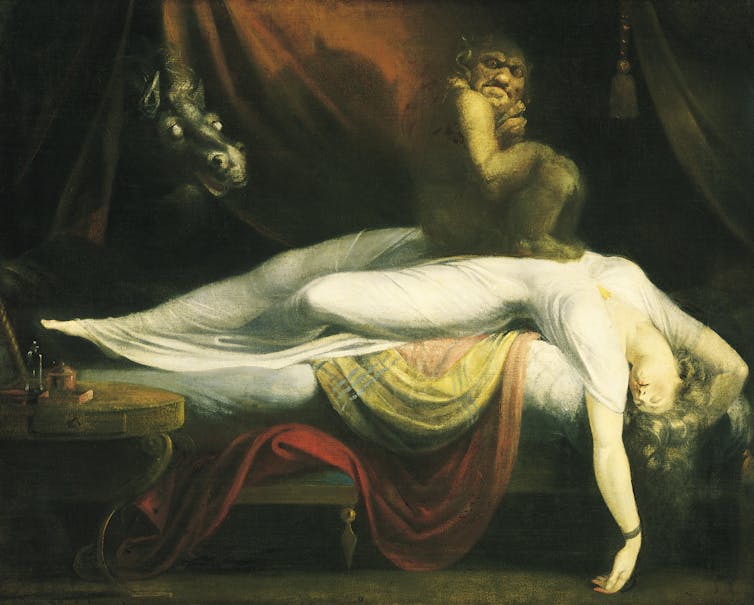
Vampire’s rebirth: from monstrous undead creature to sexy and romantic Byronic seducer in one ghost story
Sam George, University of Hertfordshire
Victorian physician John Polidori took the vampire out of the forests of eastern Europe, gave him an aristocratic lineage and placed him into the drawing rooms of Romantic-era England. His tale The Vampyre, published 200 years ago – on 1 April 1819, was the first sustained fictional treatment of the vampire and completely recast the folklore and mythology on which it drew. The vampire figure abandoned its peasant roots and left its calling card in polite society in London.
The story emerged out of the same storytelling contest at the Villa Diodati that gave birth to that other archetype of the Gothic heritage, Frankenstein’s monster. Present at this gathering were Polidori (then Byron’s physician) as well as Mary Godwin, the author of Frankenstein, Claire Clairmont, Mary’s stepsister, Mary’s soon-to-be husband Percy Shelley, and – crucially – Lord Byron.
Read more: Fantasmagoriana: the German book of ghost stories that inspired Frankenstein
Byron’s contribution to the contest was an inconclusive fragment about a mysterious man, Augustus Darvell, characterised by “a cureless disquiet”. Polidori took this fragment and turned it into the sensational tale of the vampire Lord Ruthven, preying on the vulnerable women of society.
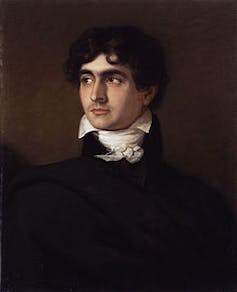
After its magazine debut the story was published in book form and went through seven English printings in 1819 alone. It was adapted for the stage the following year by melodramatic playwright James Robinson Planché, one of a growing number of vampire theatricals inspired by Polidori, such as those by Charles Nodier and others.
It was then expanded into a two-volume French novel by Cyprien Bérard, Lord Ruthwen ou les vampires. By 1830 it had been translated into German, Italian, Spanish, and Swedish.
Despite all these imitations and adaptations, “Poor Polidori”, as Mary Shelley liked to call him, has all but been forgotten and his lively tale has often been dismissed as a crude narrative, written under the influence of a greater, more subtle talent, Byron. And yet it was Polidori not Byron who succeeded in founding the entire modern tradition of vampire fiction.
Peasant to patrician
The vampire prior to this had been a blood-gorged, animalistic monster of the Slavic peasantry. In his study of the origins of Vampire lore, Vampires, Burials and Death, American scholar Paul Barber described the traditional image of the undead bloodsucker thus:
with long fingernails and a stubbly beard […] his face ruddy and swollen. He would wear informal attire — a linen shroud – and would look for all the world like a dishevelled peasant.
Polidori transformed the East European peasant vampire of old into a pale-faced, dead-eyed, licentious English aristocrat. This deceiving, dashing and cursed creature was in possession of “irresistible powers of seduction”, haunting the drawing rooms of Western society undetected. In the hands of Polidori, under the influence of Byron, vampires transitioned from dishevelled peasants into alluring, seductive aristocrats in the 19th century.
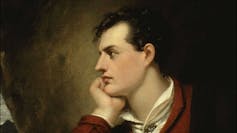
This elevation in social status is not all. Polidori’s The Vampyre is responsible for a number of groundbreaking innovations. He established links to the aristocracy – where there had never before been an urban vampire, let alone one as educated and high in social rank. He also introduced the notion of the vampire as sexual predator, showing his readers, for the first time, the vampire as rake or libertine – a real “lady killer”. As he wrote in his novella:
The guardians hastened to protect Miss Aubrey; but when they arrived, it was too late. Lord Ruthven had disappeared and Aubrey’s sister had glutted the thirst of a VAMPYRE!
Mad and bad
Lord Ruthven is a satirical portrait of Byron as a seducer of women in polite society. “Mad, bad, and dangerous to know” – as the aristocratic writer Lady Caroline Lamb described the lover who had spurned her. This is the image we have of the vampire. Lamb cast Byron as the dark and duplicitous Gothic seducer, Lord Ruthven in her 1816 novel Glenarvon. In turn, Polidori took the name Lord Ruthven in order to create the first literary vampire.
Lord Ruthven spawned a series of saturnine or demonic lovers in turn, from the Brontës’ Mr Rochester to the more sexy incarnations of Dracula and the contemporary paranormal romances of mortal women seduced by brooding bad and dangerous vampires.
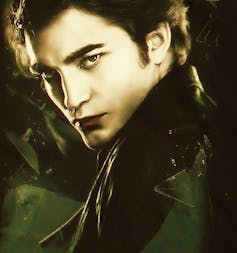
Polidori’s vampire, despite being something of a blank canvas, is sexualised and mesmeric, providing a template not only for Count Dracula but for the “Byronic hero” that features in Gothic romance from pre-Victorian times down to present-day paranormal romances such as Twilight. Edward Cullen – played by Robert Pattison, continuing the tradition of British actors playing vampires from Christopher Lee to Gary Oldman – is a reproduction of this earlier archetype. He’s something of a consumerist fantasy – as expensive as diamonds, marble or crystal:
His skin white […] literally sparkled, like thousands of tiny diamonds were embedded in the surface. He lay perfectly still in the grass, his shirt open over his sculptured incandescent chest, his scintillating arms bare […] a perfect statue carved in some unknown stone, smooth like marble, glittering like crystal.
Cullen’s aristocratic charm and anachronistic way of speaking (“I endeavoured to secure your hand” he tells Bella) indicate he is a relic of earlier models of vampiric masculinity, further evidence of the long-reaching legacy of Polidori’s vampire.
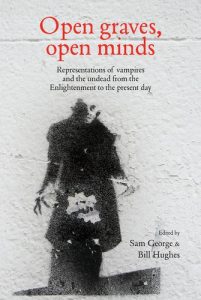
As Catherine Spooner, Professor of Gothic Literature at Lancaster University, has argued in a collection of essays about Vampires – Open Graves, Open Minds: Representations of Vampires and the Undead which I co-edited in 2012: “Over a period of about 200 years vampires have changed from the grotty living corpses of folklore to witty, sexy, super achievers.”
Polidori died in London in August 1821, weighed down by depression and gambling debts. It is said that he committed suicide by means of cyanide but that, to protect his family’s name, the coroner gave a verdict of death by natural causes. Sadly he wasn’t to know the fame his creation would achieve as the star of hundreds of books, plays and films – and millions of nightmares.
Sam George, Senior Lecturer in Literature, University of Hertfordshire
This article is republished from The Conversation under a Creative Commons license. Read the original article.
Posted in Conferences, OGOM: Polidori Symposium
Tagged Byron, John Polidori, The Vampyre, Vampires
1 Comment
Polidori’s Bloodsucking Progeny: Scholars gather to celebrate 200 years of vampire fiction
The first news stories are starting to appear now about our exciting bicentenary event, like this one…
To mark the bicentenary of the publication of John Polidori’s gothic tale The Vampyre, academics from across the world will gather at the Open Minds, Open Graves Symposium. It is well known that Polidori’s vampire emerged out of the same storytelling contest at the Villa Diodati in 1816 that gave birth to that other archetype of Gothic heritage, Frankenstein’s monster. Present at this gathering were Polidori (who was Byron’s physician); Mary Godwin, Frankenstein’s author; Claire Clairmont, Percy Shelley, and (crucially) Lord Byron. Byron’s contribution to the contest was a fragment about a mysterious man characterised by ‘a curious disquiet’. Polidori took this fragment and turned it into the tale of the vampire Lord Ruthven, preying on the vulnerable women of society. The Vampyre was something of a sensation and spawned stage versions and imitations that were hugely popular. It marked the beginning of European literature’s endless fascination with the figure of the vampire.
On 6-7 April 2019, the Open Graves, Open Minds research group at the University of Hertfordshire will present ‘Some curious disquiet’: Polidori, the Byronic vampire, and its progeny’. A symposium for the bicentenary of The Vampyre, at Keats House, Hampstead.
“The symposium will celebrate Polidori for having succeeded in founding the entire modern tradition of vampire fiction. In the hands of Polidori (inspired by the figure of Lord Byron), vampires transitioned from dishevelled peasants into alluring seductive, aristocrats. This elevation of social rank is not all. Links to the aristocracy in England were established. There seemed never to have been an urban vampire, nor an educated vampire prior to this. A predatory sexuality had been introduced in relation to the vampire. We see for the first time the vampire as rake or libertine, a real lady killer”.
Dr Sam George
Senior Lecturer in Literature at the University of Hertfordshire and convenor
of Open Minds, Open Graves
“Mad, bad, and dangerous’—and hot! That’s how Lady Caroline Lamb saw the poet Byron, the lover who discarded her. And that’s the image we have of the vampire in the twenty-first century. Lamb cast Byron as the dark and duplicitous Gothic seducer, Lord Ruthven, in her novel Glenarvon (1816). In turn, John Polidori, Byron’s physician, took the name Lord Ruthven in creating the first literary vampire, 200 years ago in April in his novella The Vampyre. Polidori’s vampire is a satirical portrait of Byron as a seducer of women in polite society. Ruthven spawned a series of demonic lovers from the Brontës and Daphne du Maurier to the more sexy incarnations of Dracula and the paranormal romances of mortal women seduced by brooding bad and dangerous vampires. At this symposium, leading scholars of the Gothic tell this story of the legacy of Polidori’s disquieting vampire.”
Dr Bill Hughes
Open Minds, Open Graves project
“Lord Ruthven is a seminal vampire, eliciting both desire and disgust. He creates the possibility for the villainous bloodsucker to become the romanticised vampire of the late twentieth century. Without Polidori’s The Vampyre, there could be neither Dracula nor his lineage. Lord Ruthven’s seductive, Byronic powers make him the first vampire you would invite into your home, and possibly your bed!”
Dr Kaja Franck
Postdoctoral researcher at the University of Hertfordshire
The event will trace Polidori’s bloodsucking progeny and his heritage of ‘curious disquiet’ in literature and film. The delegates have been selected for their expertise in the Byronic, the Gothic, and the vampiric. The Symposium is to be held at Keats House, Hampstead, home of the poet. They hold a first edition of The Vampyre.
The University of Hertfordshire’s MA module ‘Reading the Vampire: Science, Sexuality and Alterity’ is now in its ninth year
https://www.herts.ac.uk/about-us/news/2019/march/polidoris-bloodsucking-progeny-scholars-gather-to-celebrate-200-years-of-vampire-fiction.
Tickets available here
https://www.opengravesopenminds.com/polidori-symposium-2019/
Posted in OGOM: Polidori Symposium
Tagged bi-centenary event, John Polidori, vampire
Leave a comment
Demon Lovers, Crime, and the Gothic at Bath Spa
I had a great time yesterday at Bath Spa University giving a presentation on the evolution of the Demon Lover in Gothic Romance and paranormal romance. I was invited by my doppelgänger Prof. Bill Hughes and heard a variety of excellent papers from postgraduates on the MA in Crime and Gothic Fictions, covering such diverse topics as eco-Gothic, natural disaster, serial bingeing, embodiment, urban legends, and Scottish Gothic. I’d like to thank Bill and everyone who came for such a stimulating conversation.
If anyone wants to hear more on the development of the Demonic Lover in their role as vampire, there is still time to come and see me and some very notable scholars of the Gothic talk on the origins of the literary vampire in John Polidori’s The Vampyre, whose bicentenary we are celebrating at this fabulous symposium.
Posted in OGOM Research, OGOM: Polidori Symposium
Tagged crime, demon lovers, Gothic, Gothic romance, John Polidori, Paranormal romance, Vampires
Leave a comment
CFPs and Events: Frankenstein, Buffy, horror, hauntology, 1980s, death and the sacred
Quite a few calls for papers and articles here. We’ve also added two new useful links – Gothic Feminism and the journal Thinking Horror.
1. Call for articles: Deadline Extended till 15 April 2019 – Irish Journal of Gothic and Horror Studies issue no. 18
2. Call for Papers: Edited collection Frankenstein’s Lives: Shelley’s Novel as Cultural Phenomenon. Deadline 20 May 2019
3. Manuscripts wanted for new series Critical Conversations in Horror Studies
4. CFP Buffy and the Bible, University of Sheffield, 4-5 July 2019. Deadline 18 March 2019
Part of the Gothic Bible Project, and following our inaugural Gothic Bible conference in 2017 (which you can read all about here) ‘Buffy and the Bible’ will take the hit show Buffy the Vampire Slayer (1997-2003) as a case study to interrogate the relationship between religion and popular culture, and we welcome papers and posters that explore this theme in any aspect of the Buffyverse.
5. CFP symposium: The Gothic 1980s: The decade that scared us, Manchester Metropolitan University, 8 June 2019. Deadline 29 March 2019.
But why the Gothic grip on a decade many see as a time of electronic dance music, brash pop culture and new technology? ‘The Gothic 1980s: The decade that scared us’ is a symposium determined to stretch beyond the stereotypes attached to the era and invites participants to delve into the themes of what was ultimately a divisive, often dark, and certainly fascinating, decade.
6. A free panel discussion: HAUNT Manchester and Not Quite Light present: Following Hauntology: twilight streets and dark horizons, Manchester Metropolitan University, 27 March 2019
A panel discussion featuring a number of academics, artists and innovators discussing ideas and themes around Hauntology. Hauntology is a way of thinking about our world as intrinsically ghostly; one in which our present is always already ghosted by unresolved pasts and unrealised futures.
7. Death and the Sacred Symposium, 22 March 2019, Manchester Metropolitan University.
This symposium will focus on literature, arts and practice where individuals, groups, artists and writers explore a range of topics and themes deemed sacred and their interaction with death. Across all religions and cultures, death and dying has always loomed over sacred sites, texts, practises and journeys, and death has always commanded ritual and sacred attention. The theme ‘death and the sacred’, therefore, provides a fruitful topic for thinking about how the uniquely ordained, set aside, extraordinary features of particular locations and sites, bodies, practises and belief systems are influenced, reformed and repurposed by death.
Posted in Call for Articles, CFP (Conferences)
Tagged 1980s, Feminism, Frankenstein, Gothic, hauntology, horror, religion
Leave a comment
Programme and Booking for Polidori Vampyre 200
Tickets are selling rapidly for the Polidori Vampyre Symposium so do book here before it’s too late! The programme is available here and we think it’s looking fabulous–see the images below.
‘Mad, bad, and dangerous’—and hot! That’s how Lady Caroline Lamb saw the poet Byron, the lover who discarded her. And that’s the image we have of the vampire in the twenty-first century. Lamb cast Byron as the dark and duplicitous Gothic seducer, Lord Ruthven in her novel Glenarvon (1816). In turn, John Polidori, Byron’s physician, took the name Lord Ruthven in creating the first literary vampire, 200 years ago in his novella The Vampyre. Polidori’s vampire is a satirical portrait of Byron as a seducer of women in polite society. Ruthven spawned a series of demonic lovers from the Brontës and Daphne du Maurier to the more sexy incarnations of Dracula and the paranormal romances of mortal women seduced by brooding bad and dangerous vampires. At this symposium, leading scholars of the Gothic tell this story of the legacy of Polidori’s disquieting vampire.
Polidori Vampyre 200 Booking
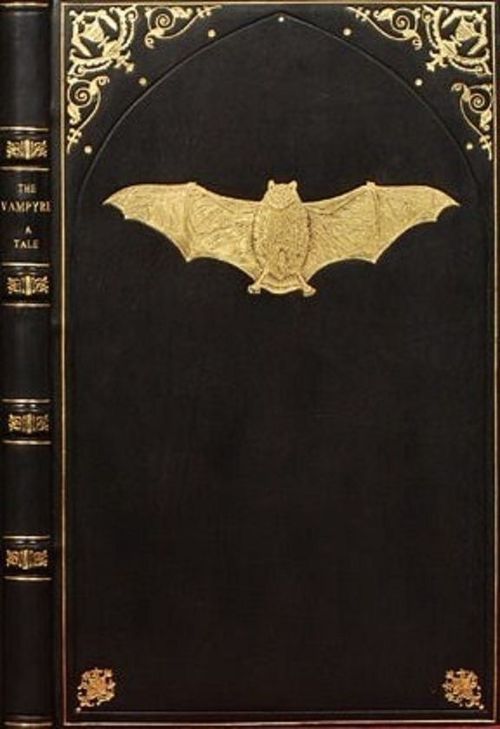
Booking for the symposium for the bicentenary of John Polidori’s The Vampyre is now open–click here. It’s going to be a fabulous event: have a look here for full details and here for the programme of brilliant speakers.
Posted in Conferences, Events, OGOM News, OGOM: Polidori Symposium
Tagged Booking, Gothic, John Polidori, Romanticism, Vampires
2 Comments
RIP Michel Legrand
It was sad to hear of the death of Michel Legrand (1932-2019) on Saturday. Legrand wrote the music to countless films, many from French New Wave cinema. His music fits perfectly the stylish and witty reinterpretation of Perrault’s fairy tale ‘Donkey Skin’, Peau d’Ane (1970) directed by Legrand’s frequent collaborator Jacques Demy. Here’s a scene from the film with one of Legrand’s songs, featuring the enchanting Catherine Deneuve.
Posted in Film Clips, News
Tagged Charles Perrault, fairy tale, Film, Jacques Demy, New Wave cinema, obituary
2 Comments
CFPs: Myth and dream, horror, Dracula and vampires, youth horror
A few CFPs for conferences and calls for articles:
1. Myth and Dream / The Dreaming of Myth, 23-24 May 2019, University of Bologna. Deadline: 28 February 2019.
The conference invites proposals addressing diverse approaches to the combination of myth and dream – literary, artistic, scientific or theological – that enjoy attention in the contemporary world.
2. Fear 2000: Contemporary Horror Worldwide, 1-2 June 2019, Sheffield Hallam University. Deadline: 1 March 2019.
We invite proposals for 20 minute papers and 80 minute panels for the fourth annual Fear 2000 conference at Sheffield Hallam University – Fear 2000: Contemporary Horror Worldwide. Hosted by staff and postgraduate students in the Department of Humanities, the conference will investigate international horror cinema in the twenty-first century.
3. Call for articles for Journal of Dracula Studies. Deadline: 1 May 2019.
We invite manuscripts of scholarly articles (4000-6000 words) on any of the following: Bram Stoker, the novel Dracula, the historical Dracula, the vampire in folklore, fiction, film, popular culture, and related topics.
4. Call for contributions to an edited collection on Critical Approaches to Youth Horror. Deadline: 17 June 2019.
We are looking for a broad base of scholarship from emerging and advanced scholars. We are open to chapters that include different types of media, but prefer chapters focused on popular youth horror film and television.
Posted in Call for Articles, CFP (Conferences)
Tagged Bram Stoker, Children's literature, Dracula, dream, Film, Folklore, global Gothic, horror, myth, TV, Vampires, YA Fiction, YA Gothic
Leave a comment
CFPs: Vampires, Gothic feminism, zombies, youth horror, creative work
A set of conference CFPs and call for articles:
1. Academic Vampire Conference: Hammer, Highgate, and the Vampire, 10-13 July 2019, Lauderdale House, Highgate Village. Deadline: 3 May 2019.
The University of South Wales, in association with the IVFAF, calls for papers by scholars interested in presenting their researched essays on vampire literature, film, folklore, theatre, games, graphic novels, lifestyle, fashion, music and wider art in the fourth annual Vampire Academic Conference (VAC) that runs alongside the festival in London.
2. Gothic Feminism 3: Technology, Women and Gothic-Horror On-Screen, 2-3 May 2019, University of Kent. Deadline: 15 February 2019.
Our conference aims to explore this relationship between technology and the Gothic by focussing upon its intersection as depicted on screen within visual media, with a specific focus on how such concerns impact on gender representations and, in particular, women.
3. Call for Articles – special edition of Revenant: Revolution in the Dead: The Cultural Evolution of the Zombie. Deadline: 30 April 2019.
Revenant (www.revenantjournal.com) is now accepting abstracts for articles, creative writing pieces, and book, film, game, or event reviews for a themed issue on zombies, examining the social and cultural evolution of the zombie.
4. Call for chapters in an edited collection: Critical Approaches to Youth Horror. Deadline: 17 June 2019
In the midst of a renewed interest in horror as a medium for the expression of cultural and social issues, this collection will take advantage of an underdeveloped field of scholarship and create new scholarly conversations focused on youth and young adult television and horror film.
5. Reimagining the Gothic 2019: Creative Competition, University of Sheffield. Deadline: 11 March 2019.
Sheffield Gothic is delighted to announce our 2019 Reimagining the Gothic creative competition!
Each year as part of Reimagining the Gothic we hold a creative showcase: an opportunity to explore the theme through various creative methods. This year, that theme is ‘Returns, Revenge, Reckonings’ – think everything from Senecan tragedies to the Marvel Cinematic Universe, from noble avengers to usurping Counts, from vengeful lovers to prophetic witches.
Posted in Call for Articles, CFP (Conferences)
Tagged Female Gothic, Feminism, horror, technology, Vampires, women, YA Fiction, Zombies
Leave a comment