Song of the Sea

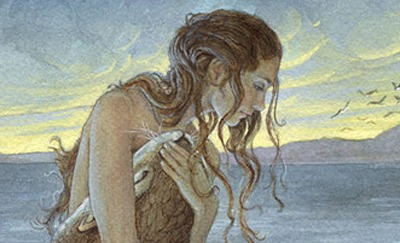
More on selkies, who are exercising their fascination over me more and more. If I disappear, it will be because I have become spellbound by a sea maiden.

This trailer for Song of the Sea was passed on to me by Curtis Runstedler, who presented on the benevolent medieval werewolf as one of the many brilliant papers at the Company of Wolves conference. This animated film looks absolutely beautiful.

Posted in Film Clips | Tagged , , | 2 Comments

Angela Carter: Lisa Appignanesi on ‘The Company of Wolves’

More on Angela Carter (I forgot to include this!).

A special showing of Neil Jordan’s brilliant film The Company of Wolves, based on Carter’s stories: 26 February 2016 at 7 p.m., London Review Bookshop: Lisa Appignesi introduces it.

Neil Jordan’s astonishing and alarming 1984 film The Company of Wolves, based on an even more astonishing and alarming short story by Angela Carter, will be introduced by Lisa Appignanesi. Featuring performances by Stephen Rea, Angela Lansbury and David Warner, and a screenplay co-written by Carter herself, The Company of Wolves remains one of the most highly-rated British films of the last several decades. Lisa Appignanesi, prize-winning writer, novelist, broadcaster and cultural commentator, will be introducing the film, and the evening will be hosted by Gareth Evans, curator of film at the Whitechapel Gallery.

Posted in Events | Tagged , , | 3 Comments

Angela Carter: Masterclass with Marina Warner; Critical Essays and Discussions

I think Angela Carter must be one of the presiding spirits haunting (benevolently) the OGOM Project. Her rich and startling prose, full of intelligence and humour, draws on all strands of fantastic narrative–fairy tale, Gothic, science fiction, horror. She has written vampire tales and the stories in The Bloody Chamber are, in a sense, some of the Ur-texts of paranormal romance. And, of course, the wolf tales in that volume and the ensuing film, The Company of Wolves inspired our 2015 conference of that name and animated much of the discussion. And Sir Christopher Frayling, in his fascinating plenary, gave a touching account of his friendship with Carter alongside a discussion of his work (which features in his book, Inside the Bloody Chamber).

Marina Warner–also a frequent subject of this blog–is delivering a masterclass, Myth, Magic & Angela Carter, ‘exploring re-tellings and re-visionings in short fiction’ in London on 27 February 2016. It looks truly fabulous (in every sense).

Carter has attracted much research but her incisive journalism and critical writing has been neglected (as Si Christopher pointed out). So this discussion of her criticism at the LRB blog is very welcome.

Edmund Gordon gives an interesting and useful introductory talk on The Bloody Chamber here.


Posted in Courses, Resources | Tagged , , , , | 2 Comments

CFP: Fantasies of Contemporary Culture, Cardiff University, 23 May 2016

There are so many exciting conferences coming up this year; they usually get winnowed down for me by my forgetting to meet the deadlines. This Fantasies of Contemporary Culture conference, at Cardiff University, is yet another very tempting event on fantastic literature of all varieties.

Roger Schlobin claims that the ‘key to the fantastic is how its universes work, which is sometimes where they are, but is always why and how they are’ (‘Rituals’ Footprints Ankle-Deep in Stone’, 2000, p. 161). With this claim in mind, we invite submissions from any discipline that address the relationship between current cultural, social and political dialogues and fantasy texts – specifically ones that interrogate dominant structures of power, normativity and ideology.

The deadline is 21 March 2016.

Posted in CFP (Conferences) | Tagged , , , , | 2 Comments

Origins of the Fairy Tale

Kaja recently commented on and posted links here to articles describing the research by Dr Jamie Tehrani (Durham University) and Sara Graça da Silva (New University of Lisbon) on the origins of fairy tales. I found this fascinating but had certain doubts about the methodology and about how the tales were considered in an abstract way that rendered them timeless and lost their particularity (much as formalist analyses like those of Propp can do).

Then I came across an interesting discussion on the research on the American Folklore Society’s Folk Narrative Section Facebook page (well worth joining!). Here, Tok Thompson (University of Southern California) shares some of my concerns, and has kindly allowed me to cite him:

I think it’s an interesting approach, but yes, there’s several problems with this research.

It’s not so much the theory as the data that is the problem. This sort of research borrows phylogeny models from biology. But stories are not like biology in the way they are replicated– not even close. Some other very questionable analyses have been done on languages using this model– and this study relies on those language studies…. but the study of narratives is even less applicable to the phylogenetic model than languages are.

One problem, simply put, how do we know if these stories are related? Polygenesis (and blended genesis) is quite common in story-telling, and almost completely absent in biology and language. The authors assemble the narratives as they like, then they declare they are related, then they align them with a family tree to make assessments about how old they are. This is just a return to the old 19th century historic-geographic search for the ur form, without any recognition of why folklorists increasingly turned away from such studies.

From the authors earlier “Phylogeny of Little Red Riding Hood” comes the following quotes:
“Folktales represent an excellent target for phylogenetic analysis because they are, almost by definition, products of descent with modification”.
Note, this is quite an assumption of a biological model–descent with modification– monogenesis and diffusion–of folktales. Thus, the author assumes from the beginning that the tales all are related– in other words, the author has already assumed the conclusion before assembling the data for the analysis!

Then when it comes to assembling the data: “In addressing this question, phylogenetics has several advantages over traditional historic-geographic methods. First, rather than basing the classification of related tales on just a few privileged motifs, phylogenetic analysis can take into account all the features that a researcher believes might be relevant.”
Note the important: “all the features that a researcher BELIEVES might be relevant.” In other words, after assuming the conclusion is true, the author then assembles the data package, according to what they think is important. Problematic! & this, importantly, is very different from how phylogenetic models would be employed with biology. Again, stories work differently than chromosomes– it’s quite an assumption to assume that the patterns for reconstructing the latter would work just fine and dandy for the former.

& another critique might be… so what? One of the reasons that Folklore Studies moved away from the quest for the ur- form was that it really didn’t produce much of interest– no glimpses as to meaning, to performance, to agency… to most of the aspects that give folklore its vibrancy and importance in the lives of individuals. The possible prehistory of the tales themselves has to be the least interesting aspect of folklore for me, personally.


Posted in Critical thoughts | Tagged , , , | 3 Comments

CFP: Global Fantastika

Just a reminder that the deadline for the Global Fantastika conference (4th-5th July 2016) is 1st March 2016. I attended Locating Fantastika last year and as my review shows, it was well worth the trip.

Posted in CFP (Conferences) | Tagged , , , , | Leave a comment

It’s A Kind of Magic: The Books of Renaissance Magician John Dee Go On Display

Book-of-Black-Magic_jrl15100807

One of the courses I was teaching last semester was Renaissance Literature and the most enjoyable part was the exploration of magic on stage from Dr Faustus to The Tempest and the magical statue scene in A Winter’s Tale. The influence of real life magicians on playwrights such as Shakespeare and Marlowe was not lost on the students and we had many interesting discussions about the conjurer John Dee. I was thrilled therefore to see a recent article by Mark Brown, Arts Correspondent in The Guardian, on John Dee in which he explains that:

Dee, known in his day as “the Queen’s conjuror”, was one of the most extraordinary Elizabethans, a Renaissance polymath who has fascinated people for centuries. He may have been the inspiration for Shakespeare’s Prospero in The Tempest, and more recently he has intrigued artists such as Derek Jarman, who had him as a central character in his 1978 film Jubilee, and Damon Albarn, who wrote the 2011 opera Dr Dee.

At the Royal College of Physicians (RCP) headquarters in London, where remarkable books from Dee’s personal collection go on public display for the first time, there is further intrigue as recent research tells us that a John Dee painting originally had circle of human skulls, x-ray imaging reveals Those interested in Harry Potter wizardry might like to consider the real history of magic here in the UK through figures such a John Dee….it’s absolutely extraordinary.

Posted in Critical thoughts, Events, exhibitions | Tagged , , | 6 Comments

Magical Skins: The Selkie’s Transformation

As soon as the seal was clear of the water, it reared up and its skin slipped down to the sand. What had been a seal was a white-skinned boy

George Mackay Brown ‘Pictures in the Cave’

3the-selkie

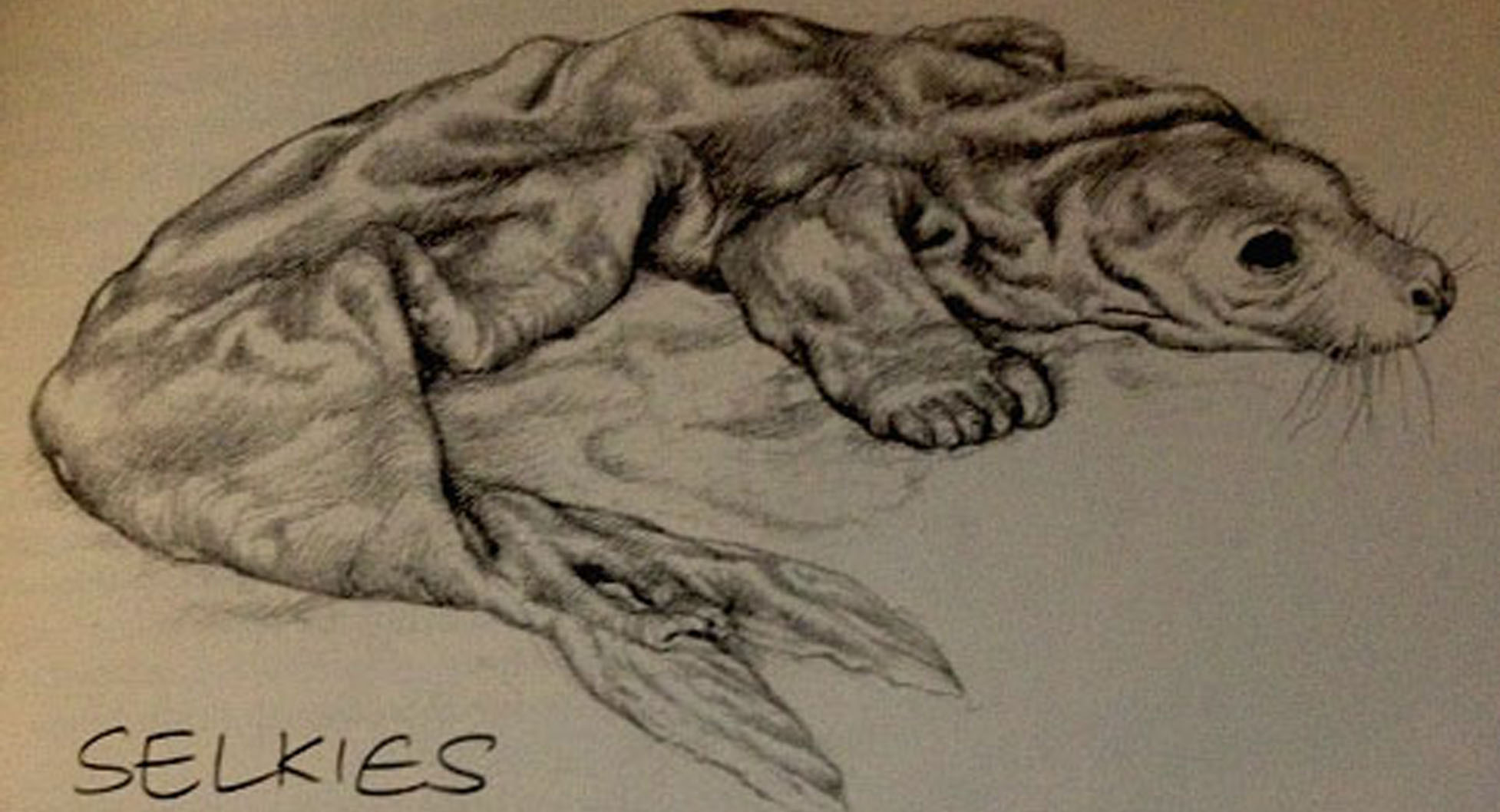
In response to the lively interest in my post on selkies and Kaja’s on the pain of transformation for werewolves I thought I would post a further extract on selkie lore describing their magical skins:

In the surviving folklore, there is no agreement as to how often the selkie-folk were able to carry out the transformation. Some tales say it was once a year, usually Midsummer’s Eve, while others state it could be “every ninth night” or “every seventh stream”.
Regardless of how often they were able to transform, the folklore tells us that once in human form, the selkie-folk would dance on lonely stretches of moonlit shore, or bask in the sun on outlying skerries.

A common element in all the selkie-folk tales, and perhaps the most important, is the fact that in order to shapeshift they had to cast off their sealskins. Within these magical skins lay the power to return to seal form, and therefore the sea.

If this sealskin was lost, or stolen, the creature was doomed to remain in human form until it could be recovered. Because of this, if disturbed while on shore, the selkie-folk would hastily snatch up their skins before rushing back to the safety of the sea.

See Orkneyjar.com for more selkie folklore!

selkieskin

Bill is currently reading a very promising YA paranormal romance with selkies–and a witch too (praised by Marcus Sedgwick). It’s Margo Lanagan’s The Brides of Rollrock Island  and OGOM contributor Victoria Amador has made us aware of this selkie film, ‘The Secret of Roan Inish’ and there’s even a children’s selkie novel, Mollie Hunter’s A Stranger came Ashore–which looks good and has been well-reviewed.

Katherine Briggs (usually my folklore bible) is a bit short on selkies but she does have an entry on the Orkney Isles where seal maidens are among the commonest of fairy brides and ‘sometimes as in the Orcadian tale of the Great Silkie of Sule Skerry, a mortal woman is wedded to a seal husband’ (Katherine Briggs, The Fairies in Tradition and Literature, p. 52).

Keep sending us your selkie books!

selkieimages

Posted in Critical thoughts, Fun stuff, Generation Dead: YA Fiction and the Gothic news | Tagged , , | 5 Comments

CFPs and Talks

This an admin-esque post just drawing people’s attention to some CFPs and a talk that might be of interest to our followers. Firstly, there is a CFP for the Victorian Popular Fiction Association which will be holding its conference from the 14th-15th July 2016 (Deadline for Proposals: 1st April 2016).

Then there is a CFP for the next edition of Studies in Gothic Fiction, a peer-reviewed journals for the Gothic, which will be dedicated to Disabled Gothic Bodies. Abstracts for this are due by Monday 30th May 2016.

The body and the mind come together at ‘(Dis)Connected Forms: Narratives on the Fractured Self’, 8th-9th September 2016. The deadline for this CFP is 3rd April 2016.

Finally, Dr Matthew Townend will be giving a talk at the University of Nottingham on ‘The Glamour of Mirkwood: From Old Norse to Modern Fantasy’ on 29th January 2016.

Posted in Call for Articles, CFP (Conferences), Conferences, Events | Tagged , , , , , , , , , , , , , | Leave a comment

Top 10 Werewolf Scenes

Bill posted a YouTube video containing the ‘Top 10 Werewolf Scenes’. Most of these scenes centre, understandably, on the transformation of man into wolf/ lupine monster. Interestingly the obsessive recording of the agonising transformation is a relatively recent addition to the werewolf.

There is an excellent transformation scene in G. W. M. Reynolds’ Wagner the Wehr-Wolf (1846-1847): ‘But, lo! what awful change is taking place in the form of that doomed being? His handsome countenance elongates into one of savage and brute-like shape;-the rich garments which he wears become a rough, shaggy, and wiry skin;-his body loses its human contours-his arms and limbs take another form; and, with a frantic howl of misery, to which the woods give horrible faithful reverberations, and with a rush like a hurling wind, the wretch starts wildly away-no longer a man, but a monstrous wolf!’ (From Terrifying Transformations: An Anthology of Victorian Werewolf Fiction, edited by Alexi Easley and Shannon Scott, p. 68).

The elongating snout and the loss of clothes would be masterfully reproduced in John Landis’ An American Werewolf in London (1981). By which time the pain of being reborn a wolf has become standard fare in representations of the werewolf in popular culture. The agony is part of the curse and the werewolf is an embodied monster – recreated each time they transform. In some contemporary texts, the transformation has become beneficial as the werewolf is able to heal as they transform.

However, what these YouTube clips remind me of is Being Human (UK, 2009-2013), which features in the video, and Mitchell’s description of George’s transformation:

“He should be dead within 30 seconds. The werewolf heart is about two-thirds the size of a human’s; but, in order to shrink, first, it has to stop. In other words, he has a heart attack. All the internal organs are smaller; so, while he’s having his heart attack, he’s having a liver and kidney failure too, and if he stops screaming, it’s not because the pain has dulled: his throat, gullet, and vocal chords are tearing and reforming. He literally can’t make a sound. By now, the pituitary gland should be working overtime, flooding his body with endorphins to ease some of the pain, but that, too, has shut down. Anyone else would have died of shock long ago, but it won’t let him. And that’s the thing I find most remarkable: it drags him through fire and keeps him alive and even conscious to endure every second. Nothing like this could just evolve; this is the fingerprint of God, an impossible, lethal curse, spread by tooth and claw. Victim begets victim begets victim. It’s so cruel, it’s… perfect”. (Being Human, S1: Ep2)

This description encapsulates the horror of the werewolf and punishment of the body for daring to transform into a stronger being.
Posted in Critical thoughts, Film Clips, Fun stuff | Tagged , , , , , , , , , | Leave a comment