‘Reimagining the Gothic 2016: Monsters and Monstrosities’ took place on 6th-7th May. It consisted of two days: the first being a showcase which featured both postgraduates and undergraduates working in the field of the Gothic presenting their work to the congregated academics. The second day was dedicated to a creative showcase that included interactive artwork and the keynote by Dr Xavier Aldana-Reyes, ‘Rethinking the Monstrous Feminine: The (Un)Gendered Body of Abjection’. Together they provided an engaging interdisciplinary approach to the Gothic and showed the vitality and visibility of a genre that is most often associated with death, the past and the hidden. (The post-mortem of this year’s ‘Reimagining the Gothic’ can be found here).
The opening panel of the symposium looked at Gothic spaces. Kate Gadsby-Mace considered Dominik Moll’s film adaptation of Matthew Lewis’ The Monk (1796), Le Moine (2011). Her paper raised the difficulties of transforming a Gothic novel from page to screen. This is particularly prevalent in Lewis’ novel as it features multiple storylines, sub-narratives, supernatural elements and an ostensibly anti-Catholic motif. Gadsby-Mace argued that Moll simplifies the novel but remains true to the spirit and themes of the text. The overarching sense of voyeurism is brought in by using gargoyles who stare at what is happening within the walls of the monastery thereby framing the action. Ultimately, Moll makes Ambrosio more sympathetic. He becomes a character who reflects the viewer’s weaknesses and human frailty in general.
Framing recurred in Hannah Moss’ paper, ‘Mary Shelley’s Nightmare: Fuseli and the Aesthetic of Frankenstein’, which suggested that, as with Fuseli’s painting, Shelley used perspective and proportion to frame and create her monster. By using Holst’s illustration as an intermediate between Fuseli and Frankenstein, Moss explored how the Gothic object (including the novel) created unanswered questions beyond the boundaries of the text. I was particularly taken with Moss’ discussion of the first description of the monster which presents him as a beautiful, not monstrous, form. The description, as Moss showed, is a form of the blazon which is more associated with courtly poetry. This was particularly pertinent to my research as it formed one of my arguments regarding how Bella described Edward Cullen in the Twilight novels. This parallel shows how desire and fear for the Gothic creature is often confused and can lead to the objectification of difference.
The next paper, ‘Alan Titchmarsh meets Victor Frankenstein: Monsters in the Greenhouse; by Teresa Fitzpatrick, caught my eye because it combined the twin interests of OGOM’s Sam George – vampires and botany. Fitzpatrick looked at two short stories, ‘The Sumach’ (1919) and ‘The Devil Flower’ (1939), and their presentation of vampiric plants born of human mismanagement. The paper argued that the fear of these plants was in dialogue with American concerns regarding the world wars in Europe and their threat to the USA. I would be interested in thinking about whether similar concerns arise in Werewolf of London (1935) and its presentation of the foreign Other in relation to lycanthropy and plant life as well as ‘The Blood Flower’ (1927) by Seabury Quinn. Both these texts relate lycanthropy (its cure and curse) to a flower and non-English speaking nations.
The final paper in this panel looked at the horror and Gothic qualities of archaeology. Dr Katy Soar argued for the importance of archaeological objects in the Gothic as showing the monstrous delineality of time. The excavated artefact stands as a reminder of the atavistic presenting to the viewer our Self in the past and removing our progressive sense of time. Soar suggested that the act of excavation is itself uncanny as it reveals that which should have remained covered: the archaeological object becomes a revenant.
Following a short break, we moved onto ‘Gothic Media’ which considered presentations of monsters and Gothic creatures in comics, the internet and video games. Barbara Chamberlain looked at how witches are represented in comic books in regards to the framing devices that are used in the page layout. In particular the manner in which the page layout disrupts the normal method of reading – from left to right and from top to bottom – allows a more complex representation of the triptych presentation of the witch, ie, the maiden, mother and crone. Chamberlain’s paper raised the pertinent point of whether witches are truly monsters since they are at once too monstrous and not monstrous enough.
The next paper, ‘Manumitting the Monster from “The Mythos of Harm”’ by Dr Sarah Cleary was of particular interest to me. Drawing on the accounts of the Slender Man stabbing, Dr Cleary showed how the media blurs the lines between reality and Gothic fictions. The reports on the Slender Man stabbing, in which two girls stabbed their friend to prove their loyalty to the fictional, online monster Slender Man, tended to slip into language that suggested Slender Man was an entity with a real-life impact. The “mythos of harm” maintains that monsters are genuine threats and that we must protect children from their deviant effects. Thus childhood monsters have become scapegoats for moral panic. The idea that every time the Gothic changes its media it is perceived as becoming monstrous again is one I find compelling. In particular, I think this is made manifest, quite literally, in the Buffy the Vampire Slayer episode ‘I Robot, You Jane’ (S8:Ep8) in which a demon trapped in a suitably Gothic ancient tome is released into the internet and becomes a digital monster.
Digital, Gothic spaces was the subject matter of the next paper, ‘Humans as Monsters, Monsters as Things of Beauty: Exploring Monstrosity in Conceptual Videogames’ given by Maria Cohut. Cohut’s paper looked at the Tale of Tales an online videogame which features multiple Gothic environments which the player can explore. In particular, Cohut considered how hybridity could be made manifest in games in which the player has to be another species. In ‘The Endless Forest’, gamers take on a deer-like avatar with a human face. They can then explore the forest and meet other gamers. However, the lack of human speech and body language forces the human-gamer to experience this beautiful landscape in an unfamiliar body. With no purpose to the game other than exploration the role of the gamer becomes experience and sensation.
Moving from humans in animal bodies, we were invited to explore monstrosity in more familiar forms. Lucy Hall’s ‘The Third Man and the Human Face of Evil’ took Hannah Arendt’s term the ‘banality of evil’ to consider how evil manifests in human skins. Having first read Harry Lime, the antihero of the film, as a vampire, Hall rejected this motif as too obvious. Rather, she suggested, our desire to read Lime as a monstrous Other spoke of our fear regarding the human potential for extreme cruelty. The film allows us to read Lime as a vampire but also forces us to acknowledge he is human and thus his charm over the viewer challenges our own ability to overcome the temptation of evil.
Sandie Mill’s paper on Tom Holland’s Child’s Play (1988) certainly made evil monstrous again. The entire room was quivering with fear at the sight of the doll gone dark. The visceral reaction to the images and clips shown proved Mill’s point that dolls were uncanny and abject. They remind the viewer of childhood innocence and our own past but when imbued with adult evil they become the apex of fear. Dolls, as inanimate objects, appear to simulate the human but they remain on the outskirts of human subjectivity looking in – quite literally as they are often placed looking into a room. Yet at the same time they are given symbolic power because of the relationship between them and their counterpart, the child, who allows them access to the heart of family life.
Returning again to fear of the human, Maryam Jameela’s paper looked at ‘The Spectre of Terror in Contemporary Horror Films’ and post 9/11 horror. Critiquing the failure of psychoanalysis in acknowledging non-white experiences, Jameela considered how more recent horror films questions how we find out what, or who, constitutes the enemy Other and how we are culpable for their creation. Using the examples of The Cabin in the Woods (2011) and The Village (2004), the paper argued that these films explore how fear is created, maintained and orchestrated by people in positions of power by invoking a nebulous monstrous entity that is beyond our comprehension.
The idea of what we fear was returned to by Karen Graham in her paper ‘Will the real monster please stand up?: Fear in the age of sparkly vampires’. I was honoured to see one of my posts for OGOM mentioned in regards to the Twilight conundrum. What Graham’s paper was concerned with however was what we fear in the age of the sparkly vampire – a vampire who is increasingly sexualised as a locus of pleasure. And who is, moreover, increasingly secular suggesting a further movement away from traditional sources of power. Graham looked at the tension between science and the supernatural as a way of suggesting that the contemporary vampire drew our attention to the limitations, and possible repercussions, of scientific knowledge.
Following Graham, was one of Sam George’s student Daisy Butcher who was speaking about the representation of the vagina dentata in Sheridan Le Fanu’s Carmilla (1872). Opening with the idea of the vampire mouth as a site of both pleasure and pain, Butcher’s reading of the text considered how the female body is at once that which gives life but also potentially destructive. The righteous, heroic man of science is needed to destroy the sexual and consuming vampire. A narrative which paralleled gynaecological advice from this period which attempted to subdue women’s hysteric sexuality. Destroying the female vampire (defanging her) echoes the removal of the clitoris to cure nymphomania which was prevalent in the nineteenth century.
The aggressive and sexual female vampire was returned to by Emily Foster-Brown in her paper on Salomé and HBO’s True Blood (2008-2014). Foster-Brown asked why Salomé is so often presented as a vampire. The answer is that Salomé is already a vampire. Despite being an unnamed character in the Bible she has become the archetypal femme fatale: deadly, seductive, a woman who uses her sexuality to gain power often through the invocation of violence. True Blood’s representation builds upon the notion of religion by showing her to be a zealot as a well as harlot.
The final paper was given by Jen Baker who looked at the Gothic pop-up book. Like the comics discussed earlier, the pop-up book plays with both the traditional notions of reading as well as the intended audience of the Gothic. Haunted houses are particularly popular because they rely on the element of surprise and the idea that though we may enter the house, the house fights back by invading our personal space – something which a pop-up book can do very effectively. Baker argued that rather than being an aberration Gothic pop-up books were Gothic spectacle and interactive objects. The history of the moveable book is as a model for dissecting human corpses so the relationship between pop-up and Gothic predates the current publications. Reading these texts is an act of catharsis and transgression in which the reader is seduced by the tactile pleasure of the book.
The following day was the creative showcase which opened with Rachel Hughes’ ‘Anathemas of Masculinity: Man-Made Bodies in Frankenstein and Barry Hines’ Miners’ Strike Play’. Alongside dramatic readings of Hines’ text by Shaun Lawrence, Hughes argued that both the figure of the scab and Frankenstein’s monster are created through isolation, treachery, facelessness and fear of contamination. Like civil war, the miners’ strike ripped apart families forcing them to question who was ally and who was foe. The legacy of ‘scabbing’ outlives the death of the scab (or the end of the miners’ strike) and haunts our cultural and political landscape always threatening to return.
The next showcase was Evan Hayles Gledhill’s ‘Empathy for the Devil: Revisioning the Monster through Gothic Romance’ which featured an audio-visual accompaniment by Lori Morimoto. In this piece NBC’s Hannibal (2013-2015) was viewed through the lens of gothic romance. By comparing the narrative of Will Graham (Hugh Dancy) and Hannibal Lecter (Mads Mikkelsen) to Charlotte Brontë’s Jane Eyre (1847) and William Godwin’s Caleb Williams (1794), the potential romantic relationship between Will and Hannibal was made explicit. Morimoto’s video re-cut the television series to show the parallels between the different narratives. Gledhill’s commentary also explored the conversation between writers, director, fans and fanfiction calling attention to how, to use a Bakhtian term, Hannibal shows itself to be a dialogue forever engaging with other texts.
Frankenstein’s monster returned in ‘“The Creative Process” – Creating My Own Monster: Paying Homage and Re-imagining Mary Shelley’s Frankenstein’ in which Steven Guscott led us through how he wrote The Diary of V. Frankenstein (2016). It is difficult for any author, or artist, to express the thought patterns that lead to creative output but Guscott paved a way for the audience through his dark imaginings. In doing so he offered another way of accessing the original – as all good adaptations should. This insight into the creativity was followed by a reading of Greg Flynn’s ‘Humans of New Britain’ by Matt Voice. I don’t want to spoil the effect by telling what the short story entailed but it is an uncomfortable and discomforting mixture of fox hunting, poverty and power gone made. I urge you to search it out.
The key note, as mentioned above, was given by Dr Xavier Aldana-Reyes. It was intended to be in conversation with Barbara Creed’s The Monstrous-Feminine: Film, Feminism, Psychoanalysis (1993). I have admired Dr Aldana-Reyes work on horror from afar – see: my review of his monograph Body Gothic (2014) – so it was wonderful to meet him, to use a rather Gothic term, in the flesh. I was also thrilled to see that he was talking about Ginger Snaps (2000) which is my favourite werewolf movie. Even more exciting was the contention that this film shows that feminist horror is a very real possibility. (Perhaps excusing the fact that I thought it was the perfect movie to show my 12 year old sister as a way of bonding). In his opening, Aldana-Reyes drew attention to the dangers of feminist psychoanalysis by suggesting that we run the risk of re-inscribing the female body as monstrous is we adhere entirely to the idea that femininity is abjected. The use of psychoanalysis which we partake in (especially as Gothicists) sees the abject as a cultural or social concept not as a psychic event. Thus we should acknowledge that whilst Creed’s work explored the problematic representation of women as monstrous this is not an absolute: women are made monstrous by culture rather than being monsters a-priori.
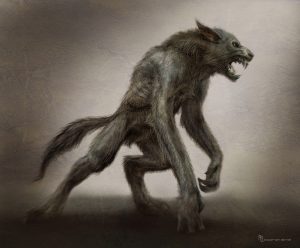
As an example of this though Ginger Snaps uses lycanthropy as a trope to explore female puberty, it does not conflate them. The boundaries between woman and werewolf are not collapsed and the narrative presents it metaphoric power at a surface level. Thus to read the film only as a metaphor for female puberty ignores the affective elements. Whilst acknowledging some of the weaknesses of the last third of the film which descends into somewhat clichéd horror tropes, Aldana-Reyes showed that Ginger’s corporeal transformation into a werewolf runs parallel to the viewer’s alienation from her as a character. Ginger loses her humanity and her body becomes a source of spectacle rather than abjection. Her final transformation is ungendered: we fear the werewolf and not the woman. To suggest that we fear the monster because she is female suggests that the most strongly defined aspect of the female monster’s body is its femininity rather than its ability to rip you apart. The film subverts monstrous female bodies by suggesting that they are fearful not because their gender makes them ‘other’ but because they are dangerous in their own right.
With regular breaks and easy access to hot drinks and sugary snacks, ‘Reimagining the Gothic’ was excellently organised. The atmosphere was welcoming and the discussion following the papers was particularly fruitful. It was a pleasure to return to the University of Sheffield which was where I undertook my BA and MA English Literature and to catch up with my previous dissertation tutor Professor Angela Wright. (It was particularly satisfying to hear that an undergraduate has asked to do their dissertation on Twilight fearing that it would be rejected because it wasn’t ‘academic’ enough and Prof. Wright was able to use my MA dissertation as proof that it can be done). I look forward to the next Reimagining the Gothic and think that the model it follows is an example of how small-scale conferences can be a more effective and financially prudent way for current students to share their work.