Full Programme for OGOM and Supernatural Cities Present: The Urban Weird, 6th-7th April

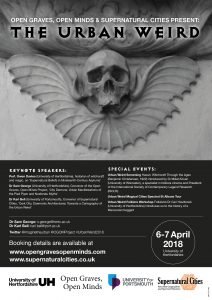
Our design for ‘The Urban Weird’ 6th-7th April has now been released in all its glory. You can view all the wonderful panels and events over two days and see the graphics for our complete programme here. 

If you are still to book there are a few days left but we will be looking at numbers for catering etc. on Thursday 29th March. Amongst the very reasonable fees are a limited number of undergraduate student tickets at 25.00 all in for 2 days including tour, workshop  and screening.  Book now to avoid disappointment.

** Please contact us directly if you experience any difficulties; the site has experienced some technical issues, though we expect to have these resolved soon.
Please email s.george@herts.ac.uk for assistance and we will make sure you get booked in successfully.

Posted in Events, Gothic Hertfordshire, OGOM: The Urban Weird | Tagged , , , | Leave a comment

The Urban Weird 6th-7th April Booking is Open

The amazing OGOM and Supernatural Cities present ‘The Urban Weird’ on 6th-7th April is now open for bookings!! You can log on and select a number of events from spectral city tours to Urban Weird screenings and workshops!! Find out more by browsing the Keynotes and Events and looking at our fantastic Panels and Papers . We’ve got everything from Demons to Trolls, Nosferatus to Boggarts. We’re in St Albans on day two,  England’s finest spectral city,  home to tortured martyrs, ghostly monks, pagan Gods, grotesque carvings, winged skulls, Wiccan communities, folklore rituals and more. If you are a delegate or you just want to come along and get involved please visit our booking site here for details.

** Please contact us directly if you experience any difficulties; the site has experienced some technical issues, though we expect to have these resolved soon.
Please email s.george@herts.ac.uk for assistance and we will make sure you get booked in successfully

Here’s the first glimpse of our gothtastic poster. It’s all very exciting! Join @OGOMProject and @imaginetheurban on Twitter using #UrbanWeird2018 #GothicHertfordshire

Posted in Events, OGOM News, OGOM: The Urban Weird | Tagged , , , , , | Leave a comment

Urban Weird Conference News

I’m just announcing one or two changes to the line up for our forthcoming ultra exciting  ‘Urban Weird’ conference. We now have Dr Mikel Koven taking us on a filmic, folkloric, urban weird journey into witches through the ages, following supper on day one. A summary of keynotes and special events is below. The amazing ‘Urban Weird’ is only a few weeks away now and  booking opens next week (we’ll post the link).  I can’t wait!

OGOM Logo

Urban Weird:  Keynote Speakers

Prof. Owen Davies (University of Hertfordshire), historian of witchcraft and magic, ‘Supernatural Beliefs in Nineteenth-Century Asylums’

Dr Karl Bell (University of Portsmouth), Convenor of Supernatural Cities, ‘Dark City, Daemonic Architectures: Towards a Cartography of the Urban Weird’

Dr Sam George (University of Hertfordshire), Convenor of the Open Graves, Open Minds Project, ‘City Demons: Urban Manifestations of the Pied Piper and Nosferatu Myths’

Special Events (all free to delegates)

Urban Weird Film Screening  introduced by Dr Mikel Koven (University of Worcester), specialist in folklore cinema and President of the International Society of Contemporary Legend Research (ISCLR).

Following supper in the bar delegates will be introduced to an eerie screening of Haxan: Witchcraft Through the Ages (Benjamin Christensen, 1922) which exemplifies our theme of folklore and the ‘urban weird’. A lively discussion will ensue!

Urban Weird: Spectral St Albans Magical City Tour

From Britannia to the Wicker Man: The Welcome Return of Folk Horror   makes reference to the ‘submerged histories’ which give play to the imagination and rise up to frame spacial narratives and this is precisely the theme for our Spectral St Albans Magical Cities Tour. St Albans is built on the remains of the ancient Roman city of Verulamium, razed to the ground by Boudicca. You can join us for a stunning tour of the buried city on the 7th April and engage with the magical and supernatural history of Hertfordshire’s finest spectral city (home to tortured martyrs, ghostly medieval monks, pagan Gods, grotesque carvings, winged skulls, Wiccan communities, folklore rituals and more).

Urban Weird Boggart Workshop

Delegates will be invited to participate in a special workshop on a Mancunian Boggart, led by folklorist Dr Ceri Houlbrook (ECR , University of Hertfordshire). Using a wide range of material – from the pens of antiquarians to local ballads and oral histories – this workshop will trace the history and folklore of Boggart Hole Clough, where today, still, ‘there lurks that strange elf’…ooh!!

Supernatural Cities logo

Posted in Events, OGOM News, OGOM: The Urban Weird | Tagged , , | Leave a comment

Frankenstein and Counter-Enlightenment

Image result for frankenstein angry villagers

I’m sure many will have seen the furore stirred up in social media, particularly among Gothicists, by the Sun’s article on Frankenstein, which screams, ‘SNOWFLAKE students claim Frankenstein’s monster was a misunderstood victim with feelings’. I don’t think it’s altogether true to reply, as some (understandably) have done, that the sympathy with the creature is the whole point of the novel (see here). Mary Shelley’s greatness lies in setting up a cluster of questions and arguments, not in didactically pushing one viewpoint.

Frankenstein itself is ambivalent. The sympathy for the monster is crucial. The claims for recognition and human rights (something the Sun clearly wants to undermine) are central. Yet the monster is a cruel and cold-blooded killer; his crime all the worse because he is sentient, cultivated to an extent, and shares the potential for nobility of human beings. But he has been unjustly exiled from all community and social life and his rebellion is justified. (The Sun isn’t notably a fan of just revolt.)

I haven’t read all of Prof. Groom’s new introduction (which is quoted from in the article). It’s almost certainly quoted in a way that distorts its meaning. He seems to be saying that students may be one-sided in their ‘sentimental’ response and to have missed the crucial ambivalence. That’s what academia is for—to restore the complexities that either/or thinking wants to efface. Yet the students’ sympathy is not untrue to the book either and their concern for rights—rights which the Sun isn’t noted for endorsing—is not to be dismissed lightly. David Barnett in the Guardian defends the need for such empathy in our atomised, asocial world.

Sun journalists probably know that the novel shows sympathy to the creature—they’re well-educated, just cynical and manipulative and contemptuous of their readers. They have had a privileged education and earn high salaries. They serve and often belong to the very elite that they are so fond of casting as monsters—that is, the real elite, those who have wealth and power, not those deemed elite just because they have had the opportunity to cultivate knowledge. The article is based on an article in The Times which is slightly more subtle, though still announcing its contempt for young people (or ‘millennials’). The Times, of course, has always been the voice of the ruling classes; they can’t even aim at the fake demotic credentials of the Sun.

The Sun article is in a wider context of right-wing attacks on students, on academics, on expertise itself. But, as quite a few social media commentators have pointed out, it takes on extra significance at this moment when university staff are striking—a strike motivated in part by a resistance to those forces which seek to degrade academic life.

There are those who read Frankenstein as a counter-Enlightenment tract, warning against the hubris of science and progress. I would say that it’s more a novel that explores the consequences of an Enlightenment project that (as the philosopher Jürgen Habermas claims) had halted. I argue here that ‘the Modern Prometheus’ of Shelley’s subtitle is a Prometheus whose pursuit of knowledge has become distorted by capitalism and who no longer serves human ends. That project is in urgent need of defence from the new counter-Enlightenment which scorns critical thinking and progressive politics, hurls insults at academia and ‘experts’, and lies behind the destruction of universities that strikers are fighting against at this very moment.
Posted in Critical thoughts | Tagged , , , , , | 2 Comments

The Selkie: Storytelling, Poetry & Panel

I am teaching Selkies this week on OGOM’s YA gothic course and I have just discovered this Selkie: Storytelling, Poetry & Panel Discussion on the 19th March in Brighton. The event is part of Imogen Di Sapia’s exhibition The Selkie: Weaving & The Wild Feminine at ONCA 17th – 25th March, see here for more info and events.

It is described as a night of tales relating to the wild feminine and magical handcraft; the second half of the evening will feature a panel discussion on the symbols within the stories. Telling from Imogen Di Sapia, Fleur Shorthouse, Stacia Keogh, Joanna Gilar & Abbie Simmonds. Musical performances from Tracy Jane Sullivan on Harp and The Butterfly Wheel with acoustic song.

Door & bar at 6:30pm, telling begins at 7pm. Follow the link above to book. Tickets 5.83.

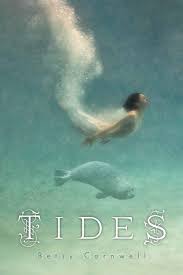
Meanwhile we are studying inbetweeness, liminality, shapeshifting and adolescence in Tides which I really enjoyed!!


Posted in Events, Generation Dead: YA Fiction and the Gothic news, News | Tagged , | Leave a comment

CFPs: Angela Carter, Lewis Carroll and George MacDonald, Contemporary Gothic

Some more calls for papers and articles here:

Ludics & Laughter as Feminist Aesthetic: Angela Carter at Play
‘Salman Rushdie famously called Carter a “one-off.” In this international collection of essays, we will consider that ludics and laughter contribute to this originality and to her unique feminist aesthetic. We seek research on Carter’s oeuvre which foregrounds “play,” and “humour” as key components of her work and of her significance to readers and feminists nearly 30 years after her death.’
Deadline: 1 May 2018

Lewis Carroll and George MacDonald: An Influential Friendship, 1 September 2018,
Sussex Centre for Folklore, Fairy Tales and Fantasy
‘This one-day symposium will examine the life and works of the two writers with particular reference to that friendship, which began in Hastings, and their interests in folklore, fairy tales and fantasy.’
Deadline: 30 March 2018

Aeternum: The Journal of Contemporary Gothic Studies, Volume 4.2 (June 2018)
‘Aeternum is an open-access biannual online journal of peer-reviewed academic articles on all aspects of the contemporary Gothic. The purpose of the Journal is to provide an emphasis on contemporary Gothic scholarship, bringing together innovative perspectives from different areas of study.’
Deadline: 5 March 2018

Posted in Call for Articles, CFP (Conferences) | Tagged , , , , , , , , | Leave a comment

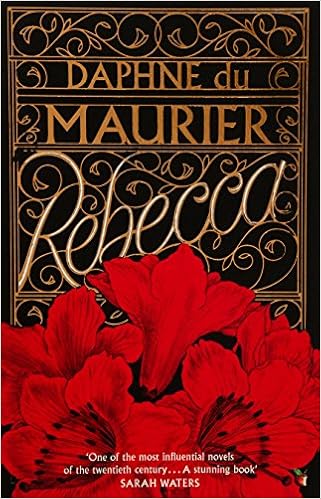
Manderley Today: 80 Years of Du Maurier’s Rebecca

I first read Daphne du Maurier’s haunting Gothic Romances in my early teens. In my thirties I did an evening class in Female Gothic run by the pioneering Avril Horner and Sue Zloznik. This featured Rebecca among other exciting texts. They then encouraged me to do a part-time MA at Salford University, which included a module on women’s writing run by Avril; Rebecca was again included.
In the past couple of months, I’ve been reading the Gothic Romances of Mary Stewart, Victoria Holt, Phyllis Whitney, and others (as I described here), which form part of a genealogy from Ann Radcliffe and then the Brons, through du Maurier, to contemporary paranormal romance. And I’ve returned to du Maurier, rereading some and reading Jamaica InnFrenchman’s Creek, and The Parasites for the first time (how could I have missed them? They’re so exciting!).

Du Maurier’s works exploit the machinery of Gothic, invoking the thrill of terror, but bringing this into conjunction with the devices of romantic fiction in ways that subvert the latter and humanise the former. Du Maurier thus employs a generic doubling to dramatise quasi-feminist concerns and her own personal feelings of  a self divided between masculinity and femininity (doubling recurs throughout her novels). This meeting of genres is something I am delving into in my study of paranormal romance.

And, coincidentally, it is the eightieth anniversary of the publication of Rebecca. Here are three interesting articles celebrating her work:

Laura Varnam, ‘Du Maurier’s Rebecca at 80: why we will always return to Manderley

Olivia Laing, ‘Sex, jealousy and gender: Daphne du Maurier’s Rebecca 80 years on

And, by the author of The Essex Serpent, Sarah Perry,  ‘”Last night I dreamt I went to Manderley again”: “Rebecca” and me’.

Posted in Critical thoughts, OGOM Research | Tagged , , , , , | Leave a comment

CFPs: Fantastika, Dark Arts, the Supernatural, Popular Culture, Witchcraft, Trees & Forests

There is a whole batch of CFPs for various exciting events here:

Theorising the Popular Conference, Liverpool Hope University, 11-12 July 2018
The conference invites submissions from a broad range of disciplines, and is particularly interested in new ways of researching ‘popular’ forms of communication and culture.
Deadline: 23 March 2018

After Fantastika: An Interdisciplinary Conference, Lancaster University, 6-7 July 2018
We welcome abstracts for 20 minute papers focusing on the role of time within Fantastika of any medium or form.
Deadline: 15 April 2018

Witchcraft Beliefs and Human Rights: Past, Present and Future Perspectives, Lancaster University, 10-11 January 2019
This interdisciplinary conference will examine the various traditions of witchcraft across centuries and continents. It will focus on how witchcraft accusations, practices and beliefs, and the consequences they generate, are understood, theorised and represented.
Deadline: 3 July 2018

Supernatural in Contemporary Society Conference (SCSC), Robert Gordon University, Aberdeen, 23-24 August 2018
The Supernatural in Contemporary Society Conference (SCSC) aims to explore the continuing role of the supernatural. SCSC intends to provide an interdisciplinary forum to discuss current and emerging research, and examine these in relation to the impact and value this has on culture, heritage and tourism.

And, finally, the University of Essex’s Centre for Myth Studies invites proposals for their Myth Reading Group throughout the Summer term
Call for Proposals: Trees & Forests
We invite proposals from anyone who is interested in any aspect of trees and forests and address the theme from a mythological perspective across cultures, periods, and media.
Deadline: 31 March 2018


Posted in CFP (Conferences) | Tagged , , , , , , , , , , | Leave a comment

Frankenstein Schools Programme

On February 27th  I will take part in a Q&A on Mary Shelley’s Frankenstein with sixth forms in Hertfordshire in collaboration with the St Alban’s Abbey Theatre. We will mark 200 years since the novel’s publication in 1818 and spend time talking to the students about adapting Frankenstein in the twenty-first century, following  a performance of Patrick Sandford’s adaptation of  Frankenstein on stage. You can find out more about the educational programme here.

The performance starts at 8pm. There will be an interval of about 20 mins and the performance will finish just before 10pm. We are hoping to go straight into the post-show talk, which Conor Gray will host. We will also be joined by Sinead (the director), Dennis (the designer), Gavin (‘Frankenstein’), Dewi (‘The Creature’) and Georgia (‘Elizabeth). Gothtastic!

http://www.abbeytheatre.org.uk/whats-on/frankenstein/

http://www.abbeytheatre.org.uk/join-in/education/

Posted in Events, OGOM Research | Tagged , , | Leave a comment

Angel Calendar #FebruaryAngels

Thanks to everyone who is contributing to OGOM’s collaboration with Folklore Film Festival on #FebruaryAngels. You can view our glorious and heavenly Angelic Moment here and contribute to it daily throughout the month.

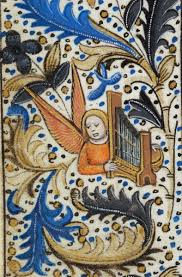
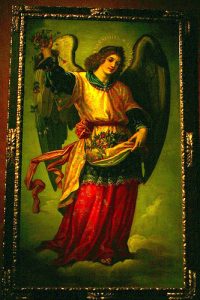
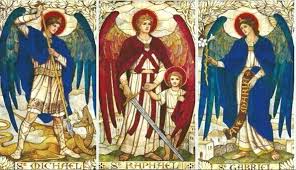
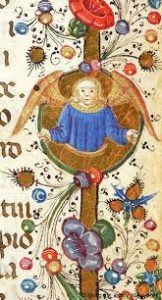
The Book of Hours, the devotional book made popular in the middle ages, uses angels and archangels in interesting ways, associating them with daily, weekly, and monthly calendars of worship. I like a good list so I wanted to share these angel emblems and provide you with a Calendar of Angels:

Angels For the Months of the Year

January: Gabriel; February: Barchiel; March: Machidiel; April: Asmodel; May: Ambriel; June: Muriel; July: Verchiel; August: Hamaliel; September: Uriel; October: Barbiel; November: Adnachiel; December: Anael

The Seven Archangels as related to the Seven Days of the Week

Gabriel (Monday), Raphael (Tuesday), Uriel (Wednesday), Selaphiel (Thursday), Raguel or Jegudiel (Friday), Barachiel (Saturday), Michael (Sunday).

Angel of the Month

Barchiel (invariably spelled Barakiel, Barkiel, Barbiel), is the Angel of the Month of February; one of the 7 Archangels, ruler of Jupiter and the month of February, and of the zodiac signs of Scorpio and Pisces.


Posted in Fun stuff, OGOM Research | Tagged , , , | Leave a comment