Excited to teach the first workshop for ‘Reading the Vampire, Science, Sexuality and Alterity in Modern Culture’ today in suitably gothicky weather (thunder, torrential rain and flash floods). I did raise a smile as I arrived hastily, dripping, and clutching my damp photocopies! I tried not to appear too eccentric in the first session – not sure I succeeded entirely. Why is it some rooms have no networked pcs and others are built like NASA? Technology aside, we did some informal introductions and got to know something of each other prior to our first discussions. The students consist of four teachers (eek, teaching teachers always tricky), recent UH graduates, international and external students of varying ages. Some students are continuing MA students and have picked up this module after having completed two others and done their first research methods training, whilst others are newly registered so this is their first intro to MA study (no pressure then).
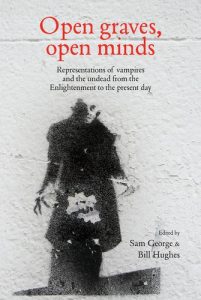
Vampires pre-Stoker is the first workshop (vampiric origins: national identity and social class from the peasant to the aristocrat) and after going over the course schedule and assessment (6,000 word essay developed from the student’s own research question) I set the scene with a few slides. We noted that: the vampire became popular in the British imagination in the early eighteenth century when accounts began to emerge from remote parts of Hapsburg of the superstitions of its recently colonised subjects. I argued that it now seems possible that the vampire is a time specific being (following Erik Butler etc ) rather than a universally recognised figure ‘as old as the world’ (as Frayling claimed). 1732 was the vampire’s annus mirabilis. There were twelve books and four dissertations on the subject published over that year, as well as the term’s enshrinement in the English language ( see ‘Wild Signs: How to Recognise Vampires’, TLS, May 6th, 2011; ‘Reflections on Vampires, Enlightenment and the Undead’, Open Graves, Open Minds, pp. 7-15). Tournefort’s ‘Voyage to Levant’ 1702 was published posthumously (alerting the French to the Greek vampire or ‘vroucolaca’). In 1725 the notorious case of Peter Plogojowitz (Hungary) was recorded in Calmet and widely read in popular reprints as The Phantom World 1850. I asked the class what seventeenth and eighteenth-century literature can teach us about vampiric origins? About ethnicity, national identity and social class? Fifteen years after Tournefort the London Journal reported some inquiries into ‘vampires’ at Madreyga in Hungary (a story later referred to by John Polidori) and thus was recorded the first use of the word in English (according to Roger Luckhurst). The earliest known reference to ‘vampyres’ in English prior to this was thought to be in Travels of Three English Gentleman in 1734 (rpr. 1745) [OED claim]. We observed that Tournefort uses ‘vroucolacas’ (re-animated corpse) whereas the word ‘vampire’ is used in Calmet.
From this we spent some time pondering definitions in the course material. OED (7-9 pages); Appendix V ‘vampire’ from Encyclopedia Britannica (1888); Katharina M. Wilson, ‘The history of the word ‘vampire’’ in Alan Dundes, ed., The Vampire: A Casebook (1998). We compared early definitions with Calmet’s in his Treatise (1746) This preamble led to the student’s response to Tournefort, ‘Voyage to Levant’ 1702. Our debate was structured around the following questions: How reliable an account is this? Does the tone and style of the journal tell us anything about T’s relationship to the events he is witnessing? What ideas around nationality and social class in relation to vampirism emerge here? What is the role of the church? Why is this account important to the representation of vampirism in the Romantic period? Next was Calmet: Treatise on the Vampires of Hungary (trans 1759): What aspects of vampire lore are established here? What are the problems he sets himself and how does he resolve them? How do notions of class, national identity impact on Calmet’s search for truth? What part does Catholicism play? How does this text differ from Tournefort? Are there any points of convergence? Is Calmet putting superstitions to rest or indulging the public’s taste for tales of the supernatural? Some of the points that might not have been picked on were suggested by our later reading of Marie Helene Huet, ‘Dom Augustin Calmet’s Vampires’, Eighteenth-Century Life, 21.2, 222-232. The following questions were posed: What is Huet’s central argument? How does her discussion of Calmet shed light on eighteenth-century notions of vampirism? From your reading of this article how do eighteenth-century vampires differ from later Romantic or 19th Century representations? We noted that Enlightenment anxieties about death are linked to two primary factors: fear of premature burial, and the growing practice of dissection, which led to grave robbing. One of the most surprising factors to emerge in Calmet is the absolute absence of mourning, once dead these previously cherished mortals (parents, husbands, children) become burdens. Disease, contagion, mental frailty and hysteria also seem to be made manifest here in widespread belief in vampires. These early accounts give gruesome details on how to kill a vampire (staking, decapitation and burning). I thought about our vampire slaying kit (see previous post). This material will be useful when the vampire enters fiction next week.
G. David Keyworth ‘Was the Vampire of the Eighteenth Century a Unique Type of Undead-Corpse?’, Folklore, 117 (December 2006)’ aided our investigation into the folkloric vampire. Suggested further reading included Paul Barber, Vampires, Burials and Death (New Haven, Yale University Press, 1988) – detailed discussion of Peter Plogojovitz from Calmet; Alan Dundes, The Vampire: A Casebook (Madison, Wisconsin University of Wisconsin Press, 1998) – used as source by Marcus Sedgwick and others for info on the East European and Romanian folkloric vampire. The students seemed to enjoy their introduction to the vampire’s origins and were lively, though understandably cautious in putting forward their ideas in the first session. I’ve asked each of them to choose a text to lead on in the workshops, focusing on critical material. From our reading of all the above we were able to conclude (following Huet) that the ‘troubling sexuality of the nineteenth-century vampire’ is as yet unexplored and ‘eighteenth-century vampire tales are singularly lacking in suspense’ (Huet, p. 6). The scene is nicely set for Romanticism’s contribution to the vampire.
Next week we move from the folkloric vampire to the aristocratic/Romantic vampire in Byron and Polidori, beginning with a handout of a Timeline of Vampire Literature Before Dracula, 1717-1897. First session over…and off to a good start…. evening classes 6.00-8.00 Wednesdays.
Until next time Lucy (aka ‘The Coffin Boffin’)
You can follow us each week and view the full course schedule here