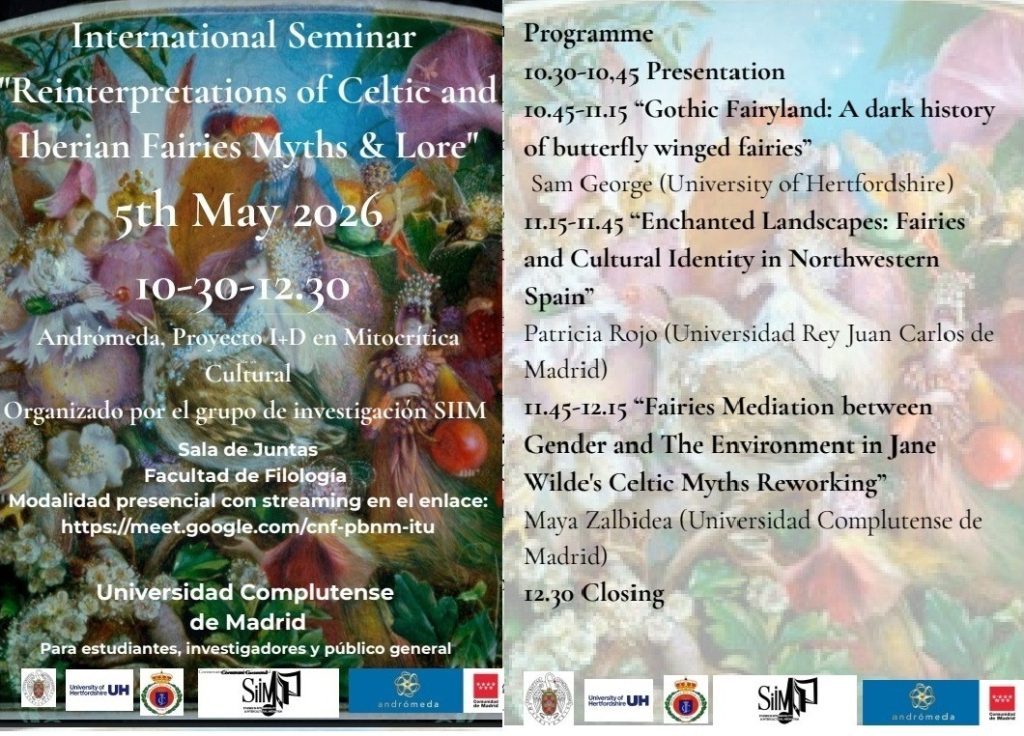
This international seminar on Fairies: ‘Reinterpretations of Celtic and
Iberian Fairies Myths & Lore’, will take place online on 5 May, hosted by the Universidad Complutense de Madrid, 9.30-12.00 UK GMT (10.30-1.00 Madrid Time). The seminar will be hybrid: in-person and online and streaming here:
https://meet.google.com/cnf-pbnm-itu
It will be recorded and posted on YouTube for those interested in watching it later. It’s free to attend and is aimed at students, researchers and other interested parties.
Programme: Three 30 minute talks followed by a Q & A
Title: Gothic Fairyland: A dark history of butterfly-winged fairies
Synopsis: The current innocent idea of fairyland seems as far away as possible from the shadowy realms of the dead, and yet, despite their wands and glitter, fairies have a dark history. In this talk I will be exploring how fairies came to be associated with spirits of the dead. I probe into the significance of how we lost our fear of fairies and our changing understanding of them (are they immortal or do they fade and die), and trace how they got their butterfly wings. If the winged fairy can be read as a darker manifestation of the soul, often depicted as a butterfly, we can argue more forcibly for fairies as spirits of the dead and uncover their gothic history.
Bio: Sam George is Associate Professor in Literature at the University of Hertfordshire and the co-convenor of the Open Graves, Open Minds project. Her research lies at the intersection of folklore and the gothic. Her publications include: From Modest Shoot to Forward Plant (2007); Representations of the Vampire (2012); In the Company of Wolves (2018); The Legacy of John Polidori (2024)and Gothic Enchantment with the Fairy Realm (2026), together with special issues of Gothic Studies on the Vampire, 15.1 (2013) and the werewolf, 21.1 (2019), and a Gothic Fairies issue of Gramarye, 22 (2022). Sam is currently completing a book on The Folklore of the Shadow in Nineteenth-century Gothic Fiction: Runaway Reflections, Sentient Shades and Lost Souls. She has amassed 335,050 reads for her lively press articles on vampires, werewolves, and dark fairies.
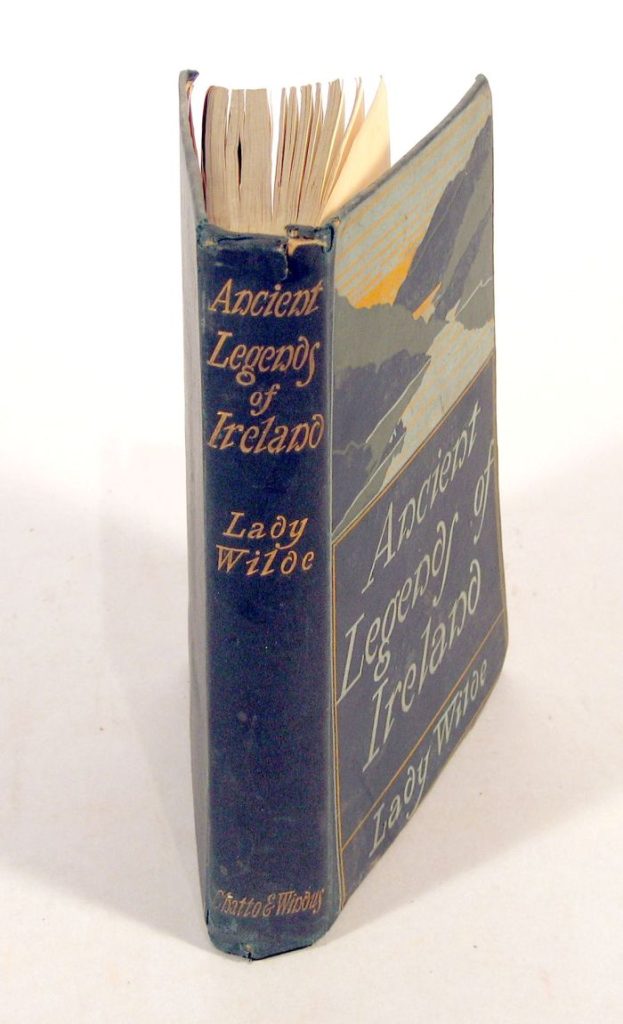
Title: Fairies: Mediations between Gender and the Environment in Lady Jane Wilde’s Celtic Myths
Synopsis: In Lady Jane Wilde’s Ancient Legends of Ireland fairies are the protectors of nature and punish those who violate natural spaces. Revisiting Celtic myths, I demonstrate that these legends underscore their contemporary relevance in addressing environmental degradation and gender inequality, showing that ancient mythological narratives offer enduring insights for ecological and social awareness in times of global crisis.
Bio: Maya Zalbidea is Assistant Professor of Literature from English Speaking Countries at Complutense University in Madrid. She is a researcher on the Andromeda Myth Criticism project. She has recently published the following articles: ‘Contemporary representations of feminine and masculine myths’ (Journal of Feminist, Gender and Women Studies, 2025); ‘Gender Studies and Intermedial Narratives’ (The International Journal of Critical Cultural Studies, 2025); ‘Ecofeminism in Rupi Kaur’s Home Body (Journal of Feminist, Gender and Women Studies, 2025); ‘We Had No Voice’: Class Inequality Through Écriture Feminine in Margaret Atwood’s The Penelopiad” (Impossibilia, 2024).
Title: Enchanted Landscapes: Fairies and Cultural Identity in Northwestern Spain
Synopsis: Fairy beliefs are commonly associated with regions such as Ireland, Scotland, and Brittany, but Northwestern Spain—particularly Galicia, Asturias, and Cantabria—also preserves a significant, though less studied, body of related folklore. These traditions reflect both broader patterns linked to so-called Celtic cosmologies and distinct local developments. A key feature of this folklore is its strong connection to the natural environment. Supernatural beings are typically associated with specific landscapes, such as rivers, caves, forests, and ancient sites. Figures like the mouras in Galicia and the xanas in Asturias illustrate how these narratives attribute symbolic meaning to the landscape and reinforce connections between human communities and their surroundings. However, the classification of these traditions as ‘Celtic’ is largely a modern construct. Since the nineteenth century, scholars have drawn parallels with other Atlantic regions, but such comparisons may oversimplify the diversity of local traditions and impose a unified identity that did not historically exist. In this talk, I will be exploring the relationship between fairies and Celtic identity, as well as their significance in Spain.
Bio: Patricia Rojo Lemos is an assistant professor of German at Rey Juan Carlos University (Madrid, Spain). She holds a PhD in Literary Studies from Complutense University of Madrid. Her research focuses on the history of the translation of female authors, as well as the relationship between literature and society. She has published in specialized journals such as Lenguaje y Textos, Magazin, and Laocoonte. Her areas of expertise include intercultural communication, translation, literature, and language learning.
Attendance details:
Date and Time: Tuesday 5 May 9.30-12.00 UK GMT; 10.30-1.00 Madrid Time.
| Location: Google Meet: meet.google.com/cnf-pbnm-itu |
Discover more from Open Graves, Open Minds
Subscribe to get the latest posts sent to your email.

Hi,
This is wonderful! I can’t get enough of the Fair Folk, and they are so tied to gothic literature. Crazy question: Is the time Madrid or GBP time? Also, when this year does Gothic Enchantment with the Fairy Realm come out on market?
Thank You in Advance,
Daylan
Hi Daylan, Sorry about the confusion. I have just edited the post to show both UK and Madrid time. It would be a 9.30 UK GMT start. There is a link to the PDF programme & poster on there too now. The book is a little late (submitting in June, 2026) so expected late 2026/early 2027. Thanks for your interest in both these things.
Thank you, Sam!
Hi! I’ve just tried to join but am not sure if I needed to register in advance to be let into the call. Will it be recorded by any chance?
Hi Betsy,
Sorry for the late reply–we usually don’t see comments right away, so not the best way of contacting us. Hope you managed to get in. I’m replying on Sam’s behalf: Sam couldn’t do her talk for technical reasons, though she may record it later. It says in the programme details that the other talks will be published on YouTube later.
Best,
Bill