David Punter’s The Gothic Condition (2016)

I’m very excited with the announcement of The Gothic Condition: Terror, History and the Psyche (2016) which will be published next year. It is a collection of fourteen of David Punter’s most recent essays. Punter is one of the most well-known and highly regarded Gothic scholars whose work is always thought-provoking and who isn’t afraid to grapple with the most recent Gothic incarnations.

Hopefully I can include it in my thesis.

Posted in Books and Articles | Tagged , | Leave a comment

The First Global Fairy Census Wants To Hear About Your Close Encounters

A fascinating account by Jess Zimmerman of investigation into the existence of and encounter with fairies.

Posted in Resources | Tagged , , , , , , | Leave a comment

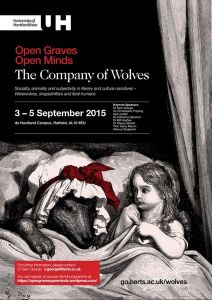
CFA: OGOM Company of Wolves Book and Journal Issue

wolvesposter3

Thank you once more for your contribution to the wonderful Company of Wolves Conference. There was a diverse range of papers, all fascinating, and this was one of the factors that made the conference work so well.

As promised, we are inviting you to recast your conference papers into essays. We will be publishing a ‘Company of Wolves’ edited book collection with Manchester University Press and a special issue of Gothic Studies.

First drafts (of 5000–7000 words, including endnotes but excluding works cited) should be submitted by 30 January 2016 as an email attachment in MS Word (12-point, Times New Roman, double-spaced) document format to both Dr Sam George, s.george@herts.ac.uk; and Dr Bill Hughes, bill.enlightenment@gmail.com.

Please use UK spelling and punctuation and conform to the MHRA format, with endnotes and short-title references and a separate works cited section. Please use your surname as the document title. The abstract should be sent in the following format: (1) Title (2) Presenter(s) (3) Institutional affiliation (4) Email address (5) Abstract (6) Article/chapter.

We hope to arrange the publications so that the interrelation of key themes among essays emerges, as it did so well at the conference. We therefore include the original blurb below to remind you of those themes.

Wolves have long been the archetypal enemy of human company, preying on the unguarded boundaries of civilisation, threatening the pastoral of ideal sociality and figuring as sexual predators. Yet, in their way, with their complex pack interactions, they have served as a model for society. Lately, this ancient enemy has been rehabilitated and reappraised, and rewilding projects have attempted to admit them more closely into our lives. Our company with wolves has inspired fiction from Ovid, through Perrault and the Grimms’ narrators, to Bram Stoker and Kipling; and, more recently, to Angela Carter, Neil Jordan, Anne Rice, Marcus Sedgwick and Glen Duncan.

The Open Graves, Open Minds Project was initiated in 2010 with the Vampires and the Undead in Modern Culture conference and reconvened for the Bram Stoker Centenary Symposium in 2012. We turn our attention now to creatures not strictly undead but which haunt the peripheries of the vampire—werewolves and shapeshifters. Such beings have served in narrative fiction to question what humanity is; weres tend to reveal the complex affinities and differences between our existence as linguistic, social subjects and our physiological continuity with other animals. They also draw our attention to questions of hierarchy and sexuality, to the instinctive, and to what extent our conceptions of these are ideological.

Werewolves, along with vampires, have recently become humanised, even romanticised, as identity politics became mainstream and the Other assimilated. The ancient paradigm of Beauty and the Beast lives on in paranormal romance. And just as the vampire figure both conditions the shape of the subgenres it dwells in and draws other genres into its sphere, so fictions about werewolves, wild humans, and human-animal relationships also invoke questions of genre and intertextuality. Thus, we are also interested in other narratives and discourses such as beast fables, taxonomies, human metamorphoses, and stories of feral children and those raised by animals which question the boundaries between animal and human.

Amidst concerns about our relationship with nature, in a culture informed by Romanticism and a post-Enlightenment doubt about the centrality of humanity, contemporary fictions often turn to the animal, and to transitions between animal and human (particularly the werewolf and kindred figures) to interrogate what is special about our species. In her werewolf paranormal romance, Shiver, the YA author Maggie Stiefvater quotes Rilke: ‘even the most clever of animals see that we are not surely at home in our interpreted world’. This perhaps captures our amphibious nature and raises the kind of questions we are interested in.

The publications will explore human social existence and its animal substrate, and the intersection between the human and the wolfishly bestial as expressed in narrative media from a variety of epochs and cultures. It will provide an interdisciplinary forum for the development of innovative and creative research and examine the cultural significance of these themes in all their various manifestations.

Possible topics and approaches may include (but are not limited to) the following:

Werewolves, lycanthropy, and shapeshifters
Feral and wild children
Language, culture, and nature
Instinct and agency
Animal studies and humanist perspectives
Phenomenology and the philosophy of language, mind, and body
Animality and sociality from Hobbes through Rousseau to Darwin
Narratives of the Grimms, Perrault, Kipling, Angela Carter, Neil Jordan, Anne Rice, Maggie Stiefvater, Glen Duncan, Marcus Sedgwick
Genre, intertextuality, and narratology
Young Adult and children’s fiction
Urban fantasy and paranormal romance
TV, film, and other media
Folklore and anthropology
Fables, fabliaux, and fantasy
The Gothic, fairy tale, and myth
Sexuality and romance
Species, ‘race’, identity, and taxonomy

For more information, contact Dr Sam George at s.george@herts.ac.uk.

Details of Open Graves Open Minds Book
Our website and blog, with updates on the project: Open Graves Open Minds blog
We also invite you to join the Open Graves Open Minds Facebook Group
Posted in Call for Articles, OGOM News, OGOM Research, OGOM: The Company of Wolves | Tagged , , , | Leave a comment

CFP — Edited collection: Gender, Race and Sexuality in The Walking Dead

From Dawn Keetley, Lehigh University, Pennsylvania: praise for the blog and a call for articles in a volume on The Walking Dead:

Hi Bill–I am very much enjoying the Open Graves blog! Anyway, wondering if you’d consider posting this CFP for a collection I’m co-editing, Gender, Race and Sexuality in The Walking Dead. Thanks very much! Dawn

http://www.horrorhomeroom.com/call-for-papers-race-gender-and-sexuality-in-the-walking-dead/

Posted in Call for Articles | Tagged , , , | Leave a comment

Del Toro’s Crimson Peak – The reviews are in …

From the first moment I saw the trailer to the delightful interview with Tom Hiddleston in which he announced he went full-nude to redress the sexist imbalance regarding nudity in film, I have been thoroughly excited about Guillermo del Toro’s Crimson Peak (2015). Well, it is now officially at the cinemas and I look forward to seeing it following my sojourn to the seaside this weekend. Once I have watched it, I’ll head back to the blog to give a frank review. Throughout the press tour for the film, both cast and director have been clear in stating that the movie is meant to be a Gothic romance which looks back to the early Gothic. Though the costumes and setting of the movie are Victorian, reference has been made to Radcliffe and Lewis as sources of inspiration.

The reviews of the movie are somewhat mixed. The Guardian calls it a ‘gothic fantasy-romance … [which] is outrageously sumptuous, gruesomely violent and designed to within an inch of its life’ and The Telegraph states that its ‘sombre sincerity and hypnotic, treasure-box beauty make Crimson Peak feel like a film out of time’. However, Forbes felt that the story is ‘painfully straightforward, unfortunately, telegraphed, and not terribly engrossing’ and Variety describes it as an ‘R-rated indulgence’. I can’t help noticing however that despite the differing opinions all the reviewers cited have used incredibly Gothic, eloquent and flourished language – a sure sign that the movie has affected them on some level.

Personally, I find The Hollywood Reporter’s rather ambivalent review the most satisfying especially in the following line: ‘It’s entirely likely that no previous rendition of this sort of sexually twisted, psychologically degenerative and spectrally haunted fright story has ever been served up with so much stylistic sauce as del Toro has poured onto Crimson Peak’. It is always nice to have a little debate regarding anything Gothic so, if anything, the variety of opinion is a good thing.

Posted in News, Reviews | Tagged , , , , | Leave a comment

Pride and Prejudice and Zombies (2016) – The Movie

For fans of Pride and Prejudice and Zombies (2009), the mash-up novel by Jane Austen and Seth Grahame-Smith which features a critique of manners and the annihilation of the undead hordes, the official trailer for the movie version has been released. Judging from the trailer the movie looks like it captures the spirit of the novel.

Whilst it has been a while since I read the novel, I remember it as being better than might be expected. Grahame-Smith managed to retain the spirit of the original novel whilst making the main characters, especially the female ones, significantly more bad-ass. The critique of manners and fashion was transposed to a debate over whether one specialised in Japanese or Chinese martial arts and there was some silly but fun punning that drew forth the sexual tension within the text. Given that Austen wrote one of the earliest Gothic parodies, Northanger Abbey (1817), it seems perfectly appropriate that her work has inspired its own monstrous adaptation.

Posted in News | Tagged , , , , | Leave a comment

Genevieve Valentine, ‘How the vampire became film’s most feminist monster’

A fascinating essay by Genevieve Valentine on the shifting nature of the powerful and ambivalent female vampire in cinema.

Posted in Critical thoughts | Tagged , , , , , , , , , , , , , , | Leave a comment

Roger Luckhurst, ‘Why bother reading Bram Stoker’s Dracula?’

And again, Roger Luckhurst! This time, a succinct essay on the significance of Bram Stoker’s 1897 novel Dracula, placing it in the context of late nineteenth-century Britain and anxieties over Empire and otherness.

Posted in Critical thoughts, Resources | Tagged , , , , , , , , | Leave a comment

Before Bram: a timeline of vampire literature

More useful information from Roger Luckhurst on the origins of the vampire. This timeline illustrates the ethnographic and literary precursors of Stoker’s Dracula.

Posted in Resources | Tagged , , , , , , , , , , , | Leave a comment

Roger Luckhurst, ‘The birth of the vampyre: Dracula and mythology in Early Modern Europe’

An extract here from Roger Luckhurst’s excellent introduction to the OUP World’s Classics edition of Dracula. The notion that the vampire is universal and archetypal is debunked, and its origins shown to lie in the Enlightenment response to folkloric panics in early eighteenth-century Eastern Europe.

http://blog.oup.com/2015/04/dracula-vampire-mythology-early-modern-europe/

Posted in Resources | Tagged , , , , , , , , , | Leave a comment