* Click on the arrows to expand author biographies and abstracts of papers.
1 Dr Ingibjörg Ágústsdóttir (University of Iceland)
Dr Ingibjörg Ágústsdóttir is Senior Lecturer/Associate Professor in English Studies at the University of Iceland. Her main research interests are in historical fiction and contemporary Scottish literature. She has published on Scottish writing, historical novels and fictional representations of the Tudors and Stuarts in literature and film. Her current research is focused on women’s historical fiction and rewritings of women’s history, representations of the Arctic in Scottish literature, and Scottish women travellers in Iceland.
Selkie transformations: Trauma, memory, and environmental exploitation in C. J. Cooke’s A Haunting in the Arctic Panel 6
In C. J. Cooke’s novel A Haunting in the Arctic (2023), the selkie myth is woven into a multilayered narrative that explores themes of trauma, memory, gender-based violence and environmental exploitation. Set primarily in 1901 aboard a Dundee whaler, the story follows the harrowing experiences of a young woman who is abducted and subjected to repeated sexual abuse. As one of the crew members begins to refer to her as his ‘selkie wife’, she eventually begins to transform into a selkie. This transformation serves as a powerful metaphor for the protagonist’s psychological and emotional trauma.
As a Gothic historical novel, A Haunting in the Arctic follows the genre’s recent trend of rewriting and reinstating marginalised experiences in history, particularly those of women. By centralising the suffering of women subjected to sexual violence, Cooke’s novel uses the selkie myth to reflect on trauma and the ways in which it can be processed and understood. In addition, the novel draws a parallel between the protagonist’s transformation and the exploitation of the natural environment, emphasising the destructive impact of patriarchal dominance on both women and nature. The protagonist’s observations on the ‘rape of the ocean’ (p. 334) reflect her own victimisation, suggesting that gender and environmental violence are interlinked. Cooke’s stated intention to examine how ghost stories can explore memory and trauma is evident in the novel’s multilayered narrative structure, with a contemporary storyline involving a haunting linked to the abused woman’s suffering. This structure highlights the nonlinear nature of memory and the haunting presence of past traumas in the present. This paper argues that the selkie motif in A Haunting in the Arctic is employed to reflect individual trauma, broader societal issues of gender-based violence, and environmental exploitation.
2 Shabnam Ahsan (University of Hertfordshire)
Shabnam Ahsan is a postgraduate researcher at the University of Hertfordshire. Her PhD project is on representations of otherness and national identity in British-authored fairytales from 1878 to the present. Her research interests include folk and fairy tales, difference and otherness in children’s literature, British South Asian voices in literature, and postcolonial diaspora identities. Shabnam is also a creative writer and has published work in anthologies produced by Bradford Libraries and Nottingham Writers’ Studio. She has had her work exhibited as part of Leeds2023 and runs creative writing workshops for young people in West Yorkshire.
Transgression And transformation: Mer-human relationships in the tales of Ruth Manning-Sanders Panel 22
Keywords: mermaids, mermen, otherness, race, gender, hybridity, liminality, postcolonialism, Ruth Manning-Sanders
Folk and fairy tales featuring mermaids are often vehicles for anxieties about border-crossing, hybridity and relationships with the Other. This includes fears about race and gender, as mermaids challenge established power dynamics. As a result, stories about mermaids and other hybrid water-beings frequently operate as warnings against human unions with hybrid creatures who are seen as ‘other.’
This paper seeks to understand how mermaid tales can also imagine the ways in which such relationships might work successfully. The mermaid tales of Ruth Manning-Sanders implicitly challenge the idea of mer-human relationships as transgressive. Instead, her stories present the possibility that these relationships are transformative and even mutually beneficial, as in her Cornish tale ‘The Mermaid in the Church,’ which initially represents the mermaid as an outsider, and then as a way of realising human desires for companionship, security and freedom.
In A Book of Mermaids, Manning-Sanders retells tales from around the world which portray mermaids and mermen as distinctly ‘other,’ both in their appearance and character – their portrayal ranging from dangerously seductive to vulnerable and innocent; cruel and heartless to cheerful and friendly. In selecting tales which subvert the more well-known tropes of merpeople as simply beautiful or dangerous, Manning-Sanders encourages readers to think of them differently and with sympathy. Using a postcolonial framework and theories of liminality and hybridity, I argue that venturing into the in-between space occupied by mermaids carries a risk, but it can also be a space of transformation and authenticity where humans can be freed of the constraints of society, and conceive of new ways of being and relating to the human and non-human Other.
3 Andrin Albrecht (Friedrich Schiller University Jena)
Andrin Albrecht is a writer, composer, and lecturer in American literature at Friedrich Schiller University Jena, Germany. They previously studied in Zurich, Colorado, and Singapore, and are defending their PhD thesis ‘Tyrannous Eyes: Performances of Romantic Genius in the Wake of Moby-Dick’ in spring 2025. They have published peer-reviewed articles in the field of the Blue Humanities, as well as on Mark Z. Danielewski’s House of Leaves, Kubrick’s The Shining, and rurality in the works of Nathanial Hawthorne. In summer 2024, they spent three months working in the Public Diplomacy section of the US Embassy to Berlin.
Sirens in the city: On river spirits, politics, and the collapse of spatial limitations in Ben Aaronovitch’s Rivers of London series Panel 10
Keywords: water, rivers, London, genius loci, spatial studies, agency, gender, transgression, Tyburn, urban studies, blue humanities
One of the more remarkable constants in imaginations of mermaids and related aquatic beings in Western folklore is their spatial stasis. Like fish to water, they tend to be tied to a specific location or, at most, the borderline thereof—a river, a well, a lagoon—towards which they lure humans who can themselves unimpededly move through land and sea. Case in point, in Hans Christian Andersen’s fairytale The Little Mermaid and its many permutations, the central conflict revolves around the protagonist desiring to walk on land, and being punished for that desire. Frequently, the spatial boundaries re-asserted through such narratives fall along gender binaries, perpetuating notions of mobile masculinity and static femininity, in which the male maintains all agency to prevent or give in to his own doom. By contrast, my talk examines an example from recent speculative fiction in which the spatial limitations of aquatic femininity are collapsed: In Ben Aaronovitch’s bestselling Rivers of London-series (2011–ongoing), the genii loci of English waterways take on the appearance of humans and effortlessly walk on dry land, participate in London high society, and generally feature among the most mobile and powerful players in the series’ multi-species political system. I argue that this puissance—both within the diegetic world and as narrative catalysts—is directly related to a subversion of traditional mermaid paradigms, in which the aspects of femininity, natural power, and supernatural allure are maintained, but the corresponding spatial limitations are discarded. Ultimately, this results not just in a re-examination of this folkloric archetype, but also in a complex engagement with water’s role in urban spaces. Far from being a mere backdrop or transport way, the domain of mermaids permeates politics, private homes, legal and economic systems, history, social identity, and, ultimately, the very future of the metropolis.
4 Dr Antonio Alcalá González (Tecnológico de Monterrey, Santa Fe Mexico City)
Antonio (Tony) Alcala is founder of the International Gothic Literature Congress (which is held biennially in Mexico City), and chair of the Humanities Faculty at Tecnologico de Monterrey in Santa Fe, Mexico City. He has co-edited special journal issues on Nautical Gothic(Gothic Studies)and the legacy of H.P. Lovecraft in the twenty-first century (Aeternum). He also co-edited the critical collections Doubles and Hybrids in Latin American Gothic and Lovecraft in the 21st Century Dead, But Still Dreaming (both published by Routledge). He has published articles and book chapters on creators such as H. P. Lovecraft, Algernon Blackwood, D. T. Neal, J. R. R. Tolkien, Ivan Albright, Carlos Fuentes and Juan Rulfo as well as the connection between the Gothic tradition and the lyrics of Underground Metal music bands. He is currently preparing an edited critical collection on the connections between the Gothic and the Anthropocene.
Tlaloc and Chac Mool over Mexico City: The haunting of Aztec water deities on Mexico City Panel 5
Mexico City experiences heavy rains during more than 6 months every year. Although the city is located in the centre of Mexico, its rainy identity is connected with the presence of tropical storms and hurricanes on both the Pacific and Atlantic oceans. This occurs because the country lies in a subtropical area, plus the fact that it has coast on both east and west. The short stories “Chac Mool” (Carlos Fuentes, 1954) and “Tlaloc sin Velo” (José Ricardo Chaves, 1997), set in Mexico City and named after Aztec deities of water, present first-person narrators that feel themselves as outsiders, trapped inside the monstrous city they inhabit. Both narratives rely on the presence of rain and water to emphasize the solitude and disenchantment that mark the lives of these protagonists. Contrary to the fact that water is in permanent movement, their existence is confined within the monotony of urban life. Besides, through the connection with said deities of water, the two texts raise concerns about the identity of Mexico as a hybrid construction that originates from its colonial past. These anxieties are deeply connected with the ones experienced by the protagonists themselves. Considering Bachelard’s and Illich’s reflections on water as matter in constant flux in the introduction, the purpose of this paper is to read Fuentes’s and Chaves’s narratives from an aquatic gothic lens in order to study how the authors scrutinize the role of the gothic haunting from the indigenous past of Mexico over its present, and its connections with rain and the coast.
5 Allison Allen-Byrd (Independent scholar)
Allison Allen is passionate about education, history, mythology, and the study of theology and ancient texts. Born in America, she has lived and travelled extensively throughout Europe and the UK. She especially enjoys exploring ancient sites, fortified towns, Neolithic burial grounds, and megalithic structures such as menhirs and dolmens.
Much of her time is devoted to traveling and reading. She is currently residing in Cornwall, England, to study the terrain and begin writing a book on the land’s connection to Celtic mythology. Allison is presently researching ancient sites related to Neolithic feminine cults. Nine years ago, she moved to France and discovered that her town, Châtelaillon-Plage, is said to have been both built and destroyed by the mythical Mélusine. Since then, she has travelled to every town in France connected to the Mélusine legend.
The metaphysics of Melusine: A tale of alchemy and initiation, reclaiming the Goddess Panel 19
Keywords: Mélusine, folklore, mythology, archetypes, symbolism, siren, Neolithic
Mélusine embodies the archetypal divine feminine in her tale as a siren. She is multifacted- fairy, Aphrodite and Venus, a chthonic water goddess connecting the visible to the invisible. Deciphering this ancient tale and its deep symbolism is important for understanding the people of this time and region, and their unique relationship to the divine world, particularly sacred waters and water spirits. Despite it being a popular myth in France and Europe, most people only regard it superficially- overlooking the true meaning and purpose of the text, and the knowledge hidden within its layers. Evaluating the story, particularly Jean D’Arras’ version, alongside history and how to interpret fairy tales through Jung, Marie-Louise von Franz and others, to understand her through an archetypal lens. Through Pierre Gourdan’s work, we can see how she represents the Mother in mythology. Mélusine’s tale is about the underworld, death and rebirth, courtly love, the cult of fertility and feminine archetypes, and the relationship between a divine being and a mortal. Research shows us that the story is based in Neolithic Pagan rites of initiation in its layers of allegory. These mythological tales continue to live through Christianity and what we now see as fiction in fairy tales. These stories represent something much deeper and real than what is seen through a modern perspective. If you can understand these tales, you can learn how to engage with this enchanting world, connect with higher powers, or simply admire this deeply magical world. It also shows us how important the feminine was in ancient cults- shown in the practices and worship of the feminine in Neolithic matriarchal cultures. By reframing how we view this truly stunning and profound work of art, we can change how we think and choose to engage with the natural and unseen world.
80 Dr Francesca Arnavas (University of Tartu)
Francesca Arnavas is a Research Fellow and Lecturer in Comparative Literature and Literary Theory at the University of Tartu. She works within the research group Narrative, Culture, and Cognition. She has researched and published on fantasy fiction, Victorian literature, cognitive narratology, and literary Victorian and postmodern fairy tales. She is the author of Lewis Carroll’s ‘Alice’ and Cognitive Narratology: Author, Reader and Characters (De Gruyter, 2021), and Uncanny Fairy Tales: Hybrid Wonders in the Mirror (Routledge, 2024).
Dark and watery metamorphoses: Mermaids, dystopian fiction, posthumanism Panel 8
Mermaids are hybrid creatures around whom a rich lore has grown and proliferated for centuries. There exists the edulcorated side of mermaids, when they become pretty Disneyfied beings and feature in commercial movies such as Disney’s The Little Mermaid or Splash, and then there is the dark, mysterious, uncanny side of mermaids (we could perhaps say the more authentic one?) – one that we find in cultural manifestations from Homer’s Odyssey to Guillermo del Toro’s The Shape of Water. Taken in this last sense, mermaids are carriers of our own essential ambiguity (Easterlin) and they take us into a realm of uncertainty and uncanniness. I would like here to focus on one of these darker (and richer) fictional appearances, a recent speculative fiction novel, Laura Pugno’s Sirene (Mermaids in Italian language), where the figure of the mermaid is associated with an unsettling dystopic climate catastrophe. What we read is a dark fairy tale with influences ranging from Greek mythology to Japanese manga. The hybrid genre of the text matches the hybrid nature of the mermaid.
What I want to concentrate on in this talk is how the mermaid becomes a cultural signifier of a post-apocalyptic scenario where the darkest side of humanity manifests: horrendous diseases, exploitation, cannibalism, are all elements that Pugno inserts in her novel. While the mermaid leads us to the uncomfortable exploration of a dark dystopian scenario, it is also true that through the mermaid’s hybridity and liminality Pugno pushes us to reflect about environmental transformations where water is involved, our own relation with water, and the possibility (and the implications) of a posthuman dimension – the novel is embedded also with correlated feminist and political consideration. The mermaid and her watery essence display a deconstruction of stable, anthropocentric and earth-centric ethical and categorical structures.
6 Dr Barbara Barrow (Lund University)
Barbara Barrow received her PhD in English and American Literature from Washington University in St. Louis in 2014. She came to Lund as an Associate Professor of English Studies in 2022. Her research on the environmental and blue humanities has appeared in Victoriographies, Ecocene: Cappodocia Journal of Environmental Humanities, CUSP: Late 19th/Early Twentieth Century Cultures, and elsewhere. She is currently at work on a monograph, The Queer Coastline in Anglophone Literature, 1840-1920, under contract with Edinburgh University Press. She is a member of the Lund Environmental Humanities Hub and supervises both MA and PhD projects on ecocriticism.
Water, desire, and crisis in the Southern Bayou: Alice Dunbar-Nelson’s ‘Natalie’ as a modern mermaid tale Panel 8
Keywords: Alice Dunbar-Nelson, mermaid, bayou, race, class, shoreline, water, flooding, Undine
In Alice Dunbar-Nelson’s short story ‘Natalie’ (c. 1898?), the title character, a young, brown, Creole woman in Mandeville, Louisiana, meets a visiting white tourist from New Orleans, Olivia, with whom she forms a close, queer bond. Their first meeting, and subsequent relationship, takes place in the space between land and sea, a space known to locals as ‘Natalie’s kingdom’ due to her facility with water, a place ‘where the lake kisses the shores…or mingles with swamp and bayou’ (153-54). The story’s climax, too, takes place near the shore, when deadly floods send Natalie to rescue Olivia and her mother, securing Olivia’s mother’s grudging consent to their relationship. My paper will argue that ‘Natalie’ is a modern mermaid story that mingles themes of queer desire with concerns about environmental stewardship. Gloria T. Hull has traced the influence of the sea on Dunbar-Nelson’s mermaid novel A Modern Undine (c. 1901-03), showing how that work reveals an interest in worlds beyond the visible anchored in her mother’s Obeah beliefs (xlv), while Francesca Sawaya argues that the novel mingles aspects of mermaid stories from the African diaspora with elements of Baron Fouqué’s Undine (1811). Building on these critics, I will show how Dunbar-Nelson’s short story queers the story of Undine, revising the heterosexual myth to tell the story of interracial love between women of different social classes, while relocating the story to the Southern bayou, a region vulnerable, then and now, to deadly flooding. Ultimately, ‘Natalie’ rewrites the Undine encounter as a powerful affirmation of queer love and of the water-based knowledges of the bayou’s local communities.
7 Dr Karl Bell (University of Portsmouth)
Dr Karl Bell is Associate Professor in Cultural and Social History at the University of Portsmouth, and co-director of the university’s Centre for Port Cities and Maritime Cultures. He is also course leader for the MA Victorian Gothic: History, Literature, and Culture. Much of his research explores the relationship between the environment, supernatural beliefs, the fantastical imagination, and the functions of storytelling in the nineteenth- and early-twentieth centuries. His books include The Legend of Spring-heeled Jack: Victorian Urban Folklore and Popular Cultures, The Magical Imagination: Magic and Modernity in Urban England, 1780-1914, and, most recently, The Perilous Deep: A Supernatural History of the Atlantic. He can be found on Bluesky at @karlbell.bsky.social
Remaking the mermaid: Comparing nineteenth-century depictions at sea and ashore Panel 15
Keywords: Mermaids, hybridity, Victorian, folklore, omens, disenchantment, advertising, representations
As seen in famous taxidermy hoaxes such as the Feejee Mermaid, and in ‘live’ exhibits at aquariums, the nineteenth-century mermaid was as much an imaginative creation of land-based cultures as maritime ones. While reflecting on the mermaid as a potent figure of hybridity, combining the human and animal, allure and fear, enchantment and disenchantment, this paper focuses on the distinctions between maritime and terrestrial notions of merfolk in nineteenth-century British culture.
The paper divides into two parts. Firstly, it explores the way maritime folklore granted mermaids dangerous supernatural powers and viewed their appearance as omens of good or bad fortune. Yet while mariners’ stories often emphasised the aquatic otherness of mermaids, their descriptions of such creatures did not always resemble the alluring beauties depicted by land dwellers. The second part of the paper explores these terrestrial depictions. The best-known figure of marine folklore ashore, the reality of mermaids and their role in evolution informed ongoing scientific debates, while they were also appropriated into art, literature, and various types of Victorian advertising. As such, the terrestrial imagining of the mermaid contained elements of enchantment and disenchantment, of disbelief and the suspension of disbelief. Unlike some mariners’ accounts, the Victorian mermaid created ashore was knowingly engaged with as a fiction. While Victorian painting may have still alluded to the deadly mermaid, in advertising they became more titillating than terrifying, watering down a once-powerful symbol of the ocean’s allure and anxiety into a safe spectacle. Such depictions suggest a sea change in Victorian attitudes, for even as the ocean was being disenchanted by the bullish power of steamship technology, it was also being reimagined as a remote, fantastical space.
8 Fredrik Blanc (Manchester Metropolitan University)
Fredrik Blanc (He/Him) is a PhD researcher and Graduate Teaching Assistant in English at the Manchester Metropolitan University (MMU), currently writing his thesis on Hybridity, Thalassophobia, and Transcorporeality in modern and contemporary Weird fiction. His research interests include the Weird, Blue Humanities, and the eco-Gothic.
The mercreature as metonym: Suspension and onto-epistemological resistance in the Blue Weird Panel 1
Keywords: Blue Humanities; The Blue Weird; Hydropoetics; Hybridity; Onto-Epistemology; H. P. Lovecraft; William Hope Hodgson; China Miéville; Rivers Solomon; Édouard Glissant.
The mercreature illustrates a transcorporeal and porous reality where the human and the nonhuman come together in the hybrid imagery of enmeshed scales, gills, and fins, thereby functioning, along with the tentacularity of the cephalopod, as a central metonymy of the Weird’s imagery and affect. The mercreature, with its abhuman liminality, moving between visible shores and invisible watery depths, between the discrete and the multiple, underscores the centrality of ontological anxiety in the modern subject (Hurley, 2004). In the weird fiction of H. P. Lovecraft and William Hope Hodgson, the ontological uncertainty of aquatic hybrids creates unease and ambivalent revulsion, yet their watery bodies also epitomise the liminality and liquidity of the Weird mode itself. At the same time, the mercreature, in its protean fluidity and grotesque liveliness, embodies a suspended onto-epistemology, a boundary-defying refusal of ontological certainty. In their re-appropriation of the Weird, authors such as China Miéville use aquatic hybridity as a metaphor for political freedom in The Scar (2002), while Black Weird authors such as Rivers Solomon confront the memory of colonial atrocities through its posthuman potential. In Poetics of Relation (1989), the Caribbean philosopher Édouard Glissant underlines the colonial project as necessarily underscored by hegemonic processes of transparency that require the unveiling of the world and the flattening of difference into a binary and reductive clarity. In calling for a ‘right to opacity’, Glissant argues for the necessity of the unknowable and the unclear as an act of decolonial resistance (Glissant, 1989). Thinking weirdly through the liminality of the mercreature is to envision its suspension in between bodies and in water as an act of ontological resistance as part of an array of en-weirded hydropoetics, wayward and opaque, unmoored and unknowable, underscoring the centrality of the mercreature within the ‘Blue’ Weird.
9 Dr Tina Burger (Heinrich-Heine University of Düsseldorf)
Bettina Charlotte Burger is a lecturer at the Heinrich-Heine University of Düsseldorf in the field of Anglophone Literary Studies and Literary Translation. Their research interests are varied and include popular literature and culture with a special focus on speculative fiction, such as fantasy literature, sci-fi, gothic and horror. They are also interested in regional literatures such as Australian or Scottish literature as well as generic subsets such as Children’s and Young Adult Literature. Additionally, they are currently focusing on queer representation in many of their research projects.
The constant selkie and the changing sea: Fluid queer identities, interspecies kinship and ambivalent seascapes in Molly Knox Ostertag’s The Girl from the Sea Panel 23
Keywords: Queer interspecies kinship; visual narrative; queer identity; fluidity; ecocriticism
Molly Knox Ostertag’s The Girl from the Sea presents a queer rewriting of folkloric Seal Wife tales, which tend to reenforce patriarchal oppression, as “the male captures the female against her will, coercing her into sexual, domestic and childbearing roles” (Le Couteur 68). Ostertag’s selkie, a young girl called Keltie, is granted considerably more agency, choosing not only to save Morgan, the graphic novel’s human protagonist, but also willingly letting her have the sealskin. Keltie also has motivations of her own and uphold her connections to her seal family, thus highlighting her role as a liminal being, belonging both to the land and the sea. Despite the ease with which she changes her form from seal to human (and back again at the end of the narrative), Keltie tells Morgan that she is “the true shapeshifter” (83) because she behaves differently depending on who she is with, keeping aspects of herself carefully hidden, while Keltie is always fully herself.
The graphic novel suggests that, in order to accept her queer self, Morgan needs to accept that identity is always fluid – like Keltie’s – rather than “tucked neatly into boxes” (5). Visually, the way the sea is depicted also emphasizes fluidity, as several sea-centric double spreads are either completely borderless or the sea is filling the gutters between panels, illustrating that the overall connectedness of the sea trumps the little boxes – the panels – in which Morgan’s life usually takes place.
In The Girl from the Sea, the loyal selkie figure Keltie and the changeable sea function as catalysts for Morgan’s journey towards queer self-acceptance and a less compartmentalized life.
Works Cited
Le Couteur, Peter. “Slipping Off the Sealskin: Gender, Species, and Fictive Kinship in Selkie Folktales.” genderforum 55.1 (2015): 55-82.
10 Dr Daisy Butcher (University of Hertfordshire)
Dr Daisy Butcher has recently been awarded a PhD in English Literature from the University of Hertfordshire. Her thesis focused on Plant-Women and Female Mummies as femme fatales and monsters of (in)fertility. She is particularly interested in representations of female monstrosity and body horror during the long nineteenth-century and modern film/TV. She has presented at many national and international conferences, served as a visiting lecturer at the University of Hertfordshire and guest lectured at another university on one of her research areas. Her publications have included topics such as the monstrous feminine and parasitism, and she has edited two anthologies for the British Library’s Tales of the Weird collection. As part of promoting these books, she has featured on local and national radio, local news and launch events at local bookshops. Most recently, her writing includes chapters on Netflix’s Stranger Things (ed. Simon Bacon),and the anthropocene and Hans Christian Andersen’s sea witch (ed. Simon Bacon).
Tentacular Defiance: An exploration of Hans Christian Andersen’s Sea Witch and female sexuality in ‘The Little Mermaid’ (1837) Panel 13
‘The Little Mermaid’ (1837) is perhaps Hans Christian Andersen’s most well-known and enduring tale. It tells the tragic story of a young mermaid who falls in love with a human prince and offers her voice to the Sea Witch to transform into a human. The character of the Sea Witch is generally understood to be as libidinous as she is repulsive. She serves as an early nineteenth-century manifestation of a much older misogynistic archetype of the witch character, bound up with hagsploitation and used to depict female sexuality as something inherently disgusting, diseased and abject. In this paper, I will explore the ways in which tentacular symbolism is used to position the Sea Witch as an embodiment of transgressive female sexual pleasure and monstrous female agency, and how she is deserving of redemption.
11 Dr Anna Casablancas-Cervantes (Universitat Autònoma de Barcelona)
Anna Casablancas-Cervantes is an Associate Professor of Literature at the Universitat Autònoma de Barcelona (Spain), where she teaches Literature of the Romantic Period and Victorian Literature. She completed her PhD on English Literature in 2016 with a dissertation on the representation of motherhood in the work of Doris Lessing. Her main areas of research are gender studies, the modern novel, and Jungian and Lacanian psychoanalysis.
She has published several articles in School of Literatures, Languages and Cultures. She is the co-translator of La Duchesse de Langeais and Ferragus by Honoré de Balzac, and the translator of Thérèse Desqueyroux by François Mauriac. Casablancas-Cervantes regularly gives lectures on literature in several libraries and institutions in the Barcelona area.
Habitat-fluid and water-bound: metamorphic characters in Mercè Rodoreda’s ‘The Salamander’ and ‘The River and the Boat’ (1967) Panel 10
Keywords: Mercè Rodoreda; hybridity; metamorphosis; liminality; myth; archetype
My proposal puts together two short stories by the Catalan writer Mercè Rodoreda (1908-1983), “La salamandra” and ‘El riu i la barca’, published in the collection La meva Cristina i altres contes (1967) and first translated into English as ‘The Salamander’ and ‘The River and the Boat’ in 1984. Both tales are representative of the mid-period of this author while she plays with fantastic elements to address themes of individuation and collective pressures on it. Remarkably enough, Rodoreda, whose main production was realistic, relied on mythological and folkloric motifs to depict the individual’s escape from hostile situations in a period when she herself experienced oppression and exile under the Francoist dictatorship.
‘The Salamander’ (1967) narrates a woman’s transformation: first into the village’s witch (a role attributed to her by the community where she lives) and later her physical change into a salamander, which allows her to escape the scapegoating she is being affected on. Border crossing from civilisation to nature, from humanity to animality, takes place in a Gothic atmosphere of myth and archetype which challenges the separation between reality and fantasy. An amphibian that has always been heavily connoted in the world of alchemy and occultism, the salamander is a highly ambiguous creature itself. The outsider status that the protagonist had in its human form seems strangely to prolong itself in its underwater condition, told in the last pages of this disconcerting story.
‘The River and the Boat’ (1967) also explores liminality between the human and the natural realms, the earthly and the aquatic. The male protagonist’s lifelong attraction for water separates him from society and reveals the lack of communication with his own kind. Therefore, his later metamorphosis into a fish makes manifest those latent aspects of his own identity in a clear Ovidian fashion. Most of the tale focuses on the actual process of metamorphosis along with an exploration of the surface/depth and life/death dichotomies, turning this tale almost into the reverse image of the former one (‘The Salamander’).
12 Dr Monika Class (Lund University)
Monika Class is Associate Professor in English Literature. She holds a doctoral degree in English Literature from the University of Oxford (awarded 2009). After appointments at King’s College London, Konstanz University, and Mainz University, she joined Lund University in September 2022. She currently researches contemporary water poetry in English. Her recent publications on phenomenology, embodiment, and the environment include the guest edition of the special issue ‘Embodied Approaches to the Novel in English in the journal English Studies (2023). She authored a monograph (Coleridge and Kantian Ideas in England, Bloomsbury Academic 2012) and various articles on the Romantic Period, including an essay on Ann Radcliffe’s The Romance of the Forest and Jane Austen’s Northanger Abbey.
From sea horror to queer grief: Representations of the sperm whale and the colossal squid, 1851–2021 Panel 9
Keywords: sperm whale, (colossal and giant) squid, sea monsters, queer grief, posthumanism, ecofeminism
Rosamund Taylor’s elegiac poem ‘From Sperm Whale to Colossal Squid’ versifies the multi-species entanglement between the largest invertebrate and largest vertebrate on earth. In the poem, a starving sperm whale laments the squid’s fatal poisoning with spilled fossil fuels: ‘I mourned you/ My hunger grew’ (Taylor 2021, 88). My paper proposes that the expression of grief for the colossal squid from the posthuman perspective of the whale marks a significant deviation from dominant fictionalisations in English of these deep-sea dwellers as sea monsters. Accounts of gigantic squids can be traced back to Nordic mythologies, including the sixteenth-century Danish legend of so-called ‘sea monks’, half cuttlefish and half holy man flowing scarlet robes. Building on the burgeoning field of queer death studies (Radomska, Mehrabi, and Lykke 2020), the paper compares Taylor’s poem mainly with Herman Melville’s Moby Dick, or the Whale (1851) and with two popular fictions that demonise the gigantic squid and/or the sperm whale as killing machines: Jules Verne’s 20 000 Leagues under the Sea (1000 Mètres au-dessous de la Mer, 1870) and Peter Benchley’s Beast (1994). I will use these examples to think about the remediations of kraken and sperm whale tropes and their potential to further or block our understanding of ‘more-than-human vulnerabilities and precarities’ (Radomska, Mehrabi, and Lykke 2020, 82).
References:
Benchley, Peter. 1992. Beast. London: Arrow.
Melville, Herman. 2017. Moby-Dick, or, The whale. London: Vintage.
Radomska, Marietta, Tara Mehrabi, and Nina Lykke. 2020. “Queer Death Studies: Death, Dying and Mourning from a Queerfeminist Perspective.” Australian Feminist Studies 35 (104): 81-100. https://doi.org/10.1080/08164649.2020.1811952.
Taylor, Rosamund. 2021. “From Sperm Whale to Colossal Squid.” In Out of time, edited by Kate Simpson, 88. Scarborough: Valley Press.
Verne, Jules. 2019. Twenty thousand leagues under the seas. Translated by William Butcher. Oxford: Oxford University Press.
13 Dr Maria-Silvia Cohut (Brunel University London)
Maria Cohut is a researcher specialising in18th- and 19th-century literatures, the Gothic mode, feminist theories, and different aspects of Otherness in Gothic, horror, and weird fiction. Her doctoral thesis, Before and Beyond the Glass: Women, ‘Mirrored’ in Nineteenth-century Literature and Visual Art (University of Warwick, 2018) explored the cultural significance of the interplay between reflective objects and female figures in the long 19th century. After a few years’ break from academia, during which she worked as a journalist and pursued her writing career, publishing creative writing on themes of identity, displacement, and belonging, Maria has now begun to resume her research efforts – particularly research on different iterations of the Gothic. Recently, she has been teaching women’s movements and feminist literature at Brunel University.
The Sirens’ silence: Uneasy matriarchy in Lucile Hadžihalilović’s Evolution Panel 19
Keywords: feminism, horror, monstrous mother, monstrous feminine, male gaze
In 2016, the French-Bosnian director Lucile Hadžihalilović released Evolution, an uncanny film set in a matriarchal world inhabited by mermaids (or sirens) taking a novel form – that of starfish – and “farming” young boys as reproductive vessels. This is a largely silent film, where few words are spoken, and the tension is typically inferred from actions – a set-up recalling one of Franz Kafka’s ideas from The Blue Octavo Notebooks: “the Sirens have a weapon more terrible than their song, namely, their silence.”
My paper will look at how Hadžihalilović’s film reinterprets the mermaid as asexual echinoderm to question ideals of motherhood and challenge the industrial, “production-line” order of patriarchal systems. The paper will argue that Hadžihalilović borrows the horror trope of the “monstrous mother” (based on Barbara Creed’s “archaic mother”, The Monstrous-Feminine) only to question and subvert it, interrogating the role of the “mother” in society. When she reproduces asexually, artificially inseminating the germ of patriarchal culture – symbolised by the young boys – to produce offspring in her own image, is she still a mother? What kind of society does she engender? These are some of the questions I will touch on. I will argue that Hadžihalilović’s asexual mermaids, interested in the infinite reproduction of the self, hint at a Sapphic, naturalistic society that is intrinsically threatening to the heavily industrialized world whose existence is briefly revealed at the end of the film. These novel, asexual mermaids reject the male gaze (Laura Mulvey, Visual and Other Pleasures). Finally, I will interrogate the message transmitted through the film’s ending, which sees the main young male character escaping this island of echinoderm-mermaids for the industrial world, asking if this naturalistic, matriarchal society contains a seed of self-destruction or if, on the contrary, its survival depends on the refusal to mirror the mechanisms of patriarchal societies.
78 Ann Conmy (Technological University of the Shannon)
Ann Conmy is an artist living and working in Co Mayo, on the West coast of Ireland. She makes practice-based research art- works in the areas of performance to camera and textiles. She is currently a PhD researcher at the Limerick School of Art and Design, Technical University of the Shannon. Her work is concerned with exploring feminisms. As she mediates her surroundings and self into the symbolic shape of the unknown and unknowable drawing on both intuitive and learned and vernacular knowledges. The edges of everything, the dialogic tensions of a modernity cloaked and bound in the past can inform and unfold new understandings and approaches to location and belonging.
A littoral rubicon betwixt and between Panel 14
The sea in Selkie folklore stories can be understood as a metaphysical zone; outside society. It’s a wild, uncivilised, dangerous place and if the Selkie woman returns to the sea by putting her seal skin back on- she may not come back to live on land again. Her hybrid body is symbolic of her transgression and desire to transgress. This implies a binary demand that the Selkie woman must accept her subjugated role as captive wife on land; or be cast out of society forever.
When the Selkie woman, now married and bound to her land life is silent/ refuses to speak in some telling’s of the story; she is tortured by her husband or his relatives by throwing boiling water on her. We see this in stories of the Selkie collected in Co. Clare. The woman’s silence through a feminist lens could refer to intersections of queerness / neurodiversity/ gender and ethnicity or simply with unhappiness at her coercion and control. The Selkie story may have been a vernacular attempt to discuss the implications and dangers of the desire for and attainment of agency as a woman.
The underlying message is that to belong as a woman is to accept the boundaries of society such as marriage by coercion. To exist outside the container of hegemony is to be a liminal othered body, is to be part animal. To exist on the other side of the threshold or ‘limen’ symbolised as the sea.
The Rubicon between the natural / supernatural, civilised / wild, belonging / othered is the littoral shoreline marking the exit point from society where wandering seal women will eventually disentangle from nets and husbands and go to the other unfathomable place.
Through my academic research and my lens based and textile fine arts practice, I am exploring folklore and the narratives within it of wandering woman as a vehicle of relation to time, place and agency.
In 2016, the French-Bosnian director Lucile Hadžihalilović released Evolution, an uncanny film set in a matriarchal world inhabited by mermaids (or sirens) taking a novel form – that of starfish – and “farming” young boys as reproductive vessels. This is a largely silent film, where few words are spoken, and the tension is typically inferred from actions – a set-up recalling one of Franz Kafka’s ideas from The Blue Octavo Notebooks: “the Sirens have a weapon more terrible than their song, namely, their silence.”
My paper will look at how Hadžihalilović’s film reinterprets the mermaid as asexual echinoderm to question ideals of motherhood and challenge the industrial, “production-line” order of patriarchal systems. The paper will argue that Hadžihalilović borrows the horror trope of the “monstrous mother” (based on Barbara Creed’s “archaic mother”, The Monstrous-Feminine) only to question and subvert it, interrogating the role of the “mother” in society. When she reproduces asexually, artificially inseminating the germ of patriarchal culture – symbolised by the young boys – to produce offspring in her own image, is she still a mother? What kind of society does she engender? These are some of the questions I will touch on. I will argue that Hadžihalilović’s asexual mermaids, interested in the infinite reproduction of the self, hint at a Sapphic, naturalistic society that is intrinsically threatening to the heavily industrialized world whose existence is briefly revealed at the end of the film. These novel, asexual mermaids reject the male gaze (Laura Mulvey, Visual and Other Pleasures). Finally, I will interrogate the message transmitted through the film’s ending, which sees the main young male character escaping this island of echinoderm-mermaids for the industrial world, asking if this naturalistic, matriarchal society contains a seed of self-destruction or if, on the contrary, its survival depends on the refusal to mirror the mechanisms of patriarchal societies.
14 Dr Joseph Crawford (University of Exeter)
Joseph Crawford is an associate professor of English Literature at the University of Exeter. He is the author of five academic monographs: Raising Milton’s Ghost (Bloomsbury, 2011), Gothic Fiction and the Invention of Terrorism (Bloomsbury, 2013), The Twilight of the Gothic (University of Wales Press, 2014), Inspiration and Insanity in British Poetry (Palgrave, 2019), and Unruly Behaviour (Rutgers University Press, 2025). His research interests include digital cultures, the medical humanities, the poetry of the Romantic and post-Romantic eras, and the history of popular fiction from the eighteenth century to the present day, with a special focus on the interlinked histories of the Gothic and romance genres. His most recent work includes research on the evolving depictions of gender and sexuality in the Japanese and American comic book traditions.
‘The girl whose eyes were like the ocean’: Yuri manga and queer monstrosity in This Monster Wants to Eat Me Panel 21
Keywords: Mermaids, yuri, manga, queer fiction, romance.
Yuri, a Japanese romance subgenre that deals with love between young women, has long been fascinated with all things aquatic. Aquarium dates are a longstanding yuri cliché, and many yuri manga franchises, such as A Tropical Fish Yearns for Snow and Days of Love at Seagull Villa, make use of Japanese coastal settings as the backdrop for queer romance narratives. In Sai Naekawa’s This Monster Wants to Eat Me (2021-present), this fascination with the seaside as a liminal space of queer becoming is literalised in the form of a romance between a traumatised girl and a cannibal mermaid who longs to devour her. Exploring themes of grief, transformation, and homoerotic desire, Naekawa’s series draws out the queer symbolic potential implicit in the figure of the mermaid, which transgresses the boundaries between human and monster, earth and sea. In this paper I shall briefly explain the nature of yuri fiction, and its focus on adolescence as a transitory yet transformational moment in the lives of its heroines, touching on the recurrent symbolic use of ephemeral footprints in the sand in yuri manga such as Our Wonderful Days and A Tropical Fish Yearns for Snow. I shall then discuss the role played by sea creatures, seasides, and aquariums in yuri media, and the use of the paranormal as a metaphor for queer experience in yuri series such as Otherside Picnic and Dear Noman. Finally, I shall discuss how This Monster Wants to Eat Me draws upon Japanese folklore to pull these threads together in the queered figure of the mermaid, who embodies the role of the sea as a space of both death and rebirth.
77 Claire Cunningham (Lancaster University)
Claire Cunningham is a Postgraduate Researcher in Creative Writing at Lancaster University. She has a BA in Art History from The University of California, Berkeley and a Joint Master’s Degree in European, American and Postcolonial Language and Literature from Ca’ Foscari University of Venice. She is writing a Gothic novel set in western Ireland inspired by the works of W. B. Yeats, Lord Dunsany, and William Blake.
Wet brown graves: Irish Gothic bog bodies in Seamus Heaney and Miranda Carr Panel 25
Keywords: Irish Gothic, eco-Gothic, bog bodies, Seamus Heaney, Miranda Carr, trauma
The bog, as a liminal space, is a defining feature of the Irish Gothic. The bog body – perversely dry despite being preserved in layers of sodden, ancient peat – is an embodied contradiction in that it is both abject and exalted. It is a potent metaphor in art and literature for violence that haunts – a hurt made unending by its submersion in water.
Much has been said about the way in which the Gothic Irish bog serves as a collective unconscious for postcolonial violence, as in Derek Gladwin’s excellent survey on the matter, Contentious Terrains: Boglands, Ireland, and Postcolonial Gothic. This paper diverges from that broader framework to focus on the intimacy of the violent act and the legacy of individual trauma. Specifically, it examines how sacrificial murder interacts with the bog’s preservative and transformative properties.
The analysis draws on Seamus Heaney’s renowned ‘bog poems’ and recent work by Miranda Carr, a playwright who has placed her work knee-deep in bog matter since her debut in the 1990s – most recently in a series of short, sung poems about bog bodies composed in collaboration with David Fennessay for Bog Cantata, premiering in spring 2025. While both writers dwell on the bog body’s saturation with violence, their poetic treatments of the victims differ: Heaney objectifies and deifies, while Carr humanises. This paper contends that these differences reflect their distinct perspectives on the afterlife of the traumatic act.
16 Dr Emma Dee (Early Career Researcher)
Dr Emma Dee is a recent doctor of philosophy, graduating from the University of Kent in 2024 with a PhD in The Contemporary Novel: Practice as Research, the creative element of which consisted of a novel of Gothic themes and proportions. Her poetry and short fiction has been published in Gothic Nature Journal, Kent Review 4, and elsewhere. Her research interests include sexuality as disease, temporal and spatial unreality, and how the text can embody these themes. When not editing her novel, she can often be found exploring the coast or at home with her black cat Bram.
Mignonette: The last voyage of The Mermaid and the cannibal erotic Panel 15
Keywords: Practice as research, cannibalism, legality, taboo, transgression, mermaids
‘The sea is a site of transgression as a liminal space where danger and taboo intertwine. Behaviour that is met with censure and disgust on land occupies a watery truce at sea. In this sense, the sea often appears as a place out of time and space, subject to older laws of nature. To be shipwrecked is to be adrift across oceans of morality.’ Or so I wrote in 2021, for my critical accompaniment to the short story ‘Mignonette’for Gothic Nature Journal. Inspired by the real-life legal case of R v Dudley & Stephen, wherein three men shipwrecked off the Cape of Good Hope murdered and ate another of their number, according to the ‘code of the sea’. Revisiting this text, I am struck not only by the myriad questions of legality, morality, and gastronomy, but the quivering image of the mermaid.
The earliest mermaids are monstrous, depicted on maps to evoke the unknown, spaces where normal rules and requirements do not apply. Their bodies reflect a kind of strange duality, and a cannibalistic one, combining the edible and the desirable. Finally, in Hans Christian Andersen’s original tale, the eponymous mermaid turns into a spirit of the air rather than return to the sea, a transubstantial gesture that echoes the creative practise to turning event into story.
In this practise-as-research paper, I will explore the various influences that came to act upon the writing of this piece, in considering retell of Hans Christian Andersen, the challenges of including a cannibalistic ‘patchwork’ of writing voices and legal texts, as well as Georges Bataille’s erotic assertion that ‘a kiss is the beginning of cannibalism’.
17 Dr Ryan Denson (University of Silesia in Katowice)
Ryan Denson was awarded a PhD in Classics and Ancient History in 2023 from the University of Exeter, where he remains an Honorary Research Fellow. He is also currently an Assistant Professor at the University of Silesia in Katowice (Poland), working as part of a research project on Byzantine conceptions of nature that is funded by the NCN (the Polish national research council). His other research interests concern cultural conceptions of the supernatural, the environmental humanities, and imaginary animals with previous publications on topics such as ghosts, demons, the Sirens/Harpies, and ecocriticism. His book on the kētos, entitled A Zoobiography of the Ancient Sea Monster is currently in press for Bloomsbury’s Ancient Environments series.
Wittgenstein’s family resemblances and the hybridity of ancient sea monsters Panel 1
Keywords: Sea monsters; mythology; marine environments; animal studies; Wittgenstein
One hallmark of the philosopher Ludwig Wittgenstein’s later thought was his notion of ‘family resemblances (Familienähnlichkeiten)’ to describe phenomena that are connected, not by a single common characteristic, but by a series of overlapping similarities. Applying this concept to cultural ideas of supernatural beings has recently been used by other scholars to understand their complex nature, particularly in relation to other supernatural beings. In this talk, I will demonstrate how Wittgenstein’s concept can be applied to the most prominent sea monster of Greco-Roman antiquity, the kētos (pl. kētē), and a creature that is the subject of my forthcoming monograph.
This ancient sea monster can be conceptualized as predominantly a blend of associations between piscine, serpentine, and canine aspects. Yet, this should not be understand as occurring in any consistent proportions as was the case with other Greco-Roman figures like the Minotaur (a creature that is invariable half-bull and half-human). Rather, a kētos will sometimes appear in ancient art or literature as more piscine than canine, or more canine than serpentine, and so on. The construction of the kētos as specifically the product of a Wittgensteinian family resemblance is crucial for understanding the construction of such an imagery animal as possessing definite, although highly variable, features and characteristics in the Greco-Roman cultural imagination. Accordingly, the kētos itself is particularly notable for illustrating the connective threads between the fields of animal studies and mythology.
19 Dr Andrew Elfenbein (University of Minnesota)
Andrew Elfenbein is Professor of English at the University of Minnesota—Twin Cities. He is the author of Byron and the Victorians (Cambridge 1995), Romantic Genius: The Prehistory of a Homosexual Role (Columbia 1999), Romanticism and the Rise of English (2009), and The Gist of Reading (2018).
Burne-Jones’s A Sea-Nymph and the displaced mermaid Panel 26
Keywords: Mermaid, Burne-Jones, Botticelli, art history, myth, Victorian, narrative
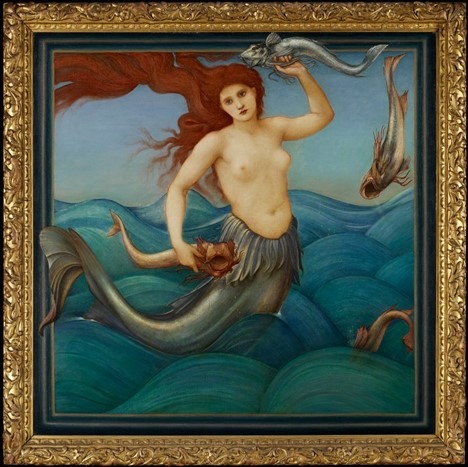
Edward Burne-Jones’s A Sea-Nymph (1881) represents a departure from the painter’s usual focus on Arthurian and Greek mythological subjects. Instead, A Sea-Nymph violates the conventions of portrait representation by presenting a portrait that upsets distinctions between human and animal, land and sea, horizontal and vertical, beautiful and ugly, and even inside and outside. My paper will understand such disruptions as Burne-Jones’s revision of The Birth of Venus by Sandro Botticelli. Both represent a beautiful nude woman with unconstrained red hair rising from a sea of pointedly non-realistic waves. Mediating Burne-Jones’s relation to Botticelli is the famous chapter in Walter Pater’s The Renaissance about Botticelli. For Pater, the painting represents an artist of the early modern period confronting classical myth as if for the first time: ‘You have a record of the first impression made by it [the classical world] on minds turned back towards it in almost painful aspiration from a world in which it had been ignored so long.’ Burne-Jones revises Pater by moving away from the classical world of Botticelli to one with no obvious ties to any particular culture or story. He imagines the mermaid as a lonely and displaced Venus, a goddess of nothing. Whereas Botticelli’s painting presents the origin of Venus and sets her within an implicit narrative, the mermaid of Burne-Jones has no obvious story to explain her, neither origin or goal. Instead, Burne-Jones presents her as an enigma. Most saliently, the abstracted beauty of her face contrasts dramatically with the violent energy with which she tosses the monstrous fish around her. This energy is enough to break the conventional frame: in two places, the mermaid spills over the painting’s represented frame to transgress near to the painting’s literal frame. The spillover underscores the boundary-violating power of the mermaid, a power that is not circumscribed by a larger social setting or mythic narrative.
20 Mariateresa Esposito (University of Iceland)
Mariateresa Esposito is a PhD candidate at the University of Iceland (Reykjavík, Iceland). Her PhD dissertation revolves around the figure of the nykur, the Icelandic water horse spirit, examining its presence in Icelandic folklore as a cautionary figure with ties to the Icelandic environment, and a representation of the evolution of Icelandic identity in connection with the role of water bodies in the context of a Scandinavian island society.
Mariateresa has conducted background studies in Scandinavian medieval literature in Italy, and has then pursued a PhD candidate career in Iceland specialising in Icelandic and Scandinavian folklore.
At the time of the submission of this abstract, alongside her PhD studies, she is also part of a research project titled ‘Monsters, Sorcerers and Witches of Northwestern Europe’, involving several Italian universities and aiming for the creation of a digitalized corpus of supernatural occurrences in a variety of medieval texts.
The Nykur: An Icelandic water spirit in folklore and cultural memory Panel 17
Keywords: Folklore, sea, Iceland, nykur, water horse, kelpie, water
By examining folktales, chronicles, and present-day references, this paper will attempt to explore the persistence of the figure of the water horse nykur within folklore and adaptation into modern Icelandic identity. It will discuss the beginnings of the nykur legends, as well as their characteristics and evolution in Icelandic cultural memory, against the Nordic-European backdrop of water spirits including the Scottish kelpie and the Scandinavian nøkk. The nykur is an often malevolent character that is present in several recorded legends from many disparate locations in Iceland. These tales exemplify the threats posed by Iceland’s harsh natural environments, serving as a warning image for people and reflecting the dependence of mankind on water. Unlike previous research that exclusively document the nykur as a mythological entity, this paper analyses the water horse through the lenses of folklore studies, cultural history, and environmental symbolism to offer a fresh perspective on its enduring relevance. By comparing regional variations and symbolic interpretations, this paper highlights the nykur’s role as a bridge between Iceland’s mythological past and its present-day cultural landscape.
21 Dr Kathryn Franklin (University of Toronto)
Kathryn Franklin holds a Ph.D. from the graduate program in Humanities at York University. A former Arts and Science Postdoctoral fellow in the Department of English at the University of Toronto, she is currently a lecturer at the Centre for Teaching and Learning and the Institute for the Study of University Pedagogy at the University of Toronto. Her current research explores the relationship between glamour and the popularization of the urban Canadian middlebrow novel in the 1950s and 60s. Her work has appeared in The Space Between, Imaginations, International Journal of Fashion Studies and World Film Locations: Berlin. She also served as a co-editor for the Canadian literary publication Descant. Her forthcoming co-edited collection, Toronto Chic: A Locational History of Toronto Fashion,is forthcoming with University of Toronto Press.
A Mari Usque Ad Mare: Phyllis Brett Young’s Undine and the female grotesque in the popular Canadian imaginary Panel 17
Keywords: Phyllis Brett Young, Canadian Literature, Undine legend, grotesque, Gothic, post-war Canadian women
In 1964, the Canadian middlebrow novelist Phyllis Brett Young published her third book Undine. Young’s novel repurposes the Undine legend, transforming it into a story of a young woman grappling with the spectral presence of her new husband’s former wife. Yet, by relocating the narrative from the realm of water spirits to the psychological landscape of modern relationships, Young’s narrative preserves the essence of the mermaid archetype: a being caught between two worlds, struggling for identity and belonging — a sentiment that would resonate with an author who made a point of capturing the rapidly changing culture of modernity in Canada, and in particular, how these changes affected post-war Canadian womanhood.
While the setting of Undine takes place in an unnamed county in upstate New York, the novel’s themes of mistaken identities and subservience to stronger personalities speaks to Canada’s often shaky cultural position in the pre-centennial years. Noticeably, Young inscribes her text with allusions to Daphne du Maurier’s Rebecca and Henry James’ The Turn of the Screw;the convergence of these two Gothic literary texts seemingly haunt her narrative in a subtle pantomime of the dominance of the UK and US on Canadian culture.
By situating Young’s work within the broader context of Canadian literature and mermaid folklore, this paper aims to demonstrate how Undine suggests a grotesque gothic femininity as central to the Canadian popular imaginary.
23 Dr Monica Germanà (University of Westminster)
Dr Monica Germanà is Reader in Gothic and Contemporary Studies at the University of Westminster. Her most recent publications include The Scottish Gothic: An Edinburgh Companion (2018), co-edited with Carol Davison and short-listed for the Allan Lloyd Prize, Bond Girls: Body, Fashion, Gender (Bloomsbury, 2019), shortlisted for the Emily Toth Award, and a special issue of Gothic Studies on Haunted Scotlands (March 2022). She has recently produced a three-part podcast on the Inuit legend ‘Skeleton Woman’ for the Haunted Shores Network, is the co-organiser with Dr Ingibjörg Ágústsdóttir (University of Iceland) of Ice and Water: a Two-Day Interdisciplinary Event (Reykjavik, 23-24 May 2024), and the curator of Vanishing Landmarks: Artivism and Climate Change (The Soho Poly, University of Westminster) for the 2024 edition of the Being Human Festival.
‘Becoming with Seal’: Mourning, separation, and kinship in contemporary selkie soundscapes Panel 24
This paper explores contemporary cultural retellings of traditional selkie lore to reflect on the environmental messages articulated by the sonic dimension of seal stories. Earlier studies suggested that the ‘[t]he plaintive-sounding barking of the seal would to primitive man hardly seem to lack overtones of human emotion’ (Puhvel 1963), to explain the wide-spread of seal-people legends across northern Europe. A close inspection of the sonic dimension of contemporary responses to selkie stories reveals a very nuanced spectrum of verbal (including dialogue and song) and non-verbal communication (ranging from silence to animal sounds), which arguably reflects the ambiguity and complexity of folkloric tales. On one hand, both the selkie’s elusive silence and verbal communication – and especially when selkies articulate their own voices – may draw attention to the boundary that separates the humans’ dry land and the selkies’ water, whilst questioning anthropocentric views on the environment. On the other hand, non-verbal communication, significantly performed in the liminal space that is the shore, frequently offers an attempt to break down binary human/animal categorical distinctions and, simultaneously, move beyond anthropocentrism altogether. Among others, this paper will make references to both verbal and non-verbal communication and sounds in Eric Linklater’s short story ‘Sealskin Trousers’ (1947), Amy Sackville’s novel Orkney (2013), Roseanne Watt’s poetry in Moder Dy (2019), Hanna Tuulikki’s sonic and choreographic performance Seals’kin (2022), Ellie Schmidt’s video works Three Selkie Songs (2022), and Nora Feingschidt’s film The Outrun (2024).
24 Jane Gill (University of Hertfordshire)
Jane Gill is a doctoral student at the University of Hertfordshire. Her Ph.D. examines the monstrous feminine from an Eco-Gothic perspective focusing on the female vampire. She is extending her oeuvre to include mermaid archetypes in nineteenth-century literature and visual art. Her research interests include nautical Gothic, botanical Gothic, gender in the nineteenth century, and the eco-Gothic. She is in receipt of a bursary which sees her affiliated to the Open Graves, Open Minds Project (OGOM) led by Sam George and Bill Hughes. The Project extends to all narratives of the fantastic, the folkloric, and the magical, emphasising that sense of Gothic as enchantment rather than simply horror. Through this, OGOM is articulating an ethical Gothic, cultivating moral agency and creating empathy for the marginalised, monstrous or othered, including the disenchanted natural world. Jane will be contributing via symposia and events and by writing research posts on aspects of nautical and botanical gothic.
The Romantic Lamia and Anne Bannerman’s ‘The Mermaid’ (1800) Panel 20
Keywords: Femme Fatale, Lamia, mermaid, monstrous feminine, Siren, Romanticism, female Romantic writers
The age of Romanticism in art and literature was an era of transition between the Enlightenment view of the world and the emerging values of industrial and modern culture. In a similar way to the changes happening at the end of the nineteenth century, these times of shifts in social attitudes led to the eruption of female serpentine monsters in Romantic art and literature: monsters that were a reflection of the attitudes of their era. The Lamia archetype first emerged in the Romantic era during these times of seismic cultural shifts in literature. The Lamia archetype can be explained as any female human-snake hybrid (including mermaids).
Anne Bannerman’s 1800 poem ‘The Mermaid’ features a femme fatale who belongs to the Lamia archetypal group. My analysis of the poem will explore and contextualise this poem in terms of the monstrous feminine as well as delving into ecophobia and eco-gender. I aim to answer the questions: ‘How did this female-authored Romantic femme fatale differ from the male-authored femme fatales from Keats in this era?’’ By comparing Bannerman’s Mermaid to other nineteenth-century monstrous females in literature, such as Keat’s ‘La Belle Dame Sans Merci’ (1819), I will explore shifts in attitudes to women and nature in the Romantic era.
25 Rebecca Greef (University of Hertfordshire)
Rebecca Greef is a doctoral student in Literature at the University of Hertfordshire. Her PhD focuses on the Faustian bargain trope in young adult fiction, new adult fiction, and the Gothic. Elsewhere, her research interests include contemporary Gothic, the female Gothic, folklore and fairy tales, the intersectionality of supernatural creatures, and the evolving nature of Gothic readership in the twenty-first century. She has a special interest in witches, fae, vampires, and demons.
Poor unfortunate souls: The Faustian bargain of ‘The Little Mermaid’ Panel 13
Keywords: mermaid, Faustian bargain, soul, humanity, immortality
Hans Christian Andersen’s The Little Mermaid (1837)can be seen as a classic Faustian tale featuring a knowledge hungry protagonist who makes a deal to escape her nautical existence and become human. The eponymous Little Mermaid longs to join the human world after years of collecting trinkets from shipwrecks and obsessing over human culture. Her main ambition, however, is to achieve her dream “of human happiness and an immortal soul”. To do this, she must give up her longer mortal life span in exchange for a soul that will live on.
This paper aims to compare Andersen’s The Little Mermaid to the Faustian tales of Christopher Marlowe (c. 1592) and Johann Wolfgang von Goethe (1808/1832), showing how Andersen’s story uses the Faustian trope, and similarly plays with the ideas of redemption and suffering that the protagonist must face because of her bargain. Like Marlowe and Goethe’s Doctor Faustus character, the Little Mermaid refuses to accept the barriers that stop her being able to achieve what she desires, so she seeks to overcome them. Andersen’s Sea Witch is more than willing to facilitate a bargain that allows the Little Mermaid to try and claim her immortal soul, making the Little Mermaid human in exchange for her voice, and setting her the task of marrying a prince.
As Marlowe and Goethe vary in their approaches to Faust’s redemption, contemporary adaptations of The Little Mermaid, including the 1989 Walt Disney film, have also changed the ending of her story to reflect different narratives and present alternative depictions of her character. This paper will explore some of these adaptations, and how The Little Mermaid fits the classic Faustian bargain trope.
27 Marci Heatherly (Pittsburg State University, KA)
Marci Heatherly is a graduate student at Pittsburg State University in Kansas. Marci was a Fulbright Bulgaria English Teaching Assistant during the 2023–2024 academic year. She attended the Fulbright Eastern European Media Literary Conference in the fall of 2023. Marci has had literary reviews published in Harbor Review and The Kansas Association of Teachers of English Journal. Her research paper ‘Devotion to Destruction: Obsession with the Miraculous in British Dramas’ was selected for the 2025 Saint’s English Graduate Conference in St. Andrews, Scotland.
Femme fatale, occult waters, and siren Silencing in Louise Erdrich’s ‘Fleur’ Panel 14
Keywords: Native American folklore, feminine agency, magical disasters, exploitation of sirens
After a near drowning in the icy, mystical waters of Lake Turcott, Fleur Pillager, the protagonist of Louise Erdrich’s 1986 short story ‘Fleur’, becomes mythic. She is simultaneously miraculous and devious, a victim and an annihilator, a water witch and an innocent girl, alien and human; it is this fluidity she possesses, which results in ostracisation from her Chippewa reservation. But even when Fleur attempts to join modern civilization, in the small town of Argus, she is othered. Linked to the water devil, Misshepeshu, Fleur cannot escape her siren hybridity. By observing how Fleur both converts and subverts to the typical role of the siren in Erdrich’s story—such as through her Chippewa roots and androgyny—an unfortunate reality is presented. Sirens control their song, but they cannot control the songs sung and spread about them. As much as Fleur is a femme fatale, through her killing of men with hiss and smile, she cannot terminate talk. She commands natural phenomena of water and wind, but not narrative.
Fleur’s story is told by a third party, and her reputation is bipartitely distorted. To the populations of both the reservation and city, Fleur is either an evil or erotic woman, but never a victim, even though she is repeatedly sexualised and assaulted by men. Fleur and her account are not tended to by society. Thus, while Erdrich’s story delves into indigenous mythology and mermaids, magical realism, and rural American communities, ultimately ‘Fleur’ serves as cautionary warning to, not only sirens, but all women: when entering male dominated spaces, such as Lake Turcott or the card game, even the strongest, most lethal, women will be trivialised and attacked.
Therefore, this paper explores how Erdrich’s ‘Fleur’ is a quintessential representation of patriarchy dominating, alienating, and altering narrative. Fleur—her magic, her power, her intentions—are reduced to fabrication. Rather than remembered as a feminine mystic acting and attacking on just vindictive, the accepted myth of Fleur delineates that she ‘[is] haywire, out of control’, a crazy woman. But truthfully, she is a silenced siren.
28 Dr Lizanne Henderson (University of Glasgow)
Dr Lizanne Henderson is Senior Lecturer, University of Glasgow. She is a cultural historian of the Scottish witch-hunts and human-animal studies, with additional interests in the history of Natural History, Scottish exploration and Arctic studies. Her first book (with E. J. Cowan) Scottish Fairy Belief: A History (2001) was a Ratcliffe Book Prize winner, her monograph Witchcraft and Folk Belief in the Age of Enlightenment: Scotland, 1670–1740 was winner of the Katharine Briggs Book Award 2016, and she is preparing a forthcoming monograph (Super)natural Animals in the Age of the Stewarts to the Age of Enlightenment. Her current research projects are Picturing Polar Bears: Past and Present Semiotic and Iconic Perceptions of Ursus maritimus and 19th-century Scottish Arctic explorers and their engagements with the natural world.
Preternatural phocids: seals, selkies and the imagined sea Panel 6
Stories featuring pinnipeds (seals) are popular and have captured the imagination of generations past and present. Tales of seals with an ability to transform into human shape – commonly referred to in English as selkies – are widespread across the North Atlantic. There are, however, multivalent interpretations as to what a selkie was and how much of a threat, or otherwise, they were to humans. How selkies are regarded is affected by the traditional storytelling mediums in which they appear. In folk ballads, for instance, selkie characters are generally innominate and highly stylised, drawing on recognisable standard tale-types and motifs. In folktales, the selkie similarly tends to be heavily stylised but can be given personal names or other forms of personal touches. A higher degree of personalisation is afforded to selkies in legends and memorates in where they can acquire deeper levels of individualisation, connected to specific geographical locations or family histories. Depending on the story context and medium, or the gender dynamics at play, the talerole function of the selkie is inconsistent, presented either as a risk to human safety or, alternatively, as the victim of human transgressions.
This paper draws on a variety of historical sources and cultural comparisons of the selkie story, mainly within North Atlantic contexts. It investigates past attitudes towards natural and unnatural animals, with particular reference to Halichoerus grypus, the Grey Seal, a member of the family Phocidae (earless seals), and the place of the selkie within this interplay between ‘magical’ and natural worlds. Specific attention is given to the ballad ‘The Great Silkie of Sule Skerry’ [113], from the F. J. Child (1882-1898) corpus of Scottish and English classical ballads. This ballad, recorded from Scotland’s Northern Isles, offers a suitable lens through which to examine the dangers selkies posed (both real and imagined), and to explore the liminal boundaries between magical and natural animals and landscapes, concepts of shapeshifting (or therianthropy), as well as the importance of gender to the overall tone and outcome of the selkie stories. Seals (and selkies), as creatures who inhabit both land and sea, are themselves liminal beings that occasionally challenge the categories of natural and supernatural, and in turn illuminate the complex relationship between humans and the environment.
29 Dr Charles Hoge (Metropolitan State University of Denver)
Charles Hoge is a scholar of folklore, film, popular culture, and literature, specifically monstrosity, vampire studies, dark folklore, the Gothic, horror, extinction, and Victorian literature and culture. He has taught literature, film, and composition classes at the Metropolitan State University of Denver since 1999, earned a PhD in English literature from the University of Denver in 2015, and has published on ludology in Doctor Who fanfiction (in Transformative Works and Cultures), medieval folkloric influences in I Am Legend (in Reading Richard Matheson), phantom dogs in Under the Volcano (in Malcolm Lowry’s Poetics in Space), the cultural impressions left after the dodo’s extinction (in the University of Toronto Quarterly), vampiric evolution in What We Do in the Shadows (Vampire Films around the World), the Victorian imagination and Jurassic Park’s dinosaurs (in The Science of Sci-Fi Cinema), and the 2022 monograph The Dead Travel Fast: The Explosive Evolution of Vampire Films.
When enchantment is made flesh: An exploration of the Steller’s Sea-ape Panel 15
Keywords: Sea-Ape, cryptid, enchantment, folklore, monsters, George Steller
Few empirical encounters have been recorded in which a human being verifiably comes into contact with the sort of enchanted, extra-natural entity one typically finds in fairy tales and the art and narratives of fantasy. One such encounter, with a possible mer-creature later called the Steller’s Sea-Ape, provides compelling and complicated evidence of how a human reacts when an apparent manifestation of enchantment appears in the flesh. On August 10, 1741 off the coast of the Shumagin Islands near what is now known as Alaska, German explorer Georg Wilhelm Steller bore witness to a furry, human-sized, bewhiskered marine creature which appeared to be a hybrid between a dog and a shark. It bobbed in the water, observing him curiously; in response, he shot at it, but missed, causing it understandably to dip below the water and disappear. Nothing resembling this creature would ever be seen again. Nonetheless, Steller recorded the incident and assigned the creature a scientific classification, naming it the ‘Sea-Ape’.
This project looks to examine this singular mer-creature encounter in depth, both the Sea-Ape itself and Steller’s responses to it, through the lenses of folklore, cultural theory, monster theory, cryptid studies, and larger notions of how humans respond to Otherness. In doing so, it intends to discover what can be learned when humanity finds itself in the apparent presence of the products of its own imagination. Importantly, can any part of this mer-creature account be meaningfully re-enchanted? Perhaps Steller’s reaction, to attempt to kill and later to classify this unique hybrid that would never be seen again, may be productively as well as critically interrogated. In doing so, this project hopes to work toward suggesting the potential for more compassionate responses to any future encounters with alleged empirical impossibilities, such as the tantalizingly mysterious Sea-Ape.
30 Fred Hook (Queen’s University, Kingston)
Fred Hook is currently a second-year PhD student in the Department of English Literature and Creative Writing at Queen’s University, Kingston in Canada. They completed their BAH in English Literature and Drama at Queen’s University, and their MA in Romantic and Victorian Literary Studies at Durham University. Their research field is long-nineteenth-century British literature, with a particular interest in monstrosity, queerness, gender and sexuality, and coded languages. Their doctoral dissertation focuses on queer coded languages in the private archives and published works of Michael Field and Vernon Lee.
The struggle of one thing twisting into another and back again’: The re-enchantment of the sea lung in Julia Armfield’s Our Wives Under the Sea Panel 25
Keywords: re-enchantment; sea lungs; Gothic; Our Wives Under the Sea; transformation
In Julia Armfield’s novel Our Wives Under the Sea (2022), Miri reflects on moments when her wife Leah would explain the science behind oceanic phenomena to her. One such instance happens during a walk by the seaside in the winter when they spot a sea lung. Leah explains to Miri that what sailors believed to be part of ‘the sea’s internal structure come loose’ is actually slushy ice that forms on the ocean with rapid temperature changes (Armfield 96). Later in the novel, Leah finds herself explaining the consistency of jellyfish to her colleague Jelka, as she would if she were speaking to Miri (134). Leah’s scientific explanations can be seen as ‘dis-enchantments’, explaining away the seemingly supernatural aspects of life. A quick Google search reveals that sea lungs are not only slushy ice (or the ocean’s organs), but also a type of jellyfish. While the novel never explains how Leah ‘came back wrong’ or what she is transforming into, many of her new-found changes are similar to the novel’s description of sea lungs – of both the ice and jellyfish variety. I argue that Leah’s transformation re-enchants the sea lung, turning it back from a scientifically explained phenomena (or jellyfish) to an unexplained supernatural ‘thing’ that comes from ‘chilly liminality of water and earth [. . .] the place where one fades into the other’ (95). Through its re-enchantment, the sea lung therefore becomes a Gothic hybrid, a monstrous being that haunts the novel.
31 Dr Bill Hughes (Open Graves, Open Minds Project)
Dr Bill Hughes is Co-Convenor, with Dr Sam George, of the Open Graves, Open Minds Project. He is co-editor (with Dr George) of Open Graves, Open Minds: Vampires and the Undead from the Enlightenment to the Present (Manchester: MUP, 2013); In the Company of Wolves: Wolves, Werewolves, and Wild Children (Manchester: MUP, 2020); The Legacy of John Polidori: The Romantic Vampire and its Progeny (Manchester: MUP, 2024); ‘Ill met by moonlight’: Gothic Encounters with Enchantment and the Faerie Realm in Literature and Culture (forthcoming). He has also co-edited (with Dr George again) the special issues of Gothic Studies on vampires and werewolves and the special issue of Gramarye on Gothic Faery. Bill is working on two monographs: on Gothic Enchantment and on The Progress of Paranormal Romance.
Bill has a doctorate in English Literature from the University of Sheffield. He is currently researching contemporary paranormal romance and Young Adult Gothic from the perspectives of formalism, genre, and Critical Theory. Publications from this research embrace YA romances of vampires, zombies, and werewolves; fairy fiction; and Angela Carter’s beast tales. His essays on this topic have appeared in books from Werewolves, Wolves and the Gothic (UWP, 2017) to Young Adult Gothic Fiction (UWP, 2021). Elsewhere, Bill has published widely on communicative reason and the interrelation of the dialogue genre and English novels of the long eighteenth century; he has essays forthcoming: ‘Enlightenment Fact, Orientalist Fantasy: Dialogues of Colonial Encounter in Sydney Owenson’s The Missionary (1811)’ (Wenshan Review of Literature and Culture) and ‘“Base and degenerate language”: Genre and rational voices in John Thelwall’s The Daughter of Adoption’. Bill has also published on Richard Hoggart, and intertextuality and the Semantic Web. This apparently disparate research is not unfocused; it has at its core concerns with the Enlightenment as viewed through the Frankfurt School and the Marxist tradition. Bill is a fanatical ailurophile and from his two cats, Morticia and Gomez, he reaches a greater understanding of Adorno day by day.
Email: bill.enlightenment [@] gmail [dot] com
Twitter: @BillBloodyHughe
BlueSky: @BillBloodyHughes.bsky.social
Threads/Instagram: @drbillhughes
Humanities Commons: https://hcommons.org/members/billhughes/
Academia.edu: https://sheffield.academia.edu/BillHughes
ORCID: https://orcid.org/0000-0002-1557-9460
Genre and gender in contemporary selkie fiction: Patriarchy, utopia, instrumentalism, enchantment Panel 24
Selkie legends, perhaps because of their unique and curious mixture of tenderness and cruelty, are fertile material for reworking into fictions that dramatise women’s concerns. Moreover, the hybridity of the creatures inspires speculations on the interconnectedness of human and animal natures that may be worked into these narratives. The tales are, significantly, enacted in the domestic sphere, and this arena of the ambivalent and adversarial relationship between men and women, where lovers, abusers, and victims all dwell is a favoured site for contemporary selkie novels, which I will be discussing.
These fictions join a corpus of novels in the genre of paranormal romance and contiguous kinds, a genre which blossomed in the twenty-first century and has acquired a huge readership of devoted readers (usually women). Novels that rework myth and folklore already exhibit tensions between different modes, of psychological and situational realism and of the marvellous and fantastic. But often, such narratives play with other distinct genres, increasing that sense of division and pitting the different epistemological stances that different genres bear against each other. This, I argue, is fruitful. Thus, Melanie Golding’s The Replacement (2023) brings the analytical mode of the procedural detective novel and the violent affect of the thriller (adapted to a female voice) into contrast with the folkloric fantastic. Margo Lanagan’s The Brides of Rollrock Island (2012) is, on the surface, more generically homogeneous. But beneath that surface swim a similar range of modes and voices: female resentment, utopian desire, retreat from modernity and commodification among others.
The polyvocal nature of selkie novels like these, almost an imperative due to the hybrid nature of the creatures themselves, enables a vivid feminist condemnation of domestic violence and patriarchy generally. However, beyond that, the dialogue of modes and genres becomes something less programmatic – an open-ended vision of the, often distorted, dialogue between the sexes that unveils utopia as well as hell. And the hybrid voices, uttered almost by the selkies’ hybrid bodies, make connections between that and the world of nature repressed and hidden by human instrumental practice, offering glimpses of reconciliation and re-enchantment.
32 Victoria Hurtado (Independent scholar)
I graduated with a BA on Social and Cultural Anthropology from the Universidad Autónoma de Madrid (UAM) in 2012, and then completed an MA in Public Anthropology in 2014. I have presented at the Congress on art, literature and urban gothic culture hosted by the Universidad Complutense de Madrid (UCM). In addition, I have participated in the IGA conferences that took place in Manchester and Dublin. The author’s academic papers are available for consultation via Academia.edu.
The fantastical narratives of Friedrich de la Motte Fouqué and Richard Wagner, featuring undines, illustrated by Arthur Rackham. Are those realms of enchantment under threat? Panel 26
Keywords: German Romanticism, fantastic genre, Undines, enchantment, modernity, disenchantment
The proposal explores the fantastic genre focusing on the domains of female water creatures. These beings appear in different types of storytelling and art, from ancient Greco-Roman and Germanic-Scandinavian myths to contemporary fiction. During the first period of German Romanticism, Friedrich de la Motte Fouqué wrote ‘Undine’ in 1811. This dark romance is full of mystery, wonder, and ambiguity, creating an eerie atmosphere. Fouqué also wrote a libretto for theeponymous opera, which was composed by his friend E.T.A. Hoffmann. The gothic revival that swept across Europe at the time sparked interest in national folklore. In 1876, Richard Wagner premiered The Ring Cycle, based on medieval legends and sagas. The first and last of the dramatic opera tetralogy feature three nymphs guarding a golden treasure of the Rhine. Arthur Rackham, renowned for his marvellous designs, was asked to illustrate both titles, which were published by William Heinemann Ltd. (London, 1910-1911).
In light of the cultural touchstones outlined above, I would like to contribute to the ongoing debate regarding the cultural tensions that arise from the juxtaposition of the Enlightenment’s focus on rationality and the Romantic movement’s emphasis on feelings and imagination. The term ‘disenchantment’ was used by Max Weber in 1918 to argue that modernity had a detrimental effect on the unconstrained and creative dimensions, resulting in a loss of subversive potential to defy the status quo in the field of art, literature and music within a technocratic society. The challenge of confronting inexplicable phenomena remains relevant. However marketable fantasy could fail to establish a framework that elicits emotional experiences through aesthetics and provides spellbinding perspectives that transcend mere ‘reality’. The concept of re-enchantment could serve as a valuable analytical tool in evaluating the impact of cultural industries, including commercial strategies, algorithmic processes, and the branding of fantastic fiction for mass consumption.
33 Dominique Ionnone (University of Salerno)
Enrolled in the doctoral program in ‘Literary, Linguistic and Historical Studies’ at the University of Salerno, Dominique Iannone is working on an interdisciplinary dissertation focusing on the relationship between word and image in Alfred Tennyson’s Idylls of the King and its visual translations—namely but not exclusively on the engravings produced by Gustave Doré and on Julia Margaret Cameron’s photographic illustrations. She is author of the essay ‘Speaking (out) of Silence: the Burden of Womanhood in Christina Rossetti’s Monna Innominata and William Morris’s The Defence of Guenevere’, published in the journal Testi e Linguaggi, 17 (2023). She participated as speaker in the Compalit conference ‘Powers of Reading. Practices, Images, Media’ (Padua, Dec. 14-16, 2023), with a paper on the woman reader in Tennyson’s ‘The Princess’and in the Compalit conference ‘Where is Literature? Circulation, Institutions, Power Relations’ (Bologna, Dec. 11-13, 2024) with a paper on Beatrix Potter’s illustrated books and their adaptations across media.
Undulant shapes of murderous femininity: Tennyson’s aquatic creatures Panel 20
Keywords: Alfred Tennyson, Victorian poetry, ‘The Mermaid’, ‘The Merman’, ‘The Sea-Fairies’, Victorian illustration, gender, song, myth
Dismissed as examples of youthful experimentation, the critically neglected poems ‘The Mermaid’, ‘The Merman’ and ‘The Sea-Fairies’ offer invaluable insight into Alfred Tennyson’s fascination with sea creatures and his ambivalent attitude towards their liminal, primaeval, dangerous but ultimately alluring feminine power. Originally published in Poems, Chiefly Lyrical (1830), these early poems announce an overpowering impulse that would accompany Tennyson for the rest of his career: the return to the mythical past. In the splendour of classical antiquity, its stories and creatures, the poet found a realm of boundless imagination removed from reality where he could experience life through the eyes of another species, a vision which would blur the dichotomies of past and present, self and other. Appearing in a number of different guises, presented under various names and inhabiting spaces of illusory idyllic beauty, his aquatic beings are an expression of man’s fight against their hybrid nature and their potential to master his phallic power — a potential that has to be restrained and tamed. This battle proves all the more difficult since the lure of the aberrant takes on the form of an exquisite beauty unstained by monstrosity and of an irresistibly flattering melody which brings death to its listener. This emerges with clarity in the illustrated collection Fairy Lilian and Other Poems (1888) where Tennyson’s mermaids and sea-fairies are pictured as creatures of voluptuous beauty who stare intently at the spectator while they seductively brush their hair, chant their destructive song or delicately stroke the strings of their harps. By means of a comparative analysis of the gender dynamics at work in the poems and in their illustrations — which often endorse voyeuristic pleasure — the present study will demonstrate how Tennyson’s merpeople and their enthralling music are ultimately nothing but a reflection of his wish to usurp their power, a carefully crafted appropriation of their voice, a reminder that, in the battle for artistic creation, it is always the male artist who emerges victorious.
35 Alex Judkins (University of Sheffield)
Alex J. Judkins is a PhD student at the University of Sheffield, funded by the White Rose College of Arts and Humanities. Her PhD project centres on historical representations of sea monsters in French- and Spanish-speaking cultures, seeking to blend the Blue Humanities with monster theory to explore the relationship between humans and the sea. This work follows on from her MA dissertation, which explored gender and monstrosity in 17th century French popular pamphlet literature. Alex also has a strong interest and involvement in film, organising screenings as part of the BFI’s Young Programmer initiative at the Showroom Cinema in Sheffield and serving on the Youth Jury of Sheffield DocFest international documentary film festival in 2023.
Dis/enchantment and Enlightenment: Fish-men, folklore and fact in eighteenth-century Spain Panel 16
Keywords: folklore, disenchantment, Enlightenment, eighteenth-century Spain, hybridity, monster theory
Sea monsters and waterborne hybrids such as mermaids are often viewed as creatures at the margins of human knowledge, existing as cautionary tales that warn off further exploration. Where such merfolk and monsters have received scholarly attention, this has tended towards literary and filmic representations that place them in the realm of the imaginary. It is less often considered that in the past, these hybrid creatures haunted the border of the real and imaginary, discussed by scientists as well as authors of fiction.
This paper will examine a lesser-known folkloric sea creature, the hombre pez (‘fish-man’) of Spain – a man transformed into a monstrous human-fish hybrid by a curse, in most retellings. These tales are studied via analysis of a discourse on the hombres pez by Spanish essayist Benito Jerónimo Feijóo. The essay appears in his Universal Critical Theatre (1726-1740), a compilation dedicated to debunking popular superstitions, yet Feijóo’s lively engagement with two folk tales – itself a hybridisation of scientific essay and folk retelling – seeks to prove rather than disprove the existence of hombres pez.
Instead of representing a failure of his usual scepticism, as has been suggested before, the paper explores the possibility that Feijóo’s essay is a glimmer of enchantment in an otherwise sceptical Enlightenment text. Viewing the text through the lens of monster theory and the Blue Humanities, I argue that Feijóo frames the fish-man’s transformation as a connection between humanity and the sea, an opportunity to learn about the unknown, and an expansion of the borders of the possible. The hombres pez trouble the boundary of real and imaginary, their hybrid form echoed in Feijóo’s hybrid essay, and represent therefore not merely the danger of the unknown, but the promise of its secrets.
36 Alexa Keough (University of Hampshire)
Alexa Keough is a first-year Master’s student in English Studies at the University of Hampshire. She earned her Bachelor’s degree in English from Colby-Sawyer College in 2017 and her secondary education licensure from Bridgewater State University in 2020. She taught high school English at several schools throughout the state of New Hampshire for four years before continuing her education at UNH. Her areas of interest include myth and folklore (specifically depictions of witches and wise women), critical analysis of pop culture, and the intersection of poetry and songwriting in pop music.
Slipping off the sealskin: Examining the nuances of intimate partner violence in selkie mythology Panel 7
Keywords: selkies, seals, intimate partner violence, women’s studies, mythology
Myths of selkies in various cultural contexts have long been used to address both environmental concerns and the ever-perilous nature of gender relations; an additional feminist reading of popular selkie folklore also reveals deeper dialogue about the issue of intimate partner violence (IPV) present in many narratives that feature them. A hallmark of the selkie story is to have one’s sealskin stolen and held hostage by a lustful fisherman–is this trope an archaic attempt at romance, or a signifier of a deeper conversation about partnership and pain to be beheld within the scope of the fable? Both readings raise questions about intimacy, control, and compulsion that hold significant modern relevance.
Much like the slippery sinuousness of the seal, definitions of IPV have been widely varied and deeply difficult to accurately diagnose; selkie stories offer perspectives on lesser-known aspects of IPV, such as coercive control, financial exploitation, and familial alienation through a distinctly folkloric lens. The following paper uses selkie myths from various cultures and locations (including but not limited to its native Scotland, Iceland, and the Pacific Northwest United States) along with the contemporary novel A Sweet String of Salt (Rose Sutherland) to examine how the legend of the selkie can provide valuable insight into both the psychological causes and effects of a pervasive social problem.
37 Shahrukh Khan (The English and Foreign Languages University, Hyderabad)
Shahrukh Khan is a PhD research scholar at English and Foreign Languages University, Hyderabad, India. He has qualified for Assistant’Professorship and been awarded the Junior Research Fellowship from UGC. He has completed his M.Phil. in “The Metaphor of Home in Sea Fiction: A Critique of Yann Martel’s Life of Pi and Joseph O’Connor’s Star of the Sea’ from Mahatma Gandhi Central University, India. He was awarded the Gold Medal in MA English from Aliah University, Kolkata. He has been published in the Cambridge Scholars Publishing and Lincom Press, Germany. His research interests include blue humanities and oceanic/sea/river in South Asian literature.
Indian ocean studies: Transoceanic memory in postcolonial Gothic sea fiction Panel 22
Keywords: postcolonial gothic, sea fiction, blue humanities, Indian Ocean, transoceanic
Rebecca Duncan defines ‘postcolonial Gothic’ as ‘fiction that takes the interrogation of colonialism as its objective, and which often entails highlighting the blindspots, conspicuous silences and failures of colonial narratives’ (306). This paper examines the oceanic space as an archive of the Indian subcontinent’s colonial past. Through its use of Gothic conventions—uncanny, ghosts, tsunami, and haunted shorelines—postcolonial Gothic Sea fiction interrogates the lingering effects of colonisation, highlighting the tensions and traumas embedded in colonial histories and their aftermath. The presence of the ghosts—freedom fighters and colonisers in Shubhangi Swarup’s Latitudes of Longing (2018) and victim of Vasco da Gama, Velu, in The Ghost of Malabar (2022)—blurs the boundary between dead and alive and opens before us non-western epistemologies. Each mutilated body of ghosts has a separate story that depicts the horror of colonialism in both novels set around water bodies. The supernatural elements, including haunted shores and eco-disaster, serve as metaphors for ecological disruptions, providing a deeper understanding of the human-nature relationship. I argue that the ocean is not merely a mysterious space of nonhuman forms but a haunting archive of transoceanic memory and a functional archive of lived experiences. Studies on Indian colonial literature has examined the merger of myth, fact, and historical trauma. The inclusion of Gothicity using sea fiction bridges the gap between the horrors of the past and its lingering postcolonial interpretation, giving a new dimension to the discourse on Indian colonialism. I intend to study how Gothicity resurfaces the horrors, disrupting the illusion of the coloniser’s ownership of land/water, underscoring the enduring presence of colonial trauma.
38 Jubby Kumar (Guru Ghasidas Vishwavidyalaya)
Ms Jubby Kumar is an enthusiastic PhD scholar with a profound interest in fairytales, currently pursuing doctoral research at Guru Ghasidas Vishwavidyalaya, Bilaspur, Chhattisgarh. Fascinated by the timeless allure and cultural significance of fairytales, she is dedicated to exploring their rich narratives and symbolic meanings. Through her unique perspective on her research, she aims to shed new light on these beloved stories and their tremendous impact on human imagination and culture. She seeks to unveil the enduring relevance of fairytales in contemporary society.
Breaking the shell: How modern mermaid fiction rewrites the Disney Princess Panel 7
Keywords: Disney, fairytale retellings, Feminism, freedom, identity,mermaids, selkies, sirens, voice
Mermaids, sirens, and selkies are the creatures of the mysterious dark sea, that have been an integral part of myths. They have been a symbol of beauty, loss, and terror. Since Hans Christian Andersen’s ‘The Little Mermaid’, there have been numerous versions of the tale. Disney brought the lighter version of the tale, removing the gruesome parts for the modern audience, and it became a huge success making the people forget about the original story. However, contemporary authors have neither confirmed nor denied this trend. In some narratives, mermaids, sirens, and selkies have been portrayed as ruthless temptresses who lure humans to death with their captivating voices. However, Disney has shown Ariel to be a submissive protagonist who eventually finds her happily ever after. Thus, mermaids can be both good and evil; they can be perceived as either angels or monsters. This paper aims to explore the alterations made to the tale and the female protagonist according to the taste of the modern audience in the following works: Liz Braswell’s Part of Your World (2018), Alexandra Christo’s To Kill a Kingdom (2018), and Tessonja Odette’s Kiss of the Selkie (2021). In my paper, I will examine the following questions: The themes of love and sacrifice portrayed in Disney’s Little Mermaid compared to the modern retellings. The reimagining of Ariel’s character from a meek protagonist who lost power to the bolder and darker ones reclaiming power in the contemporary retellings. The tragic ending of Ariel vs. the modern alternate ending to the tale. Lastly, the journey to freedom, transformation, and the loss or regaining of the voice depend on the choices one makes.
39 Scarlette-Electra LeBlanc (University of Hull)
Scarlette-Electra LeBlanc is a Leverhulme Trust Doctoral Scholar based at the Centre for Water Cultures at the University of Hull. She is currently working on her interdisciplinary PhD, which looks at the literary and cultural legacies of holy wells and sacred springs in Britain. Scarlette-Electra has an MLitt in Romantic and Victorian Studies from the University of St Andrews, and a BA (Hons) in English from Emmanuel College, University of Cambridge. Her research interests include watery folklore, contemporary ritual, fairy-tale retellings, and the Gothic. She has recently published an article in The Gaskell Journal.
Changelings in the water: Folktales, folk beliefs and a literary afterlife Panel 16
Keywords: changelings; sea fairies; holy wells; folklore; folk beliefs; changeling trials
This paper delves into the connections between changelings and watery landscapes, drawing on Cornish, Scottish, Welsh and Irish sources. While there are countless tales where water drives away changelings, I consider how the relationship between changelings and water is not always one of animosity. Across multiple nineteenth-century folklore collections, a common changeling narrative involves the changeling getting banished by being thrown into a river, lake, or stream. However, similar collections also suggest an affinity between changelings and water. One Cornish ballad sees a mother’s hopes of saving her child dashed when the changeling enjoys being bathed in the well meant to get rid of him. Elsewhere, a child saved from drowning by a mermaid is labelled a changeling.
I also examine several real-life accounts where water was used against people believed to be changelings. In Scotland, sick or disabled children, and occasionally adults, could be exposed overnight at wells, with fatal consequences, and in 1826, a child, Michael Leahy, was accidentally drowned in a river in Kerry to ‘put the fairy out of’ him. Arthur Mitchell records a similar practice in 1862: parents must ‘place the changeling on the beach by the water side, when the tide is out, and pay no attention to its screams’.
Charles Kingsley’s The Water-Babies and William Sharp’s ‘Fara-Ghaol’ condemn the parental violence of traditional changeling narratives as unethical. In Kingsley’s novel, via abduction into water, fairies protect mistreated children, while Sharp’s short story punishes a mother for cruelly exposing her disabled child to the tide. Contemporary fiction continues to be fascinated with changelings and water; Hannah Kent’s The Good People fictionalises the events leading to Michael Leahy’s death, while Zoe Gilbert’s Folk and Neil Jordan’s The Well of Saint Nobody challenge, reimagine and combine elements of changeling folktales to create captivating new narratives.
40 Beth Lettington (University of Hull)
Beth Lettington is a Leverhulme Doctoral Scholar at the Centre for Water Cultures, based at the Energy and Environment Institute at the University of Hull. She is undertaking an interdisciplinary PhD in English with significant anthropological, historical and geographical aspects, titled ‘Creature and Community: Water Mythology in Poetry of the Severn and Thames from Early Modern to Present Day’. Beth is an alumna of the University of St Andrews, where she received an MLitt in Creative Writing in 2020 and an MA in Classical Studies and English Literature in 2019.
‘Touch with chaste palms moist and cold, / Now the spell hath lost his hold’: Sabrina, Nymph of the River Severn in Milton’s A Maske Presented at Ludlow Castle (1634) Panel 11
Keywords: Milton, Sabrina, ecocritical, river, nymph, borderlands, water, magic, maske, Comus
The English–Welsh borderlands have long attracted tales of the supernatural. Perhaps a product of shadowy woodland and liminal boundaries, or the intermixing of peoples, lores, and cultures, the eeriness of Britain’s margins can be felt over centuries of literature. John Milton’s A Maske Presented at Ludlow Castle (1634) proves no exception. The masque follows a known formula: a tale of temptation, divine intervention, and redemption. The character archetypes are similarly familiar: the bacchic tempter, innocent maiden, and kindly spirit perform within the setting of a caging woodland, incarnating characters prevalent in local and wider folklore. The presence of the river nymph Sabrina, however, is a little unusual. Strongly connected to the Severn River, her namesake (anglicized from the Welsh Hafren, meaning ‘border’), Sabrina has been frequently read as a commentary on the politics of the borderlands and the intermingling of the English and Welsh (Schwyzer: 1997). Less has been said, however, on Sabrina’s characterisation from an eco-critical perspective. This paper will present an argument for Sabrina as a stand-in for nature, providing a voice to address debate surrounding consumption of natural resources. The argument for Sabrina as an animist voice for nature in protest against its mistreatment rests on the following two propositions. The first, that Milton made a conscious decision to place Sabrina in the role of healer instead of the more logical character of St Winnifred, a local water-healer deity from whom he borrows many of Sabrina’s characteristics. The second, that the audience is intended to draw a parallel between the virtuous Nature, who features in the consumption debate between the characters of Comus and The Lady, and the virtuous Sabrina.
41 Agnieszka Łowczanin (University of Łódź)
Agnieszka Łowczanin is an associate professor in the Department of British Literature and Culture at the University of Łódź, Poland. Her academic interests focus on the politics, poetics and paradoxes of the Gothic. She has co-edited two volumes of essays, All that Gothic (2014) and Gothic Peregrinations (2019), and authored a monograph, A Dark Transfusion: The Polish Literary Response to Early English Gothic. Anna Mostowska Reads Ann Radcliffe (2018). Her current project is a co-edited collection on Polish Gothic for the University of Wales Press.
Water nymphs in Polish Romanticism: Pagan justice and feminine power Panel 19
Keywords: Mickiewicz, Słowacki, water nymphs, paganism, Polish Romanticism
The purpose of my presentation is to explore how Polish Romantics employed the figure of the water nymph in their poetry. My analysis will focus on two works by Adam Mickiewicz, Świtezianka (The Lady of Lake Świteź, 1822) and Świteź, as well as Balladyna, a drama by Juliusz Słowacki published in 1839. Each of these works explores the themes of crime and punishment while drawing on a potent element of Eastern Slavic folklore: the rusałka, a water nymph associated with lakes and rivers. Enigmatic and powerful, rusałki exist in a liminal space, neither fully dead nor entirely alive, emerging to enact justice and reinforce moral truths about retribution for violating the natural order. These figures represent a departure from Latinate Christian traditions, embodying a pagan vision that captivated Polish Romantics. As seductive yet vengeful spirits, rusałki also serve as a channel for expressing untamed femininity, intertwined with the unseen forces of nature. Their presence suggests an alternative mode of female presence, one unbound by social constraints, yet ultimately restoring the disrupted balance of the moral world.
42 Rachel Martin (Harvard University)
Rachel Martin is a fourth-year PhD student in the Celtic Languages and Literatures Department at Harvard, having graduated from University College Cork with her MA in Celtic Civilisation. Her research is primarily focused on the Mythological Cycle of medieval Irish literature, especially the ninth-century text Cath Maige Tuired. Other research interests include the presentation of alterity in medieval texts, including and especially intersections of monster theory, postcolonialist theory, feminist theory, and queer theory, as well as the process of adapting medieval texts for modern audiences.
Email: rmartin [@] g [dot] Harvard [dot] edu.
Into the depths: Reading queerness in the water-horse tradition Panel 16
Keywords: gender, sexuality, Scotland, folklore, folkloric vampires, water-horses, kelpies, Each Uisge
The water-horse (each uisge, kelpie) exists in the Scottish folkloric tradition as a warning about the temptation of the unknown. Despite the name, they often appear as shapeshifters, taking a number of forms in order to ensnare mortal victims, dragging them to their watery graves. Despite the inherently liminal nature of the water-horse, however, they have often been treated to an anachronistically heteronormative interpretation. Tale types, for example, will list “the water horse and the girl”, even as there are also numerous examples of male water-horses tempting men and female water-horses tempting women, which, combined with the water horse’s ability to transcend gender, allows for a high degree of queer potentiality in water horse stories. The water-horse may be read as simultaneously representing social anxieties and, perhaps especially, sexual anxieties, while also functioning as a societal gatekeeper, enforcing heteronormativity by reminding its audience what might happen to them should they stray out of bounds. One specific tale type, drawn attention to in this paper, is the common folklore tale type in which a group of girls staying in a remote location come across a water-horse, disguised as an old woman, who gets into bed with them and, over the course of the night, drains the blood of all but one of them, the transgression of physical boundaries and the implicit sexual threat key to the sense of terror that builds up to the bloody climax. In another example, in which a water-horse tempts a young Traveller named Jockie Cameron, the tradition bearer draws particular attention to the water-horse’s good looks, representing a potential repressed queer gaze, highlighting the allure and the risk of giving in, the physical and social risk of surrender to the Other.
43 Protyasha Mazumdar (University of Hertfordshire)
Protyasha Mazumder is a student of BA English Literature (Hons) with History at the University of Hertfordshire. She likes to study the historical relevance of contemporary fiction with a particular interest on the Romantic and the Gothic in Children’s Fiction and Fairy Tales. After her graduation, she hopes to achieve a Master’s Degree in Comparative Literature so that she is then eligible for PhD candidacy. She has previously published a paper on ‘Teaching English to a Friend with Cerebral Palsy’ and hopes to one day be a Professor of English at University. Top of Form
‘Part of your world’: The reinterpretations and retellings of ‘The Little Mermaid’ (1837) based on the history and society of the human world Panel 7
Keywords: retellings, fairy tale, gender, society, history, culture, contemporary, classic
The story of The Little Mermaid, originally authored by Hans Christian Andersen in the year 1837, has been successful in captivating audiences across generations, prompting a number of retellings in different variations of cultural, social, and literary contexts.
This paper explores the transformation and evolution of The Little Mermaid through its several retellings that span from the original Danish fairy tale to its contemporary adaptations in literature, film, and media. An analysis of these retellings examines how the themes of gender, culture, and identity have been reinterpreted that reflect the evolving concerns and values of society.
The paper endeavours to investigate both the fidelity to and divergence from Andersen’s original tale from 1837. It focuses on the influence of the different historical and cultural setting on the core themes of the fairy tale. Special attention is paid to Disney’s 1989 animated film, which reimagines the story as a celebration of independence and empowerment of the self. Here we observe a sharp contrast with the tragic tone of the original version of the story. In addition to this, the research explores feminist and postmodern readings of The Little Mermaid. This highlights how the challenges brought by these perspectives effect traditional gender roles and the notion of romantic love in the story. This paper traces the narrative’s shifts across various forms of media and illuminates the enduring relevance of The Little Mermaid. It also underscores the broader cultural dynamics at play in the retelling of classic fairy tales at large. The study aims to answer the question: How do the retellings of The Little Mermaid both preserve and transform the essence of Andersen’s work, reflecting the evolving societal norms and values?
44 Helena McBurney (King’s College, London)
Helena McBurney is a PhD student at King’s College London, supervised across English and Music Departments. She is researching female opera singers who lose their voices in nineteenth century novels. Helena is enthusiastic about interdisciplinary scholarship, having completed her BA at the University of Cambridge writing her dissertation on music in George Eliot and Wilkie Collins, and her MA at the University of York on Victorian Literature and Culture. She is currently the lead writer for the theatre collective fish in a dress, and has collaborated with Complicité, Goethe Institute, and New Diorama Theatre on shows about transformation, voice, and sexuality. Upcoming work includes ‘The City for Incurable Women’, opening at the Camden People’s Theatre March 2025.
Submersive subversives: Encoded sexual fluidity in Hans Christian Andersen’s other mermaid story Panel 18
Hans Christian Andersen’s dramatic ballad Agnete and the Merman is a performance of voice as freedom and constraint. I will argue that this duality encourages a fluidity in genre, gender, and sexuality. The poem was based on the traditional Danish ballad about a girl who is attracted to the sea and is lured into marriage by a merman called Hemming. She is tempted back to land after hearing the church bells ringing. Andersen’s Agnete was an early version of The Little Mermaid; however, the poem is full of much more interesting ideas about metamorphic gender than the subsequent famous story.
Ambivalences and transpositions, not to mention the figure of the outsider, haunt Andersen’s writing. Agnete and the Merman warrants particular attention as a piece that ultimately failed to find a supportive audience. The complexity of the ‘unnatural desire’ fighting against the pull of conventionality, while simultaneously embracing a shifting idea of gender, may have hindered its credibility on a nineteenth century stage. While the morality of The Little Mermaid is clear-cut Christian doctrine, Agnete’s morality is deep and murky. Additionally, what sets Agnete apart from some of Andersen’s other stories, is the fact that this poem was set to music by Ludwig Tieck, enhancing the vocal ambiguity and tangled story of desire.
45 Shareed Mohammed (University of the West Indies)
Shareed Mohammed is currently a PhD candidate in the Literatures in English programme at the University of the West Indies, St. Augustine Campus, Trinidad and Tobago, West Indies. His PhD thesis ‘Wilson Harris’s Shamanistic Quantum Imagination in The Carnival Trilogy’ has been submitted and examined. He is also a member of the British Art Network and in 2022 he presented ‘The Magical Logic of Voodoo Aesthetics’ at the Curating Magic online seminar. His research article ‘The social cults of cinematic gendered violence: A challenge and transformation’ is published in the Caribbean Journal of Education and Development (CJED), Vol. 1 No. 3 (2024). You can access this article at https://caribed.scholasticahq.com/issue/10929
The Haitian Voodoo river gods: The shamanic call in Wilson Harris’s The Secret Ladder Panel 8
Keywords: Wilson Harris, Alfred Metraux, Maya Deren, shamanic, Haitian voodoo, river god.
Wilson Harris, the British/Guyanese writer and theorist, deliberate use of Haitian shamanic beliefs and practices, in his fiction, created an occasion that fissured the strict binding formulaic code of a progressive realism that dominated the Anglophone Caribbean literary canon. This research paper, ‘The Haitian Voodoo River Gods: The Shamanic Call in Wilson Harris’s The Secret Ladder’. argues that Wilson Harris illustrates from Haitian culture, in his novel The Secret Ladder, to portray the way Fenwick (neophyte shaman) is called to the shamanic quest by the voodoo river god or spirit known as the loa. In terms of theoretical undergirding, this study is guided by the anthropological research of Haitian voodoo undertaken by Alfred Metraux and Maya Deren. Literary criticism of Harris’s work is engaged also in the process of analysis. The findings of this research will reveal that the preliminary stage of the neophyte’s psychic journey is akin to the initiatory pattern of the shaman’s spiritual journey in Haitian voodoo. This research will further disclose that the shamanic realities of Haitian voodoo can be used as instruments to comprehend the complexity of the shamanic call depicted in Wilson Harris’s The Secret Ladder.
46 Deborah Moumane (University of Hertfordshire)
Deborah Moumane is an MRes student at the University of Hertfordshire. Her masters explores female sexual expression through the lens of faeries and vampires in what is now popularly referred to as ‘Romantasy’. She also holds strong interests in young adult fiction, Early Modern literature, and Victorian literature. She’s particularly interested in depictions of sex from the female perspective, fan fiction as a propeller of published fiction, and moments of dark romance seen in mainstream stories.
Exploring female sexual expression through merfolk encounters in The Cruel Prince and A Court of Silver Flames Panel 18
Keywords: Romantasy, kelpie, nixies, Female writers, sexuality
In folklore, water beings like mermaids and selkies are used to embody the duality of sexuality and violence, luring victims to their deaths with an allure that is both irresistible and fatal. But how does this sexuality apply when women are the target, not the tool?
This paper looks to explore the shadowy depths of female sexual expression as depicted through encounters with river creatures in two novels: Holly Black’s The Cruel Prince (2018) and Sarah J. Maas’s A Court of Silver Flames (2021). Both authors started as young adult writers, but both of these novels have recently been dubbed Romantic Fantasy or Romantasy by social media platforms like TikTok and publishing news outlets. This paper will do so by using the folklore tale Swan Maidens as a historic benchmark from which to compare.
In The Swan Maidens, a hunter captures the youngest (and smallest) of a group of swan-women, bargaining with her to become his wife in exchange for her wings back. Comparatively, in The Cruel Prince, Jude, our protagonist, is forcibly submerged into a river inhabited by nixies, in a humiliating moment orchestrated by her future lover Cardan. Meanwhile, Nesta grapples with past trauma when she is dragged deep into the pits of a marsh by a kelpie in A Court of Silver Flames.
This paper will show how starkly the three stories differ, what they each say about female sexuality and the intersection between eroticism, desire, power, and control, revealing a space that can be one of both entrapment and transformation. Ultimately, it will explore how contemporary female-driven fantasy reimagines folklore archetypes as a way to navigate the darker undercurrents of female sexual expression.
Bibliography
Black, Holly, The Cruel Prince (New York: Little, Brown Books for Young Readers, 2018)
Jacobs, Joseph, The Swan Maidens, ed. by D. L. Ashliman (1998-2008), Folktales of Type 400 https://sites.pitt.edu/~dash/swan.html [accessed 7 February 2025]
Maas, Sarah J., A Court of Silver Flames (New York: Bloomsbury, 2021)
47 Dr Izumi Nagai (Osaka Metropolitan University)
Izumi Nagai is a postdoctoral researcher and part time lecturer at Osaka Metropolitan University. Her main research interests are the influence of English and Anglo-Irish literature on modern Japanese poetry, including tanka, a short Japanese poetic form and poems for children and the reception of ‘fairies’ in Japanese culture. Izumi recently completed her PhD with the thesis Children, Fairies, and the Otherworld in Hiroko Katayama’s Writing: An Orientation to Mysticism in the Late Meiji and Taisho Periods. She composes tanka poems and was awarded the ‘Kiri-no-hana (Paulownia Flower) Prize’ by the Japan Tanka Association Cosmos in 2017.
‘A girl who came from the bottom of the sea’: Gothic and feminist aspects in Hiroko Katayama’s Tanka poetry Panel 21
Keywords: tanka, Hiroko Katayama, dragon, demon, specter, the Lotus Sutra
Hiroko Katayama (1878–1957) was a Japanese tanka poet, essayist, and translator who published Japanese translations under the pseudonym Mineko Matsumura. She translated works from the Irish Literary Revival into Japanese, including those by Lady Gregory,
W. B. Yeats and J. M. Synge were highly regarded by contemporary literary figures. Hiroko composed tanka poems about the otherworld, afterlife, and supernatural beings, particularly during the early stages of her creative career. For instance, a series of 50 tanka poems, titled ‘Pirate Ship’, contains the following poem:
The world looks at me quizzically as if I were a girl who came from the bottom of the sea.
In this study, I examine the relationship between this poem and the story of the Dragon King’s daughter in the Lotus Sutra. Although in Buddhism before the Lotus Sutra it was said that animals and women could not become Buddhas, the dragon girl in this story became a Buddha. Considering this, I will discuss the gothic aspects and feminist perspectives of ‘Pirate Ship’, paying attention to other songs about specters and demons.
50 Dr Ivan Phillips (University of Hertfordshire)
Ivan Phillips is Head of Curriculum (Education and Student Success) in the School of Creative Arts at the University of Hertfordshire. Since completing his PhD on the poetry of Paul Muldoon at the University of Wales, Swansea, in 1998, he has written for The Times Literary Supplement, Critical Studies in Television, The Journal of Wyndham Lewis Studies, The Conversation and HuffPost, and published on subjects ranging from Thomas Chatterton to Gaston Leroux’s The Phantom of the Opera. A member of the OGOM Project since its inauguration in 2010, he has contributed to Sam George and Bill Hughes’ Open Graves, Open Minds: Representations of Vampires and the Undead from the Enlightenment to the Present (Manchester University Press, 2013), The Company of Wolves: Werewolves, Wolves and Wild Children (Manchester: Manchester University Press, 2020) and John Polidori: The Romantic Vampire and its Progeny (Manchester: Manchester University Press, 2024). He has also written chapters for Paul Booth’s Fan Phenomena: Doctor Who (Intellect, 2013), Andrzej Gąsiorek and Nathan Waddell’s Wyndham Lewis: A Critical Guide (University of Edinburgh Press, 2015) and Leon Betsworth, Robyn Jakeman and Nathan Waddell’s The Edinburgh Companion to Wyndham Lewis and the Arts (University of Edinburgh Press, forthcoming). His book Once Upon A Time: The Myths and Stories of Doctor Who was published by Bloomsbury in 2020.
‘We heard the sweet bells over the bay’: What links Matthew Arnold’s ‘The Forsaken Merman’, Robert Rampling’s landscape art and the legend of Jinny Greenteeth? Panel 20
Keywords: merman, merfolk, Victorian, poetry, landscape art, pastoral, folklore, mythology, family history, river hag, grindylow
This paper takes as its starting point an uneasy resistance to Matthew Arnold (1822-88) as both poet and critic, developed as a student in the late 1980s when his stock was low. An experiment in autoethnography, it discovers associations between the coastal imagery of his poem ‘The Forsaken Merman’ and familial narratives concerning the minor Lancastrian landscape painter, Robert E. Rampling (c.1836-1909), and the river hag, Jinny Greenteeth (a.k.a. Jenny or Ginny).
Haunted by the maritime melancholy of Arnold’s best-known poem, ‘Dover Beach’ (probably composed in 1851), the initial focus of the paper is on his earlier fantastical lyric ‘The Forsaken Merman’ (written in the early 1840s). Familiar, perhaps even popular, and uncharacteristically playful in its rhythmic forms, the poem has similarities with Robert Southey’s ‘The Inchcape Rock’ (1802) and has been likened to Christina Rossetti’s ‘Goblin Market’ (1862). It has, however, tended to be dismissed by critics, even those who are supportive of Arnold. Here, its evocative descriptions of ‘the white-wall’d town/And the little grey church on the windy shore’ lead, via Rampling’s paintings of St Patrick’s Chapel at Heysham on the Lancashire coast, to his wider depictions of locations in the Lune valley, one of the folkloric habitats of Jinny Greenteeth.
Although Rampling’s artwork is firmly within realist and picturesque traditions, with no explicit references to supernatural or Gothic elements of landscape, it can nevertheless be brought into meaningful alignment with Arnold’s merfolk poem, childhood tales of Jinny, and personal family history to understand aspects of the continuing power and often dark fascination of oceanic and riverine mythologies. What begins as reflections on a sprightly piece of lyrical Victoriana ends, however briefly, in Lancaster’s Green Ayre shipyard in the eighteenth century, where ships are being built for the transatlantic slave trade.
81 Dr Amanda Potter (Open University)
Dr Amanda Potter is a Visiting Fellow at the Open University and an Honorary Fellow at the University of Liverpool, where she co-edits the Archaeology, Classics and Egyptology Creativity blog, where academics and students can share their creative work. She has published widely on the ancient world and classical mythology in film, television, and fanfiction, and co-edited (with Hunter Gardner) Ancient Epic in Film and Television (2021), and (with Anise Strong) Classical Reception and Impact of Xena: Warrior Princess (2025) for the Bloomsbury Imagines series, to be followed by Classical Reception and Impact of Wonder Woman in Comics and Film (2026 forthcoming). She is currently working on a journal special edition on ancient world and fandom.
From birdwomen to mermaids: The divergent evolution of Sirens and Harpies Panel 14
The Sirens first get a mention in Literature in Homer’s Odyssey, where the hero Odysseus manages to avoid the deadly effect of their song by filling his sailors’ ears with wax to block out the sound, and have himself tied to the mast so that he can hear it but also not jump into the sea to reach them. Here we are told that there are two Sirens, and they live surrounded by the rotting flesh and bones of their victims, but they are not physically described. Their appearance was well known in the ancient world, however, as numerous vase paintings show us hybrid creatures with the heads of women and bodies and wings of birds. In literature, In the Argonautica of Apollodorus the Sirens are described as partly like girls and partly like birds, and Jason and his sailors also manage to avoid the Sirens, this time through Orpheus’ lyre playing, Alongside these classical female hybrids were other winged female creatures, the Harpies, who also appear in the Argonautica, attacking the seer Phineus and destroying his food.
In the Medieval Bestiaries the Sirens begin to be described as mermaid-like sea girls with fish tails, and in manuscripts they are often depicted with the attributes of women, birds and fish, sometimes the literary description not matched by the illustration. In these manuscript illustrations the Sirens begin to look more feminine, with a human torso and bare breasts, while Harpies, though described as female monsters, start sporting beards. By the twenty-first century in film and television, Sirens have become attractive fish tailed women and Harpies monstrous winged creatures. In this paper I will trace the evolution of the Sirens, alongside the Harpies, using examples to suggest how and why this divergent evolution may have occurred.
53 Cecilia Rose (University of Exeter)
Cecilia Rose is in her final year of PhD study at the University of Exeter, having previously studied at Birkbeck and Royal Holloway, University of London. Her PhD project explores mermaids and sirens as androgynous figures in Victorian art and literature, looking specifically at the works of Evelyn De Morgan, Edward Burne-Jones and John William Waterhouse, and their literary influences. She has spoken about her mermaid and siren research at the Paul Mellon Centre, The Pre-Raphaelite Society, Durham University and University College Cork, among other places! Her work on Evelyn De Morgan has been published in Shima Journal in 2023 and she recently won the Pre-Raphaelite Society’s John Pickard Essay Prize for her essay on ‘John William Waterhouse and the Occult’. Her other research interests include Victorian depictions of gender, the supernatural, occultism and mythical creatures.
Feminism and spiritualism in Evelyn De Morgan’s Little Mermaid triptych (1886–1914) Panel 9
Keywords: ‘The Little Mermaid’, Hans Christian Andersen, Evelyn De Morgan, Pre-Raphaelite, Victorian, painting, feminism, Spiritualism, evolution
In this paper, I conduct a detailed study of Evelyn De Morgan’s mermaid triptych based upon Hans Christian Andersen’s The Little Mermaid (1837), exploring the relationship between feminism and spiritualism developed across the three large-scale oil paintings. In Andersen’s original tale, the mermaid can be perceived as a symbol for female experience and oppression in the Victorian era, treated as an outcast and excluded by society. However, she undertakes a physical and spiritual journey in order to reach a place where she encounters greater agency and acceptance. Second wave Pre-Raphaelite De Morgan, with her passionate interests in suffrage and Swedenborgian spiritualism, was unsurprisingly drawn to the story from a very young age and was inspired to project the mermaid’s journey both as a spiritual pilgrim, and as an oppressed woman, onto her artwork. The three oil paintings in her triptych – namely The Little Sea Maid (1886), The Sea Maidens (1888) and Daughters of The Mist (1914) – depict three different scenes in the tale, from the mermaid’s transition into human form, to her sisters’ plea for her to return to sea, to her eventual death and absorption into a purgatory-like state. Whilst many depictions of the mermaid or siren figure in Victorian art conform to the murderous ‘femme fatale’ stereotype, highlighting the potential dangers of seductive women gaining greater power, De Morgan uses Andersen’s loveable protagonist to counteract such stereotypes. I argue that these three paintings, through the use of the androgynous, isolated mermaid figure, act both as a vehicle through which to support the ongoing fight for women’s rights, and as a symbol for De Morgan’s spiritual concept of theistic evolution. The pieces were, fittingly, sold in an exhibition held to raise funds for the Women’s Social and Political Union.
54 Raymond Rugg (Bridgewater State University)
Raymond K. Rugg is a middle-school teacher in New England with a background in literacy education. He holds a master’s degree in education from Bridgewater State University where he is also a graduate student working toward his educational specialist degree in reading. Rugg has presented at regional, national and international conferences such as the Popular Culture Association’s national conference, the annual Vampire Academic Conference and Disabled Tales’ Disability and Fairy Tales Symposium. Rugg is also a working speculative fiction author and Pushcart Prize-nominated poet.
Love, Atlantean style: Portrayals of merfolk sex, love and marriage in adult cartoon series Panel 2
Keywords: mermaids, adult cartoons, interspecies relationships, sexuality and satire, love and marriage, animated series, fantasy and sexuality, social commentary, cultural representation of mermaids
For more than a century, art and literature concerning mermaids have often portrayed them as otherworldly women of the sea who use their songs and sexuality to lure men to their deaths. This seductive and dangerous portrayal has carried over into contemporary popular culture, including adult cartoons. Adult cartoons—animated series that are often satirical or comedic and address mature themes (not to be confused with pornographic cartoons, which focus on explicit sexual content)—frequently revisit these mythic elements of merfolk, reimagining them within the context of modern relationships.
This paper explores instances of sex, love, and marriage between humans and merfolk as depicted in adult cartoons. By examining animated series such as Futurama and Rick and Morty, it examines how these relationships challenge and reframe traditional human concepts of intimacy and partnership. Merfolk, as mythological beings with fluid and often ambiguous boundaries, offer a unique lens through which to interrogate themes of desire, power dynamics, and societal norms.
Through comparative analysis, the paper highlights how these relationships reflect both fantastical elements of mermaid lore and the complexities of contemporary human interactions. It further examines how these portrayals subvert or exaggerate ideas of love and consent, often using humor and satire to address deeper issues such as gender, identity, and social taboos. Ultimately, the paper argues that adult cartoons featuring merfolk offer both a critique of and a creative space for re-envisioning the conventions surrounding sex, love, and marriage.
55 Madelaine Sacco (University of Newcastle, NSW)
Madelaine Sacco is a PhD candidate in History at the University of Newcastle, Australia. Her research interests include the history of ideas, religious studies, and folklore with a focus on Otherworlds and otherworldly beings and ancient Greco-Roman mythology. Her thesis explores the role of the Virgin Mary in the construction of Maltese identity.
Making waves: The fluidity of gender in merfolk mythology Panel 2
Keywords: merfolk, gender, fluidity, Greco-Roman, Celtic, transformation
Since antiquity, merfolk have embodied a state of gender fluidity, existing beyond the binary norms of male and female that still so often dominate human society. Merfolk with their hybrid bodies and belonging to the sea embody both masculine and feminine characteristics which, when coupled with an ability to shift between human and non-human forms, symbolises a rejection of binary classifications and gendered cultural roles. In many myths and folktales, the ability to shapeshift between forms is seen as both a challenge to traditional cultural expectations and a symbol of the wild and unpredictable characteristics of nature. Additionally, and especially in narratives from Greco-Roman and Celtic traditions, there is an underlying theme of human desire to control or dominate merfolk (e.g., through capturing or binding them in some way) and in doing so subdue nature itself. The narratives of Nereus and Thetis in Greek mythology, along with the Selkie Wife in Irish and Scottish folklore, serve as examples through which to explore these themes. These tales illustrate how such depictions of gender fluidity and resistance to cultural norms transcend geographical and temporal boundaries, revealing a shared cultural fascination with the fluidity of identity and the tension between control and autonomy.
Bibliography
Potts, Donna L. ‘Underneath the wave: Nuala Ní Dhomhnaill, Mermaids’. East Meets West (2014): 132.
Glynn, Ruth. ‘Herakles, Nereus and Triton: A Study of Iconography in Sixth Century Athens’. American Journal of Archaeology, vol. 85, no. 2, 1981.
Halberstam, Judith. Female Masculinity. Duke University Press, 1998.
Luce, Stephen Bleecker. ‘Heracles and the Old Man of the Sea’. American Journal of Archaeology, vol. 26, no. 2, 1922.
Nicholson, Sarah E. and Vanessa D. Fisher. Integral Voices on Sex, Gender, and Sexuality: Critical Inquiries. State University of New York Press, 2014.
Pseudo-Apollodorus, Bibliotheca, vol. 121 & 122 (Sir James George Frazer (Trans.): Leob Classical Library, 1921).
Stifjell, Celina. ‘Submersive Mermaid Tales: Speculative Storytelling for Oceanic Futures’. Feminist Review 130, no. 1 (March 1, 2022): 97–101, https://doi.org/10.1177/01417789211064886.
Strang, Veronica. ‘Lording It over the Goddess: Water, Gender, and Human-Environmental Relations’. Journal of Feminist Studies in Religion, vol. 30, no. 1, 2014, pp. 85-109, doi:10.2979/jfemistudreli.30.1.85.
Curtin, Jeremiah. ‘Tom Moore and the Seal Woman’. Tales of the Fairies and the Ghost World. Boston: Little, Brown & Company 1895.
56 Dr Francesca Sawaya (College of William & Mary)
Francesca Sawaya is a Professor of English and American Studies at the College of William & Mary. She is the author of Modern Women, Modern Work: Domesticity and Professionalism, and American Writing (University of Pennsylvania, 2003) and The Difficult Art of Giving: Patronage, Philanthropy, and the Literary Market (University of Pennsylvania, 2014). She is at work on a book on transatlantic mermaid culture in the nineteenth century and has published essays on Alice Dunbar-Nelson and Edith Wharton’s use of Fouqué’s Undine. She teaches an undergraduate course entitled ‘Mermaid Tales’.
Mermaid ballets in the twentieth century Panel 26
Keywords: ballet, race, Undine, ‘The Little Mermaid’, Ondine ou La Naïde, shadows in art and literature, Jules Perrot, Sir Frederick Ashton, John Neumeier
This paper examines two twentieth-century mermaid ballets that revise and adapt Friedrich Karl Heinrich de la Motte Fouqué’s famous early nineteenth-century mermaid story Undine (1811) but especially its celebrated staging by Jules Perrot in the ballet blanc, Ondine, ou La Naïde (1843). Given the normative embodiment of mermaids in the West with tails, the idea of mermaid ballets seems both risible and kitschy. But the twentieth-century choreographers who were inspired by the story and the 1843 ballet use those sources to explore the violent response to difference (race difference particularly) in the West, and in a parallel but separate register, also reflect on the history of the ‘ephemeral’ art of ballet.
My paper begins with an exploration of Perrot’s ballet and its most famous and celebrated moment, the pas de l’ombre, or shadow dance, in which the mermaid, Ondine, dances with her shadow. While the actual steps of the 1843 ballet were lost, the image of the mermaid/ballerina and her shadow were reproduced in multiple lithographs and became a standard image not only for Perrot’s ballet, but for ballet blanc more generally. Through a brief examination of the representation of the shadow in nineteenth-century art and literature, I argue that Perrot’s dance evokes the racial history of ballet, its ‘whitening’ of other dance traditions, and its stories that focus on what Banes and Carroll describe as human/’inhuman’ encounter and conflict. I then briefly analyse Sir Frederick Ashton’s homage to and revision of the pas de l’ombre in his neo-romantic ballet Ondine (1958). I compare it to John Neumeier’s homage and critique of both Perrot and Ashton in his use of shadows in his modernist ballet The Little Mermaid (2005). I pay particular attention to the relation of the mermaid and her shadow in both of these ballets to think about the imbrication of race in the history of ballet, as well as ballet’s status as ‘ephemeral’ art form.
79 Dr Elena Emma Sottilotta (University of Cambridge)
Elena Emma Sottilotta is Research Fellow in Italian studies at Murray Edwards College, University of Cambridge. Her research interests encompass folklore and fairy-tale studies, women’s and gender studies, comparative literature and intermedia studies. In Autumn 2024, she was a Visiting Scholar at Brown University, Providence, Rhode Island, and a Fellow of the Ragusa Foundation for the Humanities in New York. She is the author of Seekers of Wonder: Women Writing Folk and Fairy Tales in Nineteenth-Century Italy and Ireland (Princeton University Press, 2025). She has published articles on nineteenth-century women writers, on landmarks of the European fairy-tale tradition, and on contemporary fairy-tale reimaginings in several international peer-reviewed journals. She is the founder of the Cambridge Research Network for Fairy-Tale Studies, a member of the Scientific Committee of the European Fairy Tale Route (Council of Europe) and a consultant for the International Fairy-Tale Filmography (University of Winnipeg, Canada).
Cola Pesce and the Gothic Mediterranean: Hybrid bodies and haunting waters in contemporary reimaginings Panel 12
Keywords: Cola Pesce; Mediterranean folklore; Sicilian legends; contemporary rewritings; children’s literature; fairy tales
In Fiabe italiane (1956), Italo Calvino described his immense work of collecting and editing Italian folk and fairy tales as a plunge into the sea, an attempt to retrieve something elusive and vital from the cultural depths of memory, with the risk of never returning, like the legendary Cola Pesce. This evocative metaphor takes on literal and symbolic resonance in the fairy tale of Cola Pesce itself, a half-human, half-fish figure whose metamorphosis and disappearance beneath the Strait of Messina speaks to the Gothic enchantment and tragic ambiguity of aquatic hybrid beings. Dwelling in a liminal space between Sicily and Calabria – waters once haunted by Scylla and Charybdis – Cola Pesce exemplifies the fluid hybridity central to many merfolk and sea creatures of global lore, simultaneously terrestrial and aquatic, protectors and outcasts.
This paper explores the modern afterlives of Cola Pesce in contemporary Italian literature and visual culture. Works such as Raffaele La Capria’s Colapesce: favola italiana ([1974] 2021), Daniela Iride Murgia’s Il mistero di Colapesce (2013) and Cola Pesce (2015) by Riccardo Francaviglia and Margherita Sgarlata, reimagine the tale in dialogue with themes of ecological fragility, human loss and otherworldly transformation. Meanwhile, artivist reinterpretations such as Dario Muratore’s Shuma Tragliabissi (2022) and Gianluca Caporaso’s Il signor Conchiglia (2022) cast the Mediterranean Sea as a site of deep Gothic tension, a space of metamorphosis, mourning and migration.
In these retellings, Cola Pesce emerges not just as a hybrid merboy rooted in southern Italian folklore, but also as a spectral figure of resistance and sacrifice, whose immersion in the abyss evokes both mythic potency and the ongoing tragedies unfolding in the Mediterranean Sea. This paper considers how this submerged hero haunts contemporary consciousness and explores how contemporary writers and artists recast his enchanted body as a symbol of drowned histories and the political violence of borders. With attention to both fairy-tale and Gothic entanglements, this presentation situates Cola Pesce among a broader constellation of alluring yet tragic sea-beings, suspended on the uncannily fluid thresholds between human and other, memory and myth, surface and depth.
Selected bibliography
Bacchilega, Cristina and Marie Alohalani Brown (eds) (2019). The Penguin Book of Mermaids. New York: Penguin.
Calvino, Italo (2015 [1956]). Fiabe italiane, 3 vols. Milan: Mondadori.
Caporaso, Gianluca (2022). Il signor Conchiglia. Milan: Salani
Croce, Benedetto (1885). La leggenda di Niccolò Pesce. Naples: Pesole
Francaviglia, Riccardo and Margherita Sgarlata (2015). Colapesce. Mascalucia, Catania: Splen
La Capria, Raffaele (1974). Colapesce: favola italiana. Milan: Mondadori
La Capria, Raffaele (2021). Colapesce, illustrated by Vincenzo Del Vecchio. Rome: Gallucci
Muratore, Dario (2022). Shuma Tragliabissi, illustrated by Eva Christine Schenck. Palermo: Torri del Vento
Murgia, Daniela Iride (2013). Il mistero di Colapesce. Bazzano, Bologna: Artebambini.
Pitrè, Giuseppe (1904). Studi di leggende popolari in Sicilia e nuova raccolta di leggende siciliane. Turin: Carlo Clausen.
Pitrè, Giuseppe (2016 [1888]). Fiabe e leggende popolari siciliane, ed. and trans. Bianca Lazzaro. Rome: Donzelli.
Pitrè, Giuseppe (2017). Catarina the Wise and Other Wondrous Sicilian Folk and Fairy Tales, ed. and trans. Jack Zipes, illustrated by Adeetje Bouma. Chicago and London: The University of Chicago Press.
57 Dr Silvia Storti (Early Career Researcher)
Dr Silvia E. Storti is an early career researcher with a PhD in English Literature from Kingston University London, and an MA in Viking and Anglo-Saxon Studies from the University of Nottingham. Her primary research focuses on the portrayal of villainy in fairy-tale narratives and adaptations. Part of that research is published in Interdisciplinary Essays on Cannibalism (2021), edited by Dr Giulia Champion for Routledge. Currently reworking her thesis for publication, her wider research interests include interdisciplinary and environmental humanities; cross-discipline aspects of folklore and fairy-tale studies; gender and sexuality in fairy tales. She is a member of The Angela Carter Society, The Folklore Society, and of the Disney Culture and Society Research Network.
Venture where you will: The aquatic Other in fairy-tale retellings Panel 12
Keywords: adaptations, environment, femininity, liminality, monstrosity, nature, otherness
Folklore is permeated with the presence of water as the province of special knowledge; on a basic level, it challenges the fixity of boundaries. Watery creatures such as mermaids, nixies, undine, melusines, nereids, and nymphs inhabit those liminal spaces. Ultimately, their hybrid bodies form an unresolvable contradiction and emphasise their otherness. The melancholic heroine in Hans Christian Andersen’s ‘The Little Mermaid’ has eclipsed the others and her voicelessness exposes the limitations of mere beauty, disinvested from the self. It precipitates the discourse into agency and passivity that is integral to fairy-tale studies, but that can also lead to absorbing these figures into a debate about the natural world. To be different in any respect, to be suspected of ‘difference’, is always dangerous by fairy-tale logic, especially as a woman. To explore our relationship with the aquatic Other, I will mainly draw on contemporary adaptations of these figures of folklore and fiction. There’s the desperate girl in Emma Donoghue’s ‘Kissing the Witch’, who pleads ‘You must change me first. Make me better. Make me right’ as she actively yet recklessly chooses for her monstrous self to be torn asunder. And there’s the lonely second-person narrator in ‘Tangleweed and Brine’ by Deirdre Sullivan, who muses that ‘the world is harsh beneath the waves sometimes’, but not as harsh as the world above, as they intimately spell out their plight for us. Just as characters disenchant and re-enchant themselves with their own monstrosity, humanity, and nature, I want to ask how they speak to the fluidity of the Other, and what insight we may glean from the transitional space they are ensconced in.
References
Brown, Rosellen. ‘It is You the Fable is about’, Mirror, Mirror on the Wall: Women Writers Explore their Favourite Fairy Tales. Ed. Kate Barnheimer. New York: Anchor Books, 1998.Oates, Joyce Carol. ‘In Olden Times, When Wishing Was Having . . . Classic and Contemporary Fairy Tales’. The Kenyon Review, vol. 19, no. 3/4, 1997, pp. 98–110.Orme, Jennifer. ‘Mouth to Mouth: Queer Desires in Emma Donoghue’s “Kissing the Witch”’. Marvels & Tales, vol. 24, no. 1, 2010, pp. 116–30.
59 Dr Per Elben Svelstad (NTNU in Trondheim)
Per Esben Svelstad is Professor of Norwegian with an emphasis on literature and literary education. He holds a PhD in Comparative Literature and has published on Scandinavian and European fiction in various genres and media, as well as literary education. His main research interests are gender and queer theory, ecocriticism, and Scandinavian interwar literature. In 2024, he published the monograph Same-Sex Desire and the Environment in Norwegian Literature 1908–1979 at Palgrave, the first book-length study of LGBTQ+ topics in Norwegian poetry and prose from the combined perspective of ecocriticism and queer theory. Currently, Svelstad’s research focuses on how to integrate Education for Sustainability and the Environment (ESE) in the literary classroom.
The maiden in the mountain lake: Becoming-woman in Sigrid Undset’s Kristin Lavransdatter Panel 9
Keywords: posthumanism, ecofeminism, reparative reading, becoming-woman, Sigrid Undset, Kristin Lavransdatter
The trilogy Kristin Lavransdatter (2005 [1920–22]) by Norwegian Nobel Prize laureate Sigrid Undset (1882–1949) follows the life of its eponymous heroine, the daughter of a wealthy farmer in fourteenth-century Catholic Norway. Kristin’s destiny is marked by a decisive childhood event: as a young girl, she encounters a mysterious and frightening elf maiden by a mountain lake. In a scene foreshadowing her subsequent conflicts between Christian faith and heathen practices, as well as between duty and desire, Kristin’s pious father saves her from being abducted into the mountain.
The character of the elf maiden draws on Scandinavian folklore, where nonhuman nature is endowed with a dangerous yet tempting erotic force. This is significant considering Undset’s resistance to the female emancipation movement of her time. However, while scholars have largely labelled Undset an anti-feminist, I argue that acknowledging the elf maiden as a ‘fluid’ creature allows for a more complex understanding of womanhood in Undset’s masterpiece. From the perspective of posthumanist ecofeminism (cf. Braidotti 2002; Neimanis 2019), I suggest a reparative reading (cf. Azzarello 2017) of Kristin’s becoming-woman as depicted through her interactions with the more-than-human world.
Central to this reading is attention to the meaning of the mountain lake as an alternative space compared to the patriarchal society that governs the protagonist’s life. I argue that her encounter with the elf maiden may also be read as emblematic of Kristin’s search for a female community. As such, it arguably anticipates her choice of joining a convent at the end of her life, where she ultimately dies from the bubonic plague. Thus, Undset employs the trope of personified, aquatic, female eroticism as a way of exploring the tensions at the core of becoming-woman.
Works cited
Azzarello, Robert. 2012. Queer Environmentality: Ecology, Evolution, and Sexuality in American Literature. Farnham: Ashgate.Braidotti, Rosi. 2002. Metamorphoses: Towards a Feminist Theory of Becoming. Cambridge: Polity.Neimanis, Astrida. 2019. Bodies of Water: Posthuman Feminist Phenomenology. London: Bloomsbury Academic.Undset, Sigrid. 2005. Kristin Lavransdatter. Translated by Tiina Nunnally. New York: Penguin.
60 Dr Maria Szafrańska-Chmielarz (University of Warsaw)
Maria Szafrańska-Chmielarz obtained her PhD at the University of Warsaw, at the Institute of English Studies. Her main area of research is fantasy and its reworking of contemporary ideas and issues, as well as South Asian adaptations of British novels, mostly focused on Korea, Japan and China. She is also interested in steampunk and alternate history novels, especially in those that join Western and Eastern elements.
An impossible outsider: Singaporean mermaid in Amanda Lee Koe’s Siren Panel 22
Keywords: folk stories, magical realism, mermaid, queer identities, post-colonialism
The Ministry of Moral Panic (2013) by Amanda Koe Lee throughout different forms and genres discusses various aspects of identity, shaped and challenged by various diseases, such as madness, illness or loneliness, both on the individual and on the national level. As Hannah Ming-Yit Ho writes, ‘A crucial concern in Koe’s debut collection of stories is the plight of the disenfranchised and disempowered Singaporean, who is rendered incorrigible, isolated and at odds with the larger discourse of national identity.’ This aforementioned plight takes many forms throughout the short stories, operating with various symbols and elements of Singaporean culture, including that of a mermaid. Siren intertwines a folk tale featuring a fisherman who fell in love with a mermaid, and a contemporary story about Marl – an androgynous boy rejected by his peers, told through the eyes of one of his bullies. Through the odd, hard to classify and yet fascinating form of Marl, as well as through the impossible love affair between a man and a mythical beast, the author discusses not only the concept of queer identity and alienation, but also of Singapore itself – half-fantastical, half-mundane, born out of a historical anomaly. The aim of this paper is to not only to examine the meanings the figure of the eponymous siren carries with it, but also to suggest that the author uses interchangeably three beings – a mermaid, a siren and a merlion –to enhance the uniqueness and alienation of both the characters and the country the live in, as they are all weaved from familiar elements, yet still remain a new, foreign entity.
61 Colleen Taylor (Boston College)
Colleen Taylor is Assistant Professor of English and Irish Studies at Boston College in Massachusetts, USA. Her research and teaching specialise in eighteenth-century Ireland, New Materialism, and the environmental and blue humanities. She is the author of Irish Materialisms, The Nonhuman and the Making of Colonial Ireland, 1690-1830 (Oxford University Press, 2024).
Mermaid love and seal hunting: The complexities of the Irish seal skin Panel 6
Keywords: selkie, seal, mermaid, folklore, Ireland, consumerism, nonhuman
‘The Man Who Married the Mermaid’, entitled by folklore scholar Bairbre Ní Fhloinn, is one of the most common folktales in the Irish tradition. It tells the story of a seal-woman (or mermaid / merrow) who comes on land, meets and marries an Irish peasant, then years later discovers the seal skin he had hidden away from her. The story concludes with her swift return to the sea, leaving her children and husband behind. The story narrates a number of environmental themes, most importantly the literal idea of human-seal connection and kinship (in line with Donna Haraway’s contemporary motto ‘make kin’). However, this story of seal-human kinship sits uncomfortably with the violent, material reality of seal hunting along the Irish coast in the eighteenth and nineteenth centuries. By the mid nineteenth century, a small body of adventure tourism literature began to advertise Ireland as a place to enjoy the native excitement of hunting seals at a time when international sealing was undergoing regulations. How then, from within the field of blue humanities, do we navigate this contradiction of narrative seal kinship and material seal violence? This paper explores these contradictions by approaching the seal skin as a material-discursive text. Using Stacy Alaimo’s ideas about transcorporeality and new materialism at sea, I argue that the amphibious vibrancy of seal furs mean that they ultimately resist any form of commodification or objectification by always circling back in material and narrative terms to the ocean as a place distant from market trends. For example, in several folktales recorded in Ireland’s folklore archive, seal skins are believed to be ‘alive’ or ‘active’ and indicate stormy maritime weather. As narrative texts in their own right, seal skins speak, posthumously, to human-seal encounter and the enduring presence of the ocean on land.
62 Stefanie Tegeler (University of Münster)
Stefanie Tegeler completed a BA degree in English Studies with a minor in psychology, as well as an MA degree in English Literatures and Cultures at the Rheinische-Friedrich-Wilhelms-Universität Bonn (Germany), including also one term spent as a visiting student at the University of Oxford, UK, in 2020. Since May 2021, she has been working as a doctoral student and research associate at the Chair of British Studies at the English Department of the Universität Münster (Germany). Her dissertation project focuses on the ghost stories of M. R. James and has involved archival work at King’s College Archive, Cambridge, and the British Library, as well as an extended period of research at the Bodleian Libraries, funded by the German Academic Exchange Service. In general, her research interests include speculative fiction (especially fantasy and gothic), as well as nineteenth-century, Young Adult, and children’s literature, and narratives about books and reading.
Dead in the water: Narrating trauma through Tolkien’s dead in the marshes and Rowling’s Inferi Panel 25
Keywords: Tolkien, Rowling, gothic, undead, ghosts, trauma, resurfacing, water
It is a truth universally acknowledged that ‘[t]he ghost […] functions as the figure par excellence for trauma’ (Andrew Smith). In particular within the gothic genre, this liminal figure, there and not there at the same time, has frequently been utilised to narrate the similar experience of partly-remembered, traumatic pasts resurfacing in the present. This paper will discuss the works of two writers who, though they are primarily associated with the fantasy genre, draw heavily on this tradition, but moreover succeed in narrating different, additional facets of trauma by forging an unusual connection between their ghosts and water.
Both Tolkien’s The Lord of the Rings novels and Rowling’s Harry Potter series feature oblique entanglements of traumatic experiences and encounters with ghosts lurking in watery depths: Tolkien’s Dead of the Marshes powerfully express the mental and emotional strain Frodo suffers as Ringbearer, while Rowling’s Inferi threaten to translate their victims’ psychological drowning into a physical one. Considering both iterations of the undead alongside each other, this paper will conduct a two-part analysis: First, it will briefly introduce the traditional ways and features by which these ghosts can be linked to the return of personal, traumatic memory. Secondly, it will interrogate how the ghosts’ watery milieus of marshes and lakes enhance the narrations of trauma formulated through them by drawing on the unique qualities of water to set unusual emphases and direct attention to otherwise neglected aspects. Points of consideration will include, for example, parallels to drowning and the uncommon emphasis it places on the physical components of trauma experience, as well as the ambivalence of water as both life-giving yet also treacherous, which renders it an apt metaphor in narrating the trauma-associated sense of being betrayed by one’s own body and mind.
63 Dr Kwasu Tembo (Lancaster University)
Kwasu David Tembo is a lecturer at Lancaster University. Aside from lecturing full-time in Global Anglophone literature, New Media, and Film, his research interests include – but are not limited to – comics studies, literary theory and criticism, philosophy, particularly the so-called ‘prophets of extremity’ – Nietzsche, Heidegger, Foucault, and Derrida. He has published on Christopher Nolan’s The Prestige, in The Cinema of Christopher Nolan: Imagining the Impossible, ed. Jacqueline Furby and Stuart Joy (Columbia UP, 2015), and on Superman, in Postscriptum: An Interdisciplinary Journal of Literary Studies (2017). He also has essays forthcoming in Porn Studies; American, British, and Canadian Journal; and Messengers from the Stars.
The machine in the monster and the monster in the machine: Towards a teratology of technology through the techno-monstrosity of Nemo’s Nautilus Panel 1
Keywords: 20,000 Leagues Under the Sea, technology, monstrosity, Nautilus, Kraken, cryptozoology
Alongside many Gothic luminaries of the 19th century but often overshadowed by them, Jules Verne’s 20,000 Leagues Under the Sea (1870) is instrumental in providing a holistic consideration of what I’ll call the teratology of technology and vice versa. One of the leitmotifs pervading Verne’s text is the onto-existential, socio-cultural and politico-economic impasse between the technological advances, mass production, and widespread increase in the mechanisation of Occidental society and the Romantic ideal of natural Polytheism during this period. This manifests clearly in not only the elusive and radical figure of Nemo himself, but the techno-cryptid hybrid of the Nautilus itself – a meta-mechanical subaquatic ‘skin’ for a real supernational ‘monstrosity’ within. In Nemo’s Nautilus, a fusion of sea-monster and submarine represents a technologization of older mythologic and folkloric cryptozoological creatures like the Kraken, with polyvalent theoretical outcomes. This paper will offer a close reading of an often sidelined case of techno-monstorsity in Nineteenth-Century Anglophone gothico-science fiction literature. It will refer to Donna Harraway, Frantz Fanon, and Giles Deleuze, and Felix Guattaris’ respective discussions of identarian play, and the interstices of onto-existential hybridity and Otherness to develop the idea that, in the last instance, techno-monstrosity in the Nautilus/Kraken hybridity, the notion of radical onto-existential emancipation from serfdom and the repressions of Occidental civilisation through an amalgamation of the monstrous and technology are made not only possible, but operational.
65 Prof. Judith Thompson (Dalhousie University)
Judith Thompson is Professor Emerita / Inglis Professor of English Romantic Literature at Dalhousie University and the University of King’s College in Halifax, Nova Scotia. General secretary and archivist of the John Thelwall Society, she is currently writing the first full biography of this Romantic radical orator, poet and polymath. She has published print editions of Thelwall’s Selected Poetry and Poetics (2015), his novels The Daughter of Adoption (2013) and The Peripatetic (2001), and a multimedia digital volume on his romance The Fairy of the Lake (2011), as well as the co-edited collection Literary Couplings: Writing Couples, Collaborators and the Construction of Authorship (2006). She is the author of The Silenced Partner: John Thelwall in the Wordsworth Circle (Palgrave Macmillan, 2012) and numerous papers, articles and chapters on Thelwall.
Let ‘brooks and echoing falls repeat’: John Thelwall’s Fairy of the Lake Panel 4
Keywords: Rivers, seas, gothic, fairyland, Welsh myth, bardic prosody, body politics, therapoetics, redemption
John Thelwall, best known as a radical romantic orator and fighter for political reform and democratic rights, is not generally associated with gothic enchantments. But his Fairy of the Lake, a fantastical, Arthurian dramatic romance, has many deeply gothic elements, including a fiery villain who descends to hell and, like a female Manfred, commands its minions. But the character my paper will focus on is the ‘good witch’ Fairy, who as her title suggests, embodies the elemental power of water, a force of transformation, elusiveness, natural cycles and a redemptive hope that triumphs unlooked for. She is just one of several figures in Thelwall’s prolific (but still little known) oeuvre who manifest his fascination with the actions and reactions of bodies of water: from giant storms and shipwrecks in his epic The Hope of Albion to the sea creatures who symbolize the Rights of all ‘sentient Nature’ in a climactic Ode in his The Peripatetic; and from the rivers that measure the progress of his elocutionary science in his comically metatextual ‘Pegasus O’erladen’ to the dynamism of his Essay on the river Wye, in which he stands like the Wanderer in Caspar David Friedrich’s iconic painting, looking out on a on Miltonic deluge of ‘dark . . . nothing visible’ followed by an ‘icicle frost’ of “the most beautiful crystal . . . not to be equalled by the fictions of necromancy and fairy land’. It was while living beside the ‘echoing Wye’ between 1798 and 1800 that he wrote the enchanting Fairy, which draws from local myths of a drowned city and fairy bride, weaves Welsh bardic prosody into his own lyrical magical therapoetics, and acknowledges the power of eros that would become increasingly important as he sought to redeem himself and his nation, organically, morally, politically.
66 Harley Tillotson (University of Hertfordshire)
Harley Tillotson is a funded PhD student at the University of Hertfordshire, working on her thesis ‘Ecology YA Fairy Fiction: Eco-Gothic Approaches to Contemporary Environmental Issues’. Her interests in the gothic, fairy tales, and folkloric creatures began in the undergraduate module ‘Generation Dead: Young Adult Fiction and the Gothic’. Her BA Dissertation focused on the gothic-ness within Helen Oyeyemi’s Boy, Snow, Bird (2013). The fairy tale interest led to her taking the MA Folklore Studies, where her focus was on the representation and portrayals of selkies, mermaids, and water spirits in folklore and popular culture. Her learnings at the university has built up to her PhD topic of YA Fairy fiction and the engagement with contemporary environmental issues through an eco-Gothic lens.
Selkies and adolescence: An eco-Gothic reading of anxieties in Tides Panel 23
Keywords: selkies, anxieties, transformation, eco-Gothic
Throughout the various portrayals of Selkies throughout folklore, art and literature, they have been used as an embodiment of fears and concerns of their time. This trope has been continued within the Young Adult novel, Tides (2013) by Betsy Cornwell. Although Tides focuses on the adolescent’s perspective, the Selkie’s symbolism remains relevant to the context of its creation and beyond. This paper will explore how Selkies are significant within Tides to interrogate anxieties and concerns of teenagers within the twenty-first century. While the novel demonstrates both personal and wider concerns adolescents have: this paper will explore the personal through the acts of transitions between the seal and the human through selkie, Mara. As well as the wider, through Noah’s revelation of how scientific discoveries can lead to corruption and misuse of power. In order to fully analyse and engage with these themes within the novel, an eco-Gothic lens will be applied. In particular, the gothic tropes of the monstrous body, the female victim and the ecocritical through the concerns of the environment throughout. Together, these tropes allow an understanding of how the Selkie is used as an embodiment of contemporary concerns as well as supernatural metaphor of puberty and adolescence.
67 Sinead Tobin (Lancaster University)
Sinead Tobin is a second-year PhD student at Lancaster University. She holds an MA in Children’s and Young Adult literature with a focus on children’s Gothic literature. Her current research focuses on all aspects of Disney Gothic across films, books, theme parks and merchandising, identifying and arguing the explicit Gothic influences in Disney’s outputs from the first Disney production in 1923 to the present day.
Mysterious fathoms below: Exploring the depths of Disney’s Gothic mermaids Panel 13
Keywords: Disney Gothic, Disneyfication, Disney mermaids, adaptation, body horror, violence, The Little Mermaid, Peter Pan
Disney and Gothic are not words often heard together, or indeed as a single term. Yet, I argue that Disney Gothic is a specific type of Gothic atmosphere which can be found in Disney films. This is especially true of Disney’s representation of mermaids, from the 1938 short Merbabies to the 2020 Disney/Pixar film Onward. The most striking representations of mermaids, however, can be found in the Disney film adaptation of Hans Christian Andersen’s tale, ‘The Little Mermaid’. I argue that the so-called ‘Disneyfication’ of Andersen’s tale, as well as the adaptation of Peter Pan (1953), does not diminish the Gothicism of mermaids, but rather allows for a new approach to what can be considered Gothic.
I argue that the ‘Disneyfication’ of traditional Gothic elements is itself an adaptation of Gothic, made suitable for Disney’s target audience, which is mainly children. This Disney Gothic is inspired and influenced in many ways by traditional Gothic literature and art. Disney Gothic it is not an assault on the Gothic or classical literature, but rather a means of expanding the Gothic mode and introducing Gothic themes to a broader audience. In the case of The Little Mermaid (1989), audiences are introduced to many of the Gothic elements associated with mermaids: the hybrid body and fluidity relating to sexuality and gender; metamorphosis echoing body horror; the danger of the sea reflected in a siren’s song; and the seductive sexuality of the mermaid. What is often considered a tamer, sanitised —indeed Disneyfied — version of Andersen’s tale, is rather a primer for the Gothic.
68 Georgia Toumara (Independent Scholar)
Georgia Toumara has recently completed her PhD at the University of Glasgow. She holds a BA in English Language and Literature from the University of Athens and an MSc in Literature and Society: Enlightenment, Romantic and Victorian from the University of Edinburgh. Her research explores the intersection of Gothic Hellenism and Byronic clichés in late Romantic and Victorian travel accounts related to Greece. She is particularly interested in travel literature and poetry, sea gothic, nympholeptic responses, temporal distorted spaces and mechanisation of the landscape.
‘[O]h, love, at last!’: Dangerous nereids and deadly encounters in George Horton’s Aphróessa: A Legend of Argolis, and Other Poems (1897) Panel 18
Keywords: travel poetry, late nineteenth-century Greece, Gothic Hellenism, nereids, paranormal romance, temporalisation
The long narrative poem ‘Aphróessa’ from the poetry collection Aphróessa: A Legend of Argolis, and Other Poems by the American scholar and consul to Greece from 1893 to 1898, George Horton (1859-1942), recounts a fin-de-siècle paranormal tale of romance, infatuation, and tragedy between a Nereid and a young Greek shepherd taking place both on the shores of the Greek island, Poros, and the coastal town of Argolis. Aphróessa is a dangerous, white-veiled Nereid with long blonde hair and human limbs who lives in a magic spring near the sea with her sisters. Her melodious voice and song tragically allure the young shepherd into his death. Horton’s watery iconographical descriptions draw on the mermaid’s dangerous nature and evoke a combination of a fairy-tale aura with darker allusions based on the aesthetic ambivalence and liminality of late nineteenth-century Greece. Despite his five-year residency in Greece, Horton’s poetic voice is fashioned by nineteenth-century travellers’ clichés that conflated reality with fiction and marked the Greek landscape and seascape as fantastical loci populated by ancient mythological figures, spectres and unknown pagan forces in the form of light. In this paper, I shall explore how Horton’s temporalisation of nineteenth-century Greece through nereid myths is another foray into Gothic Hellenism.
69 Amanda Trainham (SUNY)
Amanda Trainham is a PhD candidate in English at the State University of New York (SUNY) at Binghamton. Amanda received her master’s degree in English Literature from SUNY Oswego in 2014, focusing on nineteenth and twentieth-century African-American literature. After working in higher education for six years, Amanda pursued her PhD and was accepted at SUNY Binghamton in 2021. Here, her passion and drive shifted from American Literature to British Literature, finding a home in Restoration drama with an explicit interest in spectacle, the supernatural, and seventeenth-century audience reception.
‘Farewel, ye Fair Illusions’: The Distorted siren’s song in Dryden’s King Arthur and Shadwell’s Psyche Panel 5
Keywords: siren, song, distortion, illusion, Restoration, drama
Sirens are often presented as melodious and feminine representations of intrigue, deception, and desire. A siren’s song calls out to unsuspecting men, leading them to their doom. These sexualized and desirous voices deceive their intended victim, who are almost always men. As a raw representation of feminine wiles and deception, what happens when men attempt to create a siren song? In Thomas Shadwell’s Psyche and John Dryden’s King Arthur, inappropriate characters in these dramatick operas attempt to utilize and embody the siren song’s function, failing to replicate them as these distortions either pull women away from danger or fail to ensnare their prey. This paper explores the altered production of the mock siren song in Psyche and King Arthur and the perversion depicted when fictional male characters attempt to manufacture the siren’s song. These distorted manifestations are significant because they become doubly displaced as the inferior siren song inside of the play is amplified to the audience by the newly introduced “siren-songstresses” of the Restoration stage, calling the audience forth to meet their theatrical fate with the promise of grandeur and spectacle. Before the powerhouse actress-singers of the 1690s, Psyche distorted the siren song not by mere female representation in song, but by male inversion where the River God represents the distorted siren who lures Psyche away from her suicide. King Arthur, however, uses a female siren song produced through male fantasy to twist the intrigue of sexual desire and lust. With the spectacular musicscape of these dramatick operas as the epicenter of their aggregate layers that enrapture the audience while failing to entrap their intended internal characters, the siren becomes further displaced and distorted as it breaks the fourth wall, melodically captivating audiences, luring them into the dramatic world of the play.
70 Marion Troxler (University of Bern)
Marion Troxler has completed her studies in English Languages and Literatures and World Literature at the University of Bern and has joined the project ‘The Beach in the Long Twentieth Century’ as a doctoral researcher in 2022. Her PhD project explores how the setting of the beach stands in relation to merfolk bodies and how their respective hybridity and transformability can be read as resistance to hegemonic dualistic structures.
Merfolk and the beach: Resisting dualisms with tooth and scales Panel 23
Keywords: littoral studies, blue humanities, ecofeminism, selkies, mermaids, Mami Wata, Afrofuturism, Africanfuturism
The beach is not only where merfolk and humans can meet and transformations often take place, it is also the setting where the hybridity and transformability of merfolk is reflected in the materiality of the environment. Embodying in-betweenness, merfolk and the beach challenge dualistic constructions of land/water, human/animal, culture/nature and human/nature, and highlight interdependences. In twenty-first-century merfolk literature, this inherent hybridity and transformability is often used as a mode to resist the domination underpinned by heteronormative, patriarchal and (post-)colonial structures. Using examples from Amy Sackville’s Orkney (2013), Margo Lanagan’s Brides of Rollrock Island (2012), Nnedi Okorafor’s Lagoon (2014) and Rivers Solomon’s The Deep (2019), this paper proposes that merfolk literature offers an encounter with porous boundaries, shifting meanings, and counter-hegemonic structures. Moreover, merfolk texts pose an excellent opportunity to read the more-than-human, the non-human and the human together as an exercise in resisting dualistic oppositions. The choice of texts draws specifically on different cultural realisations of merfolk figures, from selkies, mermaids and Mami Wata to the afrofuturist ‘Deep Sea Dwellers’ of Drexciya. Drawing on ecofeminist theory and new materialism, this reading of beaches and merfolk furthers the “recognition of a complex, interacting pattern of both continuity and difference” in order to challenge these current hegemonic structures which threaten existences (Plumwood 1993, 67).
71 Agelika Velissariou (AUTh, School of Primary Education, Thessaloniki)
Ageliki D. Velissariou graduated from DECEd-NKUA (National and Kapodistrian University of Athens) in 2003 with a degree in Preschool Education and has been employed in Greek Public Kindergartens since 2006. On 2020 she got a Master’s degree in ‘Cultural Studies and Children’s Learning Environments’ from SECEd-AUTH (School of Early Childhood Education-Aristotelian University of Thessaloniki). Her area of interest focuses on Children’s Literature, folktales, folklore, oral narration, myths and gothic literature. She has a particular interest in the dark motifs and how they are manifested in various literary genres. Since November 2021 she’s a PhD candidate at SPEd-AUTh (School of Primary Education of Thessaloniki), exploring children’s and young adult’s gothic/horror/fantasy stories, within possible educational scenarios for good practices in teaching.
The tale of the Mermaid of Thermaikos Panel 5
Keywords: lighthouse, folklore, fiction, film, children’s literature
This presentation attempts to shed some light on the symbolisms, the stories and the multiple interpretations of the lighthouse in western folklore and fiction, through some characteristic examples. The lighthouse due to its functionality, especially in the times before radar was put to use, shown in the dark for seamen as a sight of hope but also as a warning sign indicating danger waters ahead. Also, duo to its location, at the edge of shore, on the liminality between land and water, with endless waves shattering across the structure’s body, the howling of the wind and the surrounding dark dangerous abyss, the lighthouse seems to pinpoint the place between safety and danger, life and death, sanity and insanity. Last but not least, like a hero in an epic story battling the elements, the lightkeeper was called upon an impossible and demanding task of keeping the light always lite and keeping all his marbles. There are numerous stories of hauntings, sightings of ghosts and sea creatures, even murders, that hover around lighthouses. Nowadays, lighthouses are on the verge of being obsolete, due to new technologies, but the lore that surrounds these dominating buildings standing out in the wilderness, looking over seas and oceans, continuous to capture the imagination as it is depicted in arts, literature and film.
72 Heru Wang (Lingnan University)
Obtaining my master’s degree at the University of Hong Kong, I am currently a PhD student of English literature at Lingnan University. My research focuses on the literary works of William Sharp (1855–1905), including those published under his female pseudonym Fiona Macleod from 1895 onwards. My current project involves Fiona Macleod’s rewriting of Celtic folklore and the interaction between paganism and Christianity manifested in ‘her’ cultural revivalist texts. My previous research interest includes Macleod’s fourth publication Green Fire, which is rarely commented on despite its daring political ramifications.
Selkie without seal skin: Mythmaking and storytelling in Fiona Macleod’s rewriting of selkie tales Panel 24
Keywords: selkie, Scottish folklore, Christianity, paganism, mythmaking, storytelling, Fiona Macleod, William Sharp, The Sin Eater
Contrary to popular Victorian selkie stories that feature domesticated mother selkies in seeking their sealskins, ‘Fiona Macleod’ does without both the trope of sealskin and Victorian gender ideology to retell selkie tales in The Sin Eater (1895). This paper argues that by subverting elements of ‘the uncertain’ as a generic feature of folklore, Fiona Macleod’s selkie tales emphasize the subjective nature of the belief system and allude to the danger of mythmaking (un)conscious that demonizes others, making a human selkie without the magic of sealskin. In ‘The Dan-Nan-Ron’, the alleged selkie falls victim to a flute tune played by his rival to tease his ancestral connection with the seal folk; driven mad by the siren-like accusation, he ends up throwing himself into a pool of hungry seals and being torn apart immediately. ‘The Judgement of God’ narrates the story of a pious father who cut ties with his son, because he, seen playing with a seal at sea, is alleged to have returned the wild love of a woman seal. In the latter story, evangelization discourse serves as a portal to examine how Christianity, once as mythical as its paganism counterpart, catalyzes partisan belief rooted in folklore culture. Hence religious reverie and folk belief alike cause the tragic death of both ‘selkies’ who are no less human than anyone else. This paper further demonstrates how the stark contrast between the awe-stricken, reverie-looking fisherman storytellers and the distant, non-commentary witness narrator, presumably Macleod herself, signifies. Such structure of framed storytelling metafictionally drives my point home—be wary of the story you believe no matter how convinced the storyteller is, because what you believe becomes true for yourself, while your projection may be the last straw for the demonized other.
73 Dr Amy Waterson (Royal Holloway, University of London)
Amy Waterson completed her doctoral studies last year, graduating from the University of Edinburgh in July 2024. Her PhD research examined how nineteenth-century realism was influenced by contemporary scientific developments, through the novels of George Eliot, Thomas Hardy, and Henry James. She is Nineteenth-Century Matters Fellow at Royal Holloway, University of London and editor of the BAVS Newsletter. Her work has been published in The Hardy Society Journal and The Australasian Journal of Victorian Studies. Her article ‘Sympathetic Narrative in The Mill on the Floss’ will appear in the George Eliot Review next year.
‘This modern world is a world where the wonderful is utterly commonplace’: Dangerous disenchantment in H. G. Wells’s The Sea Lady (1902) Panel 11
Keywords: H. G. Wells, German Romanticism, science fiction, mermaids, folklore, fin de siècle, New Woman, modernity, nature, British literature
H. G. Wells’s The Sea Lady received mixed reviews when it was first published. One reviewer praised it for being ‘full of fun; yet it is at the same time a criticism of life’, while the Saturday Review concluded that ‘while we recommend The Sea Lady we do so with the proviso that it is not up to Mr. Wells’s standard, and that it will not at all please the more fervent admirers of his grim scientific fantasies’. More recently, Paul Kincaid suggests that the novella is weakened by its inconsistent narrative style: ‘it is not really a full-blooded work of the fantastic, and as a social novel it is thin compared to the other mainstream novels Wells was writing at this time’.
The Sea Lady is set in 1899; the end of the decade in which the New Woman had emerged, and which had already seen the material world demystified by scientific and technological advances. It is, therefore, unsurprising that the Bunting family are unperturbed when they discover a mermaid during a trip to the seaside. Wells’s uncharacteristically inconsistent style, and his decision to embed his mermaid fantasy within a comedy of manners narrative, works to obscure the strangeness and threat the mermaid embodies while simultaneously critiquing the shallow social world within which she insinuates herself.
Examining Wells’s novella alongside Friedrich de la Motte’s Undine (1811), the German fairy story to which Wells’s narrative is indebted, reveals a shared interest in the relationship between polite society and the natural world, and the mermaid figure as disruptive to social order. This paper demonstrates that Wells adopts folkloric traditions and exploits contemporary social and feminine conventions to expose the sense of disenchantment afflicting his characters, serving as a grim portent for humanity’s future.
75 Dr Jie Zhuang (University of California, Irvine)
Jie Zhuang is a lecturer in the English department at the University of California, Irvine. Her research interests include long eighteenth-century British literature and culture, Gothic literature, the novel, gender and feminist studies, postcolonial studies, and eighteenth-century Chinese literature and culture. Her articles have appeared in journals such as Studies in the Novel and Persuasions. She is currently working on Jane Austen and her contemporaries.
Forging the literati self: The merbeing in ‘Bai Qiulian’ Panel 2
Keywords: Merbeing; Other; feminine; literati; ‘Bai Qiulian’
This essay investigates the figure of the merbeing in a ‘strange tale’ entitled ‘Bai Qiulian’ (白秋练)by Pu Songling, an early eighteenth-century Chinese writer whose Strange Tales from a Chinese Studio features various types of supernatural beings and their relationships with human beings. Like Hans Christian Anderson’s ‘The Little Mermaid’ who is enamoured with the human world, Pu’s Bai Qiulian is a female merbeing who falls in love with a human male after hearing his declaiming of poetry and seeks a human life as a result. By examining the ways in which Pu Songling adapts the mermaid figure in Chinese folklores into this ‘strange tale’, I explore merfolk as a cultural category of the strange distinct from the more powerful, demonic Others like fox spirits or ghosts, investigating its unique affordances as a literary vehicle in configurating gender relationships and constructing the male literati identity in Pu’s tale. I argue that Pu’s ‘strange tale’ is a masked fashioning of the male literati self. While the story endorses the agency of the hybrid, feminine Other and critiques patriarchy through its sympathetic portrayal of the merbeing, the mirroring of the othered positions of the male protagonist and the female merbeing reveals a masked critique of the political structures that marginalize the male literati in a commercialized society. As I will show, the figure of the merbeing, as a hybrid, human-animal other, facilitates an imagined resistance to the male literati’s political disempowerment and enables the forging of the literati self.
76 Valentýna Žišková (Charles University/Sapienza Università di Roma)
Valentýna Žišková holds a Bachelor’s in Czech Language and Literature and a Master’s in Comparative Literature from Charles University, Prague. Her Master’s thesis examined the synthesis of Marxist-Formalist polemics in the works of Bakhtin Circle members. Since 2024, she has been pursuing a joint doctoral degree in German and Slavonic Studies at Sapienza University (Rome) and Charles University (Prague). Her doctoral research project, ‘Gothic and post-postmodernism’, investigates Gothic elements in contemporary literature, comparing their manifestations in Anglophone literature, where the Gothic tradition is well-established, with Eastern European literatures. Her research examines how contemporary conditions – which she terms ‘post-postmodernism’ – are reflected in modern texts and their relationship with traditional Gothic motifs.
The transgression of boundaries: Urban’s Hastrman between folklore and eco-Gothic Panel 17
Keywords: eco-Gothic, Czech literature, Miloš Urban, folklore, vodník, transgression
Our paper examines the forms of transgression in Miloš Urban’s novel Hastrman (2001). Its protagonist is a figure from Slavic folklore, traditionally depicted as a green man living under water, drowning people and capturing their souls in cups. Since the earliest folklore mentions, ambivalence has been highlighted as a fundamental characteristic of the vodník (or hastrman). According to academic publications, vodník has escaped the ethical dualism imposed on the original supernatural beings by Christianity; his nature varies considerably from narrative to narrative (but even within a single story), both harming and helping humans without external explanation. His corporeality is also ambiguous – he appears both in his anthropomorphized form and as a hybrid of man and fish, or as a black horse.
Urban deepens this ambivalence in his novel – whether it is in the mixing of genres (dark romance and eco-thriller) or in drawing on diverse literary traditions (first half of the book is focused on descriptions of nature, drawing poetically on Czech Romantism and referencing the authors of this era, the second is more straightforward, at times evoking kitsch, and using postmodern techniques). In addition to this, the book also transgresses the vodník folklore itself, e.g. in the protagonist’s relationship with women, or through the fact that this entity acts as a narrator. Following the pattern of the Gothic novels, the vodník also crosses the gap between past and present. In the story he takes on the role of ghosts/traumas, serving as an embodiment of the collective injustice that humanity inflicts on nature, while constantly trying to wrench it away – just like the bodies of water of which vodník is the protector.
We plan to demonstrate how Urban’s novel maintains deep connections to a National Revival’s conceptualisation of folklore while reimagining vodník as an eco-gothic metaphor for humanity’s troubled relationship with nature.